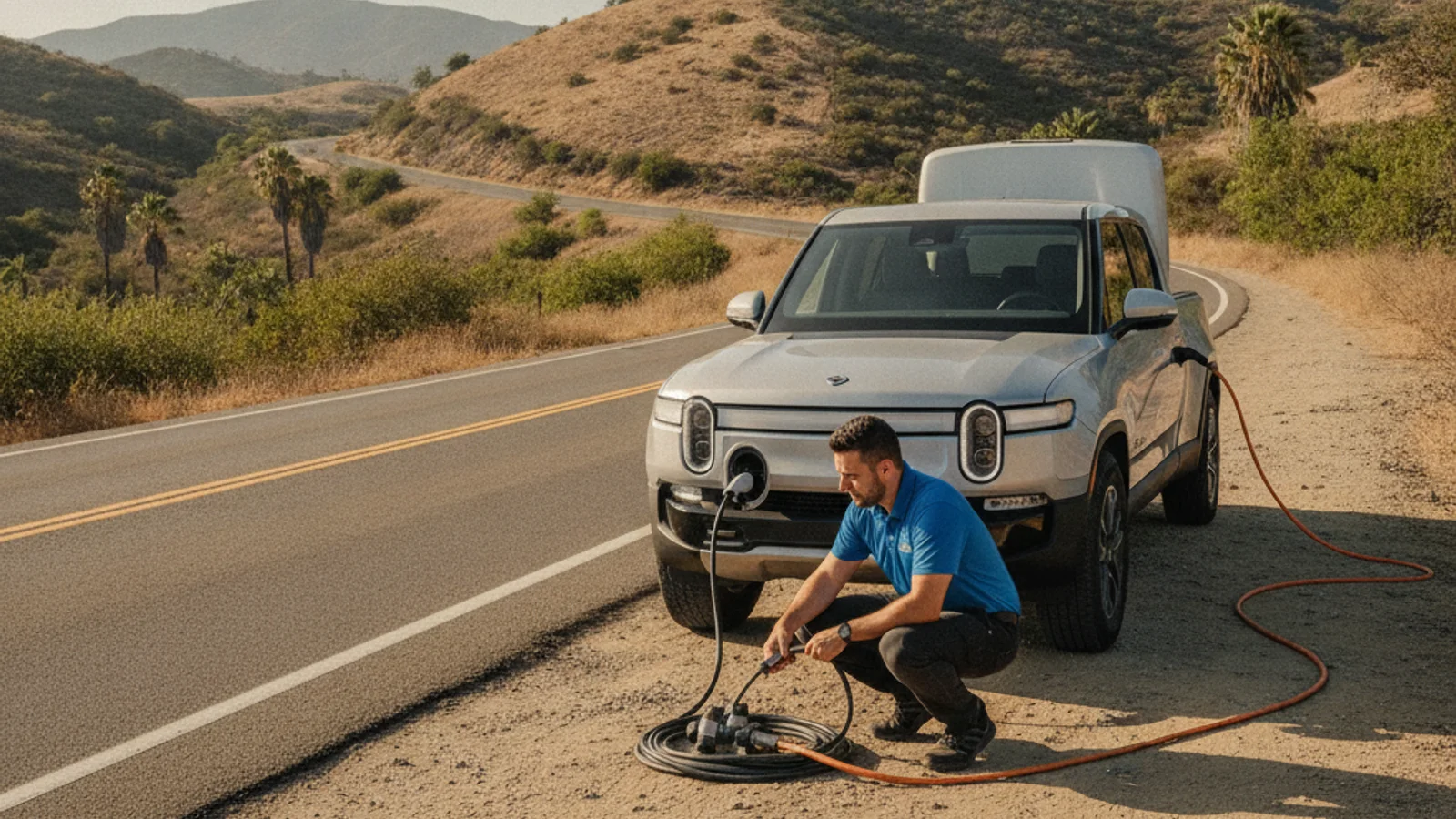
A stranded Rivian on Inland Empire roads still needs 240-volt charging. The inlet takes NACS, CCS, or a J1772 adapter. You confirm that on this truck, not from a badge. Model, model year, and Rivian’s current owner materials decide the match.
Grades and heat don’t pick your connector
The plug question is the same in Temecula as in Hesperia. The miles around that plug are not the same. I-15 through Cajon Pass toward Victorville is a long climb. I-10 through Redlands, Beaumont, and Banning is a slower drain. I-215 across Moreno Valley and Perris runs hot on the valley floor. SR-60 through Jurupa Valley stacks warehouse traffic on weekdays. The Ortega near Wildomar is a two-lane grade with thin shoulders.
None of that tells you which inlet your Rivian has. It tells you why one charger answer doesn’t cover this market. A truck that left a Fontana warehouse with a thin buffer is one case. An R1S that sat all day in an Ontario airport lot is another. Both still need a confirmed plug before anyone connects a cable.
Eastvale’s housing stock is mostly newer, by Census vintage. Only 2.2% of units were built before 1980, per ACS 2019-2023. San Bernardino sits at 60.9% on the same vintage. An older panel can shape a home charger install. It doesn’t change which plug your Rivian takes on the shoulder.
Open the charge port first
Don’t lead with a connector name you haven’t checked. Lead with what you can see on this vehicle.
Open the port cover and look at the inlet. Note the inlet’s shape in plain words. Check the frunk, the cab, and the Rivian app for an adapter. Then read Rivian’s current owner materials for your model and year. A salesperson’s recap from last year can be stale. A used listing can be wrong about the port.
US charging uses a few connector families. J1772 covers Level 1 and Level 2 AC. J3400, also called NACS, is the Tesla-designed connector now used more widely. CCS is the DC fast-charge family many non-Tesla EVs still use. CHAdeMO is another DC family you’ll see on older maps. Those names help you talk to an operator. They don’t confirm the build sitting in front of you. If the port, an adapter, or compatibility isn’t confirmed, say that. “I haven’t checked the inlet yet” is useful. A guessed connector isn’t useful once a cable is in hand.
R1T or R1S, and the year on the sticker
Rivian has shipped more than one vehicle. Hardware and software have changed since the first trucks. An early R1T and a later R1S can differ at the port. They can also differ in software and in which adapters Rivian currently supports.
Read the model year on the door-jamb sticker or the registration. Don’t use the date you bought it used. The Rivian app’s vehicle profile is another place to check. Write the year down before you call. It’s one of the first things non-Tesla EV rescue operators need. Saying it’s a Rivian isn’t enough detail. R1T or R1S plus the year is what they need.
Skip your neighbor’s setup, even if the trucks look alike. Skip a rental you drove last month. Confirm the truck you’re standing next to.
240 volts on the shoulder is a specific source
Public charging maps list connector types by stall. Check them before you roll toward a stall. A map pin still isn’t proof your year and build will take that cable. Your year and build may still need an adapter. Treat the map as a lead, not a verdict.
A mobile EV charging visit is a different source. The operator brings a 240-volt Level 2 supply to the car. The unit has a native NACS plug. CCS and J1772 adapters cover other inlets. Matching happens before anything is plugged in.
That session is charging time, never an arrival time. Operators typically add 10 to 20 miles of range in 15 to 30 minutes of charging. That’s enough to reach a stall you can use. It can also get you home if you’re close. It isn’t a full pack, and it isn’t meant to be.
Home 240-volt charging uses similar voltage. The site, the panel, and the permit path are different. Home 240-volt charging versus a roadside Level 2 hookup covers the home-versus-shoulder split. On the shoulder, the only question is whether the operator’s connector matches your inlet.
Your city’s utility doesn’t choose the plug
Most Inland Empire cities sit on Southern California Edison. That list includes Ontario, Fontana, Chino, Corona, and Upland. Not every city in this market does.
Riverside has been on Riverside Public Utilities since 1895. Colton owns the electrical infrastructure inside its city limits. Banning runs a city electric utility. Big Bear Lake and Big Bear City are on Bear Valley Electric Service. That utility also names Moonridge, Fawnskin, Sugarloaf, and Boulder Bay.
Rancho Cucamonga is split between two electric utilities. SCE covers most of the city. Rancho Cucamonga Municipal Utility serves a southeast pocket. That pocket has more than 3,900 metered businesses and residents. It includes the Victoria Gardens area. Moreno Valley is a split-utility city too. SCE covers part of the city. Moreno Valley Utility serves over 6,500 customers on newer development since 2004. MVU publishes an address lookup so you can check a meter.
San Jacinto Power supplies generation while SCE delivers. Apple Valley Choice Energy procures while SCE delivers. Victorville Municipal Utility Services covers the Southern California Logistics Airport. It also covers Foxborough Industrial Park, and that’s the published limit. It doesn’t serve residential streets at this time. A Victorville driveway sits on Southern California Edison.
Those boundaries matter for home rates and rebate pages. They don’t change the inlet on your Rivian. A roadside Level 2 visit doesn’t run through that household meter. The operator quotes you before starting and bills you directly. Charge Pro IE doesn’t set that price. We’re a referral line, not a charging fleet. We match you with an independent local operator.
When a charger isn’t what you need
Not every stalled Rivian is an empty pack.
If the truck won’t wake or unlock, look at the 12-volt system. That’s a separate battery from the traction pack. Start with the R1T and R1S 12V checks before you ask for a charge.
If the port door won’t open, more power on a cable won’t help. Freeing a stuck Rivian charge port is a mechanical problem. It isn’t a connector-family problem.
If the dash shows a fault that isn’t low battery, say the exact wording. Charging gear can’t clear a software stop or a damaged inlet. Describe what you see, in the vehicle’s own words. Don’t diagnose it on the call.
What to tell the operator
Keep the list you give the operator short and accurate.
- R1T or R1S, plus the model year from the jamb
- What the inlet looks like with the cover open
- Whether you found an adapter, or confirmed you didn’t
- Dash or app messages, copied as they appear
- Your exact spot: Cajon shoulder, warehouse row, mountain lot, or driveway
Access and parking room change from site to site. A warehouse aisle in Bloomington isn’t a street in Chino Hills. A lot in Cabazon isn’t a cul-de-sac in French Valley. Crestline and Lake Arrowhead add mountain access on top of the same plug question. A weekend in Murrieta isn’t the same drive as a High Desert run past Adelanto. You don’t need the right technical name. You need what’s in front of you.
If Rivian’s own coverage is already in motion, keep a local path too. Rivian’s roadside number and an Inland Empire backup explains that split. Don’t mix the two on the same call.
If the match still isn’t clear
Don’t guess the plug while you’re on the shoulder. Confirm the inlet, the year, and the source. Then decide whether you need a charge, a 12-volt jump, or a tow.
If you’re stuck on that choice, call (909) 250-2881. We’ll connect you with a local mobile rescue operator. That operator can talk through NACS, CCS, or a J1772 adapter on your specific Rivian. Nothing gets plugged in until that match is confirmed.