A 240 volt EV charging setup at home is Level 2 on a planned circuit. It isn’t the same job as a mobile Level 2 hookup on the shoulder. Inland Empire drivers use the house plug for overnight miles. They call for a roadside visit when that plug is out of reach. A matched operator typically adds 10 to 20 miles of range. That takes 15 to 30 minutes of charging. That window is charging time only, never an arrival time.
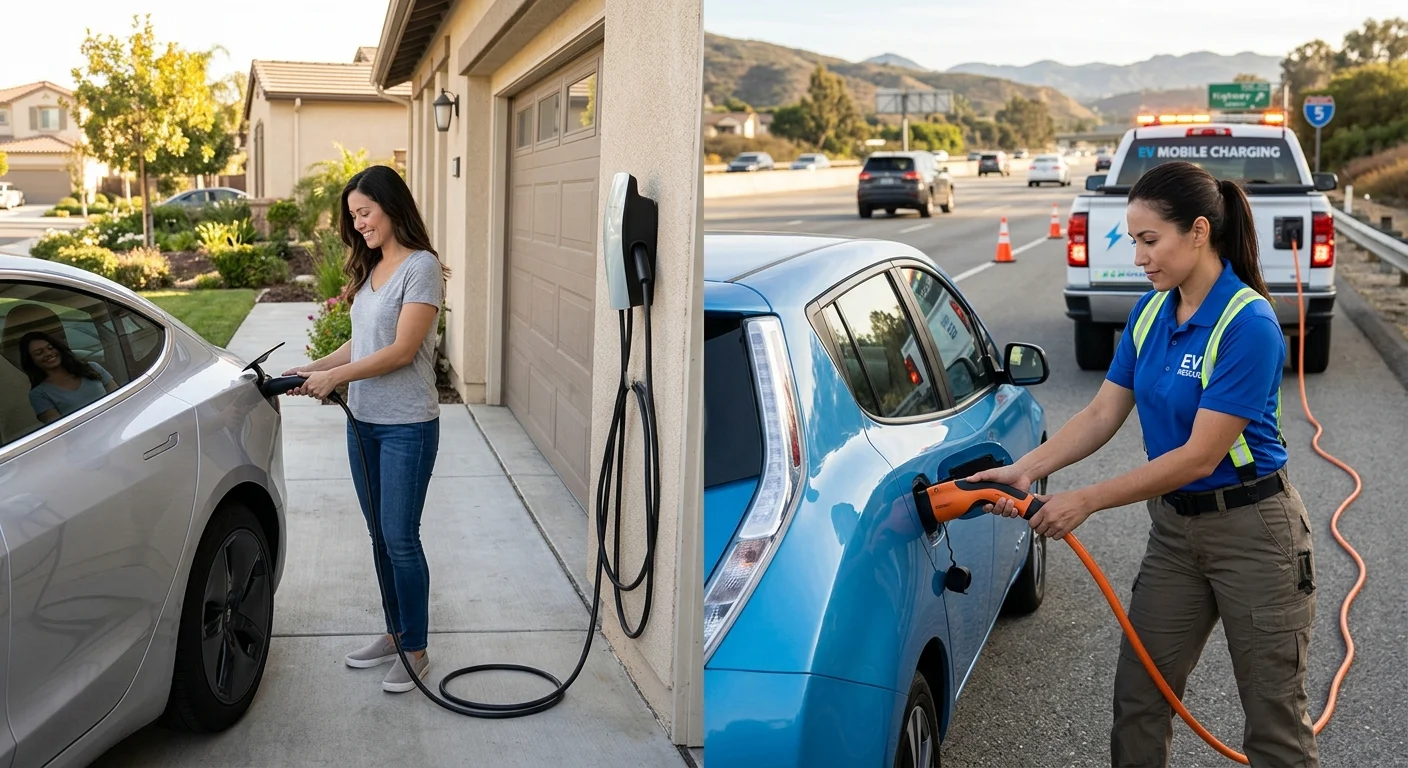
The same voltage, two different jobs
The US Department of Energy describes home Level 2 as 240-volt service. Some commercial sites use 208 volts instead. Voltage by itself doesn’t set how fast the pack fills. The circuit, the charger, and the car all change the result.
A home station is a fixture on the property. You park in the same spot most nights, so you’ve got time. A licensed electrician sizes the circuit against the panel. Older Inland Empire panels and EV chargers fail that check before the car does.
A roadside hookup is a short patch, not a remodel. The operator brings a 240V Level 2 source to the car. Teslas take a native NACS plug. Other EVs use a CCS or J1772 adapter. The point is enough range to reach a charger you can use. It isn’t a stand-in for a full home session.
Level 1 is a regular 120-volt household outlet. It feeds the pack much more slowly. That outlet won’t recover a stranded EV on inland grades. Why Level 1 charging isn’t enough here walks through that limit.
Inland Empire homes don’t share one charging story
Eastvale and French Valley are mostly newer housing. ACS 2019-2023 figures put pre-1980 stock at 2.2% in Eastvale. French Valley sits at 2.3%, Temecula at 6.5%, and Murrieta at 6.2%. Younger panels still need a circuit that matches the charger you want.
The San Bernardino Valley is a different housing map. In San Bernardino, 60.9% of units were built before 1980. Riverside city sits at 56.4% pre-1980. Ontario is 50.7%, and Redlands is 60.4%. Across San Bernardino County, 43.8% of housing is pre-1980. Riverside County as a whole is 30.2%. An older panel can trip or come up short. That check belongs at the house, not on the shoulder.
The electric utility isn’t one company either. Southern California Edison serves most of the market. That list includes Fontana, Ontario, Chino, Corona, Temecula, and Hemet. The City of Riverside runs Riverside Public Utilities and has since 1895. Colton owns the electrical infrastructure inside city limits. Banning has its own electric utility. Big Bear Lake and Big Bear City sit on Bear Valley Electric Service.
Some Inland Empire cities split the electric map. Rancho Cucamonga is mostly Southern California Edison. Rancho Cucamonga Municipal Utility covers a southeast pocket with over 3,900 metered businesses and residents. That pocket includes The Enclave, Day Creek Square, The Resort, and the Victoria Gardens area. Moreno Valley is SCE plus Moreno Valley Utility. MVU has served newer development since 2004. It publishes an address lookup so you can see which side you’re on.
Residential service in Victorville is Southern California Edison. Victorville Municipal Utility Services covers only the Southern California Logistics Airport and Foxborough Industrial Park. It doesn’t serve residential areas at this time. Apple Valley gets delivery from Southern California Edison. Apple Valley Choice Energy procures the generation. San Jacinto follows a similar delivery split. SCE delivers the power, and San Jacinto Power supplies the generation.
SCE publishes a residential EV plan called TOU-D-PRIME. Riverside Public Utilities publishes its own Electric Vehicle Rate. Those pages change, so confirm the current plan with the utility on your bill. Charge Pro IE doesn’t install chargers, pull permits, or set rates.
If you’re weighing a permanent install against a car that already won’t move, start with home charger install versus a mobile charge. Keep those two calls separate.
Confirm the car, then confirm the power
Start with the exact make, model, and year. Then read what the owner’s manual says about charging. Don’t pick a cable because the plug looks familiar. The manufacturer is the authority for that vehicle.
Saying there’s a 240-volt outlet in the garage isn’t a full answer. A licensed electrician still has to check the circuit and the panel. Household demand and the proposed equipment matter too. Charge Pro IE doesn’t inspect houses and doesn’t do electrical work.
A single Inland Empire permit path could not be confirmed. That includes home 240-volt stations, based on the sources reviewed for this page. Confirm the current forms with the building department that serves the address. Don’t borrow another city’s checklist for your address.
On a roadside call, tell the operator the vehicle and the dash warnings. Add remaining charge, connector type, and the exact pin. Say whether the car can shift, steer, or take a charge. The operator then decides whether mobile energy or a tow fits. EV charging levels for a driver already stranded maps those categories onto that choice.
When the home plug can’t reach the car
A fixed outlet only helps if the car can get to it and use it. A cord on a nearby building isn’t a charging plan. The property owner, the circuit, the connector, and the car all have to match.
That limit shows up on I-15 at the Cajon climb toward Victorville and Hesperia. It shows up on I-10 through Colton, Redlands, and Beaumont. It shows up on I-215 through Moreno Valley and Perris. It shows up on SR-60 in Jurupa Valley and on the 91 in Corona. A home station stays at the house. It can’t reach a car stopped on those routes.
The same split hits hillside and desert trips. A Chino Hills driveway start can still run down on the grades. A High Desert run toward Adelanto, Phelan, or Apple Valley burns miles in heat. A Lake Arrowhead day trip makes the downhill the part people misread. None of that means a public stall isn’t there. It means your remaining range has to actually get you to one.
If the pack is already empty, use out-of-charge recovery. That’s the service path, not a garage circuit. Check the charging network’s current status for your connector. Don’t guess how far a stall sits from the shoulder.
A dark dash isn’t always an empty traction pack. A dead 12-volt battery can leave the car looking fully dead. Adding Level 2 energy won’t wake a car that won’t close its contactors. Report the exact message on the dash. Don’t assume more energy will clear a fault.
A failed overnight charge at home isn’t automatically a roadside case. If the car is parked safely, start with the charger or the breaker. Call for a mobile visit when the car is away from home. That fits when it can’t reach a usable charger.
Smoke, fire, a collision, or live traffic exposure comes first. That’s emergency help, not charging advice. After those hazards are handled, an EV rescue operator can look at mobility.
Mobile Level 2, or a tow
Mobile charging can fit when an out-of-charge EV will accept compatible power where it sits. The usual goal is practical miles, not a full charge. The operator assesses the vehicle, access, the plug, and the surroundings before quoting. What a mobile EV charging visit actually is keeps that visit in proportion.
Charge Pro IE is a referral line. It matches stranded drivers with independent local mobile rescue operators. It performs no work and owns no trucks. It employs no technicians and sets no prices. The mobile EV charging page is how you start that match. The operator quotes you before work starts and bills you directly.
A tow can be the better path when the car won’t take power. It can also fit when the location won’t support a safe hookup. The operator can say whether the EV should go to a charging site. It might also go to a shop, or another stop you choose.
Inland geography changes how you pick that destination. A stall near downtown Riverside isn’t the same access problem. A warehouse row in Fontana is a different one. Confirm the destination’s connector and current status. Don’t treat the first pin on an app as a plan.
Ask the operator what equipment will show up. Ask what outcome they expect, and what you’ll pay. Charge Pro IE doesn’t set prices and doesn’t warrant the work. Confirm those details with the operator before they start.
When to call for a match
Call when the car can’t reach a usable charger. You need an operator to assess a charge or a tow. Charge Pro IE connects drivers with licensed, independent local operators across the Inland Empire. Call (909) 250-2881 and we’ll connect you with a local EV rescue operator.