A dead Lucid Air can leave you choosing between manufacturer support and local roadside help. First, identify whether you need a low-voltage jump, mobile charging, or a tow.
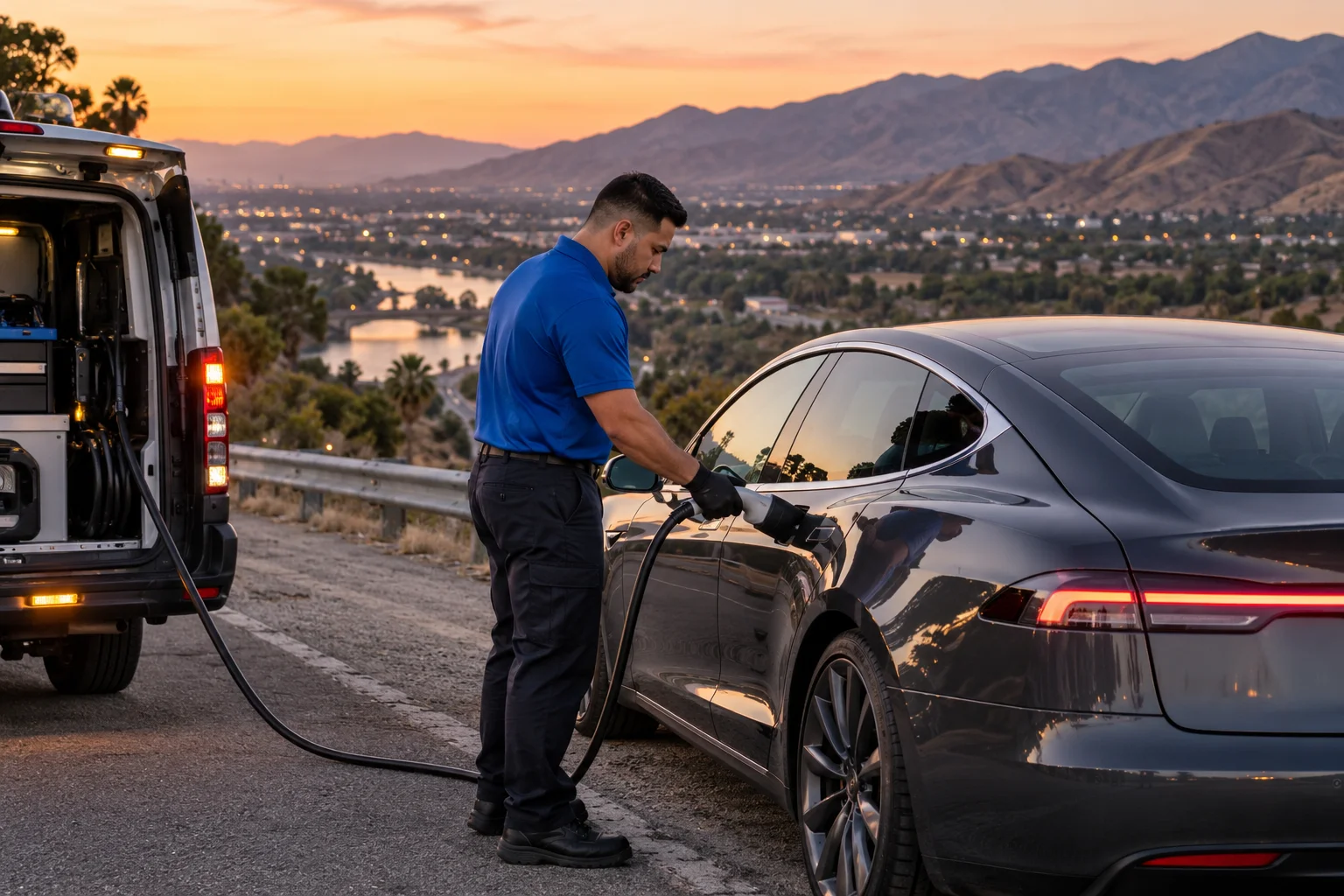
Start by separating a 12V failure from an empty pack
A Lucid that won’t start isn’t automatically out of driving range. The low-voltage system and main propulsion battery have different jobs. A dark screen, unavailable locks, or an unresponsive car can point toward a low-voltage problem. Those signs don’t prove the cause, though.
An empty main pack usually has a different history. The driver may have watched the range fall before the car stopped. A failed charging session can create a similar situation. So can a charger that connected but never delivered power.
Start with what you can observe without opening panels:
- Is the dashboard or center display awake?
- Do the doors and key controls respond?
- Does the app connect to the car?
- Was the displayed range already very low?
- Did a warning appear before the car stopped?
- Is a charging cable connected or stuck?
Don’t guess at jump points or towing procedures. Lucid-specific instructions weren’t confirmed in the approved research for this page. Check the owner documents tied to your model and model year.
Our Lucid Air won’t-start guide explains the first checks in more detail. The broader charge, jump, or tow guide can also help you describe the problem.
That description matters. A local operator needs to know whether the car is dark, awake, damaged, or simply low on range. Clear symptoms reduce the chance of requesting the wrong kind of help.
What Lucid roadside may handle
Lucid’s current roadside coverage, eligibility rules, service limits, and contact number couldn’t be confirmed from the approved claims ledger. Don’t rely on an older search result or saved phone number. Check the Lucid app and the current owner documents for your specific vehicle.
Look for answers to these questions:
- Is roadside assistance active for this VIN?
- Does the request qualify under the current program?
- Is towing covered, and where may the car be taken?
- Does the program address an empty propulsion battery?
- Are tire, lockout, or low-voltage problems included?
- Will the car go to a Lucid facility or another location?
- Does your owner document require a specific towing method?
Roadside assistance and warranty coverage aren’t interchangeable. A tow may be available even when the underlying repair isn’t covered. The reverse may also happen. Only the documents governing your car can settle that distinction.
Use the app’s support or service area to find Lucid’s current contact route. It should also identify the service location available for your vehicle. This page doesn’t publish an unverified Lucid phone number or service-center address.
If the app won’t connect, keep your VIN and vehicle details ready. Then consult the current owner materials stored with the car or your account.
For a wider comparison, see Tesla, Rivian, and Lucid roadside help. That guide focuses on the decision process, not assumed coverage.
What to confirm before accepting a tow
A tow solves the location problem, but it doesn’t automatically solve the vehicle problem. Before accepting one, confirm the destination, towing method, payment responsibility, and next handoff.
Ask who selected the destination. It may be a service location, approved drop point, charging site, or another place. Don’t assume the nearest repair shop can diagnose or repair a Lucid. Use the Lucid app or current owner documents to identify the proper service route.
Ask these questions before the vehicle moves:
- Where exactly will the Lucid be delivered?
- Is that location prepared to receive it?
- Who authorized the destination?
- What towing method does the owner documentation require?
- Can the car enter its required transport mode?
- What happens if the low-voltage system remains unresponsive?
- Who quotes and bills for the tow?
- Does any coverage limit apply to distance or destination?
No verified Lucid towing limit or roadside price appears in the claims ledger. Confirm both before agreeing. If a local operator is involved, that independent operator provides the quote and bills you directly.
Damage from a collision changes the decision. So does a car blocking traffic. Tell the person arranging help about visible damage, wheel position, ground clearance, locked wheels, and whether the vehicle can roll.
Our emergency EV roadside assistance service connects drivers with licensed independent local operators. Charge Pro IE doesn’t tow vehicles or set towing prices. The matched operator explains the available service and its terms.
Why Inland Empire distance changes the decision
A roadside choice near central Riverside isn’t the same as one beyond Victorville. The Inland Empire covers Riverside and San Bernardino counties, with long freeway corridors, mountain grades, and distant communities.
Location affects the practical value of each option. A tow from a Riverside parking lot may have several possible destinations. A Lucid stopped near the Cajon Pass, Wrightwood, or Big Bear can face a longer move before reaching suitable help. Drivers around Banning and Cabazon also need to account for the San Gorgonio Pass corridor.
Give an exact location, not only a city name. Riverside covers more than 81 square miles. San Bernardino covers more than 62 square miles. Hesperia and Victorville each cover more than 72 square miles. A city alone doesn’t tell an operator which road, shoulder, lot, or entrance contains the car.
Freeway location also matters. Riverside County’s Freeway Service Patrol lists SR-91, I-15, SR-60, and I-215 corridors. San Bernardino County’s program lists portions of I-10, I-15, I-215, SR-60, and SR-210. Those programs provide certain roadside services and no-charge CHP-designated towing, but their published pages don’t mention electric vehicles.
Dial 511 or use a freeway call box to seek Freeway Service Patrol help. Coverage and operating periods can change. If you’re still in a traffic lane, call 911.
For mountain travel, check current conditions through Caltrans QuickMap. Chain controls and closures can change the available route.
Manufacturer help versus a local operator
Manufacturer roadside help can make sense when coverage is active and the vehicle needs Lucid-directed service. It can also reduce uncertainty about the preferred destination. Still, you need the current program terms before relying on it.
A local operator may fit better when you need a nearby service that Lucid’s program doesn’t confirm. Examples include a low-voltage assessment, an appropriate jump, mobile charging, or a privately arranged tow. The operator must still follow the vehicle’s current owner instructions.
Mobile charging is most useful when the main pack is depleted and the vehicle can accept a charge. The approved rescue figure is 10 to 20 miles of range during 15 to 30 minutes of Level 2 charging. That’s charging time, not an arrival estimate. Actual added range depends on the car and conditions.
A low-voltage problem needs a different response. Adding energy to the propulsion battery won’t restore an unresponsive low-voltage system. Likewise, a low-voltage jump doesn’t refill an empty main pack.
A tow is usually the clearer path when the car has collision damage, can’t accept a charge, can’t be prepared for movement, or may need repair. The owner documents should control the transport method.
Our non-Tesla EV rescue service connects Lucid drivers with licensed independent operators. The operator quotes and bills the driver directly. Charge Pro IE doesn’t set prices, promise arrival times, or perform the physical work.
How to share the car and location details
Good information helps the operator bring the appropriate equipment. Start with the exact model and model year. Then describe what happened without diagnosing it yourself.
Share these details:
- The Lucid model and model year
- The displayed range before the problem
- Whether screens, locks, and lights respond
- Any warning message shown
- Whether the app connects
- Whether the vehicle is plugged in
- Whether a cable or adapter is stuck
- Whether the wheels can roll
- Any visible collision or tire damage
- Your exact location and safe access point
For a freeway, provide the route, travel direction, nearest exit, and shoulder side. On I-15, saying “near Hesperia” isn’t enough. Give the direction and nearest marked exit. In a Riverside or San Bernardino parking lot, name the entrance and a visible storefront or row marker.
For mountain roads, mention chain controls, snow, debris, narrow access, or a closed approach. Check current conditions before directing anyone toward the car.
Photographs can help explain wheel position, clearance, damage, and parking access. Don’t stand in traffic to take them. If the car is in a dangerous position, handle the immediate emergency first.
The mobile charge or tow guide can help organize these facts. You can also review the Department of Energy’s EV information for general vehicle and charging background.
When to call us
Call when your Lucid needs local help with a suspected low-voltage failure, depleted pack, or tow decision. Charge Pro IE will connect you with a licensed, independent operator who can discuss the available service and quote you directly.
Call us at (909) 250-2881 and we’ll connect you with a local EV rescue operator.