Tesla is roughly two of every three battery-electrics in the Inland Empire. That mix is why Tesla vs Rivian roadside assistance comes up first. Lucid owners ask a third version of the same question. The cars look similar when they won’t roll. The help each brand sends doesn’t.
A Tesla on I-10 through Colton is the usual inland stall. A Rivian R1T on the Ortega near Wildomar is less common. A Lucid Air in Eastvale or Chino Hills is rarer still. Factory programs for all three are built around a tow. Independent operators in the Charge Pro IE network can charge the car in place. They bring a 240-volt Level 2 source to the port. They can also jump or replace a dead 12V on site.
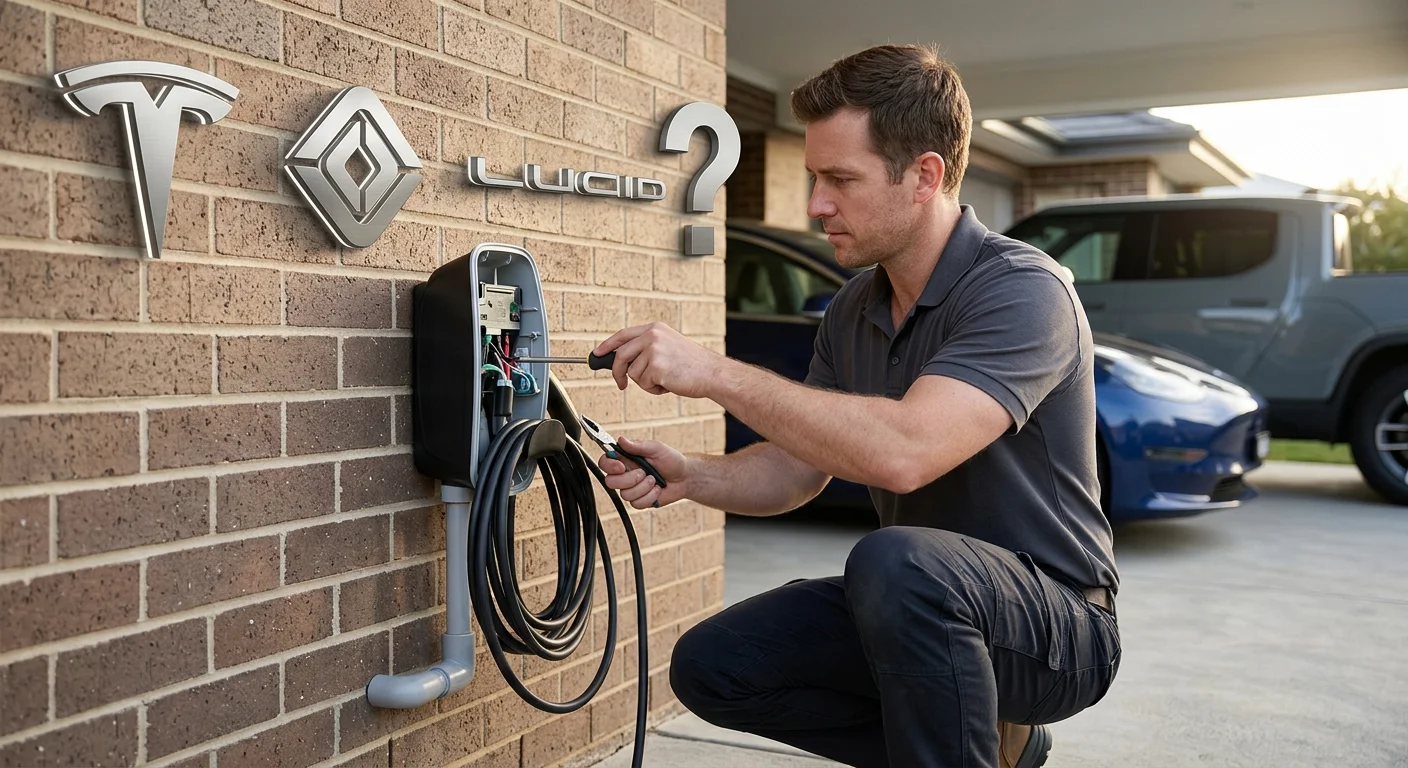
Inland roads change the stall even when the car is the same
Riverside County’s ACS 2019-2023 population is 2,478,600. San Bernardino County’s matching count is 2,197,104. Those two counties aren’t one driving pattern. The San Bernardino Valley mixes warehouse rows in Fontana with older streets in San Bernardino. Ontario adds airport lots and industrial miles on top of that. The 91 through Corona and the 60 through Jurupa Valley stack commute traffic. South county adds Temecula, Murrieta, Menifee, and the Ortega toward Wildomar. The High Desert starts after the Cajon climb on I-15. Victorville, Hesperia, Apple Valley, Adelanto, and Phelan sit on those drier miles. Mountain towns sit above the valley. Those towns include Lake Arrowhead, Crestline, Running Springs, Big Bear Lake, and Big Bear City.
Heat and grade drain a pack in ways a flat basin loop doesn’t. That’s physics, not a claim about missing chargers. You can still strand when a stop runs long. A grade can eat more range than the dash estimated.
Housing age changes whether a home charger is even in the story. Eastvale’s housing stock is only 2.2% pre-1980 on ACS 2019-2023. French Valley sits at 2.3% on the same vintage. Temecula’s pre-1980 share is 6.5% on that vintage. Those are new-build maps, where a wall unit is common. San Bernardino is 60.9% pre-1980. Riverside city is 56.4%, and Redlands is 60.4%. Upland is 55.9% on the same ACS vintage. Older panels and shared driveways show up more in those cities. When the house charger is dark, the stall often starts in the driveway.
The electric utility isn’t one company on this map. Southern California Edison serves most inland cities named here. Riverside runs Riverside Public Utilities, not SCE. Colton runs City of Colton Electric Utility inside city limits. Banning runs its own municipal electric utility. Big Bear Lake and Big Bear City sit on Bear Valley Electric Service. Rancho Cucamonga is split between SCE and Rancho Cucamonga Municipal Utility. Moreno Valley is split between SCE and Moreno Valley Utility. The outage map you check depends on the city. The roadside call doesn’t. A dead pack is a dead pack in every territory.
What factory roadside is built to do
Tesla, Rivian, and Lucid all bundle roadside help with the new-vehicle limited warranty. The exact year and mile window is in the app. It’s also in the owner’s guide or the warranty booklet for your VIN. Confirm those terms before you assume a tow is covered. A single cap that covers every car couldn’t be confirmed here.
What the programs share is the tool they send. They send a contractor, usually a tow. Mechanical failure often means a haul to the nearest brand service point. A flat often means a tow to a shop that can handle the tire. An empty traction pack often means a tow to a charger. It isn’t a charge on the shoulder. A dead 12V can look like a total failure. Factory dispatch still often treats it as a tow-in.
Lockout help is commonly listed in owner materials. Some writeups also list a 12-volt jump. What arrives is still usually a tow truck, not a mobile charger. Read the live policy in the app. Policies change, and a page shouldn’t invent the fine print.
Tesla volume matters on these roads. Tesla is roughly two of every three local battery-electrics. Tesla’s contractor pool is the one most inland drivers already know. Rivian and Lucid owners are calling a thinner brand map. The car still needs the same physics on I-215 through Moreno Valley. It needs the same physics on I-10 through Redlands.
Empty pack, dead 12V, or a tire: pick the failure first
The brand comparison is useless until you name the failure. Three inland stalls get mixed up constantly.
The traction pack is empty
The dash still wakes. The car won’t add miles. You already passed the low-battery warnings. Factory roadside, when it covers this, is typically a tow to a charger. That can be the right call if you want the car at a DC stall. It can be right if you’re inside the warranty rules. It’s the wrong call if you only need enough range to roll again.
A local mobile visit is a different tool. Operators in the Charge Pro IE network bring a 240-volt Level 2 source. They plug it into the car where it sits. Tesla owners get a native NACS plug. Rivian and Lucid owners get CCS or J1772 through an adapter. That depends on the port on that VIN. A typical session adds 10 to 20 miles of range. That takes 15 to 30 minutes of charging. That’s charging time. It isn’t an arrival time. Charge Pro IE doesn’t promise one. The operator quotes you before any cable goes in. The operator bills you directly.
See mobile EV charging for what that visit is, and isn’t.
The 12V is dead
Every Tesla, Rivian, and Lucid still depends on a low-voltage battery. It runs the computers, the locks, and the contactors that close the high-voltage pack. When that 12V dies, the car can look completely dead. The screens stay dark. People call it a failed pack when it isn’t.
Factory help often tows that car to a service bay. A local operator can jump the 12V at the curb in many cases. They can replace it on site when that’s the quoted job. Tesla owners can start with Tesla 12V battery jump. Rivian and Lucid owners should treat it as a 12V problem first. Then treat it as a pack problem if the car still won’t wake. Start with Lucid Air won’t start: what to do when the dash stays dark.
The tire is the problem
These three brands run large, often specialized tires. A spare isn’t something you should assume. Factory roadside may send a tire change if a spare exists. It may send a tow if it doesn’t. An independent operator in the network may repair or swap on site. They may also tell you the tire needs a shop. Don’t guess a shop price from a blog. Ask for the quote before work starts.
Tesla’s path, because it’s the inland majority
Tesla roadside starts in the app for most owners. You can also use Tesla’s published roadside line. What Tesla sends is a contracted third-party truck. It isn’t a Tesla employee. Coverage, exclusions, and current policy details belong in Tesla’s documents. They don’t belong in a guessed summary. See Who actually helps a stranded Tesla in the Inland Empire for that inland fork.
Tesla Supercharging is a separate network from roadside. A Supercharger doesn’t roll to the shoulder. If the car can’t drive to a stall, you need a tow. You can also ask for a mobile charge. Use Tesla roadside rescue when you want a Tesla-first operator.
Tesla’s queue is also the busiest brand queue on these roads. That isn’t a wait-time claim. It’s a volume fact. You’re one of many Model 3 and Model Y drivers. You share I-15, I-215, I-10, the 60, and the 91.
Ontario airport lots and Fontana warehouse rows see a lot of that Tesla mix. So do commute stretches through Riverside and Corona. The failure is usually an empty pack after a long shift.
Rivian’s path, and the Highway Assist mix-up
Rivian roadside is a warranty program for the R1T and R1S. It isn’t Highway Assist. Highway Assist is a driving feature. It won’t dispatch a truck. If you want the official Rivian roadside number, it lives in the Rivian app. Keep a local backup anyway. That split is in Rivian Highway Assist vs roadside assistance: what each one does.
Confirm your port before you assume a Tesla stall will take it. A local operator in this network brings CCS or J1772 adapters. That’s the non-Tesla EV rescue path.
Rivian trucks get used as trucks. That’s why they show up on grades more than a sedan does. The Cajon climb toward Victorville is one of those grades. The Ortega near Wildomar is another. The drop from Lake Arrowhead or Running Springs is a third. A factory tow to a charger can still be the covered path. A Level 2 hookup on the shoulder leaves the truck in your hands.
Colton is a useful inland example for Rivian owners. Factory coverage can still leave you on a contracted tow. The local operator still quotes before starting. The city also runs its own electric utility. A dark home charger in Colton isn’t an SCE problem.
Lucid’s path, on a thinner inland map
Lucid Air owners are a small slice of inland battery-electrics. You’ll see them more in newer, higher-income cities. Eastvale, Chino Hills, Temecula, Canyon Lake, and parts of Rancho Cucamonga fit that pattern. That isn’t a registration count. It’s the housing pattern where a Lucid is a plausible daily driver. Eastvale and French Valley barely have pre-1980 housing.
Lucid publishes roadside with the new-vehicle limited warranty. Confirm the window in Lucid’s app and the warranty booklet. With fewer Air sedans on the road, Lucid’s contractor pool is thinner than Tesla’s. Don’t treat that as a published wait time. Treat it as a reason to keep a local backup. That backup should already carry CCS or J1772.
A Lucid that won’t start is still usually a 12V or a pack. Same fork as Tesla and Rivian. Same need to keep the car in Park. Stay off the travel lane when you can. Call from a safe spot.
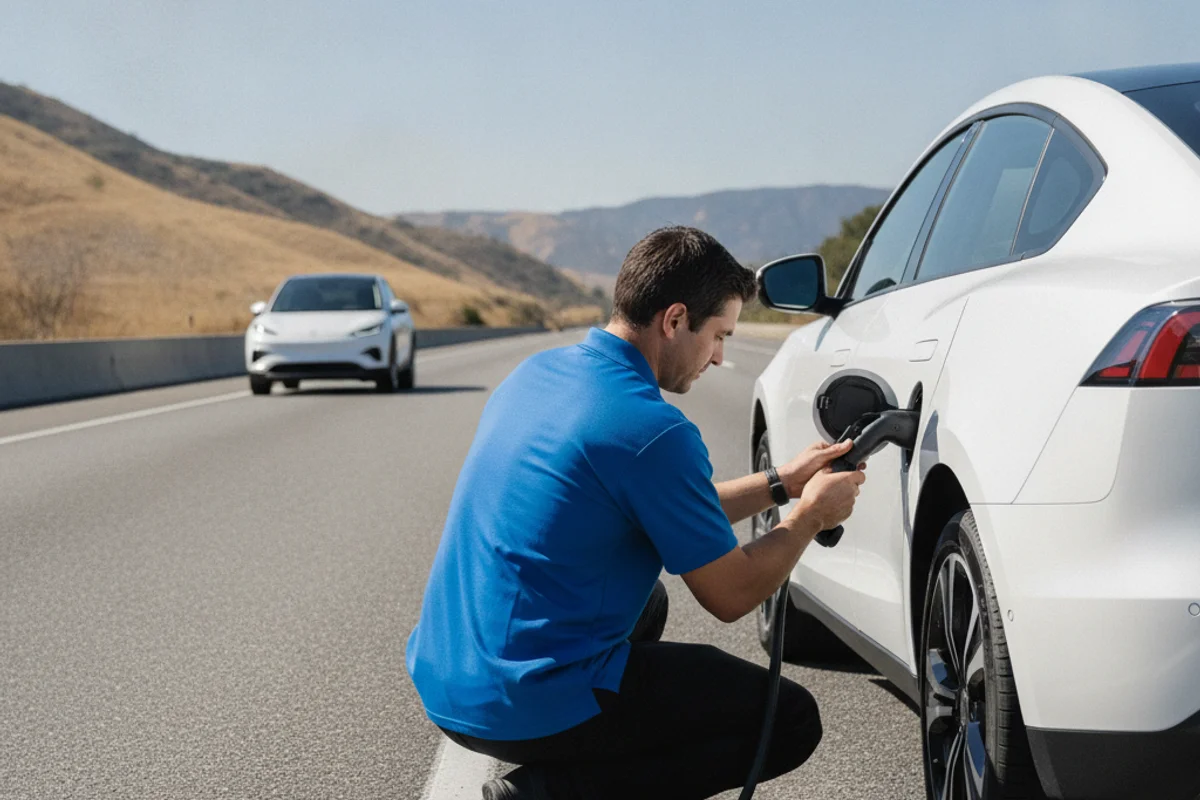
A local operator is a different tool, not a factory clone
Charge Pro IE is a referral line. It matches stranded EV drivers with independent local mobile rescue operators. It doesn’t hold a contractor license for the work. It owns no trucks, no chargers, and no parts warehouse. It employs no technicians. It sets no prices. It publishes no business hours. It promises no arrival time.
The operator who takes the job quotes you before starting. That operator bills you directly. The pros in the network are licensed and insured. They handle Tesla and every major EV brand.
What they actually do is narrow, and that’s the point. They bring 240-volt Level 2 charging to the car. They jump or replace a dead 12V on site. They work on a freeway shoulder or in a warehouse lot. They work in a driveway when the home charger never woke.
They don’t replace Tesla Service, Rivian Service, or a Lucid service center. A warrantable mechanical failure still belongs with the brand. A mobile charge won’t fix a failed drive unit. A 12V jump won’t repair a high-voltage pack. If the car is unsafe to roll, say you need a tow. Then the operator doesn’t quote the wrong job.
Factory roadside can still be the right first call. That’s true when you’re inside warranty. It’s true when you want the car taken to the brand. A local operator is the right first call for a charge where you sit. It’s also right for a 12V jump in place. Those are different outcomes. Compare them that way, not as a race.
How to choose in the moment on an inland shoulder
Start with safety. Put the hazards on and stay away from traffic. Don’t stand on the freeway side. I-15 at Cajon isn’t a place to troubleshoot at the fender. Neither is I-215 through Perris Valley.
Then name the failure. If the screens are dark and the car is a brick, think 12V first. If the car wakes and the range is gone, think empty pack. If a tire is flat, think tire, not charging.
Then check the brand app. If warranty roadside covers a tow you actually want, use it. If you need miles added where you sit, ask for a Level 2 quote. If Tesla is your car, you can start with Tesla. You can also start with a local Tesla-focused operator. If Rivian or Lucid is your car, don’t hold for a Tesla-only truck. You need CCS or J1772, or a tow.
You can also stall in a destination lot that isn’t a freeway. Ontario airport is one. A Fontana warehouse is another. Glen Helen, Cabazon, and Pechanga in Temecula are the same fork. The operator still quotes before the cable goes in.
Don’t use a price you saw on a forum. Manufacturer-arranged tows after warranty are priced by the tow company. This site doesn’t publish those figures. Local mobile charging is priced by the operator on that job. Ask, then decide.
When the brand truck isn’t the tool you need
Tesla vs Rivian roadside assistance comes down to one inland fact. Lucid sits in the same comparison. Tesla is the majority of the battery-electrics on these roads. Rivian and Lucid aren’t. All three factory programs still lean on a tow. When you need a charge on the shoulder, that’s a different call. A 12V jump on site is a different call too.
Charge Pro IE connects you with an independent operator who quotes before starting. Call (909) 250-2881 when that’s the job you want.