A Lucid Air that won’t start is almost always a flat 12V. The dash stays dark. The flush handles never present. The fob doesn’t unlock a thing. The traction pack can still hold a long drive. The car still looks finished. Owners hit this in quiet Inland Empire garages and Ontario airport lots. They also hit it after a week away. Jump the 12V. Give it a couple of minutes. The Air usually boots.
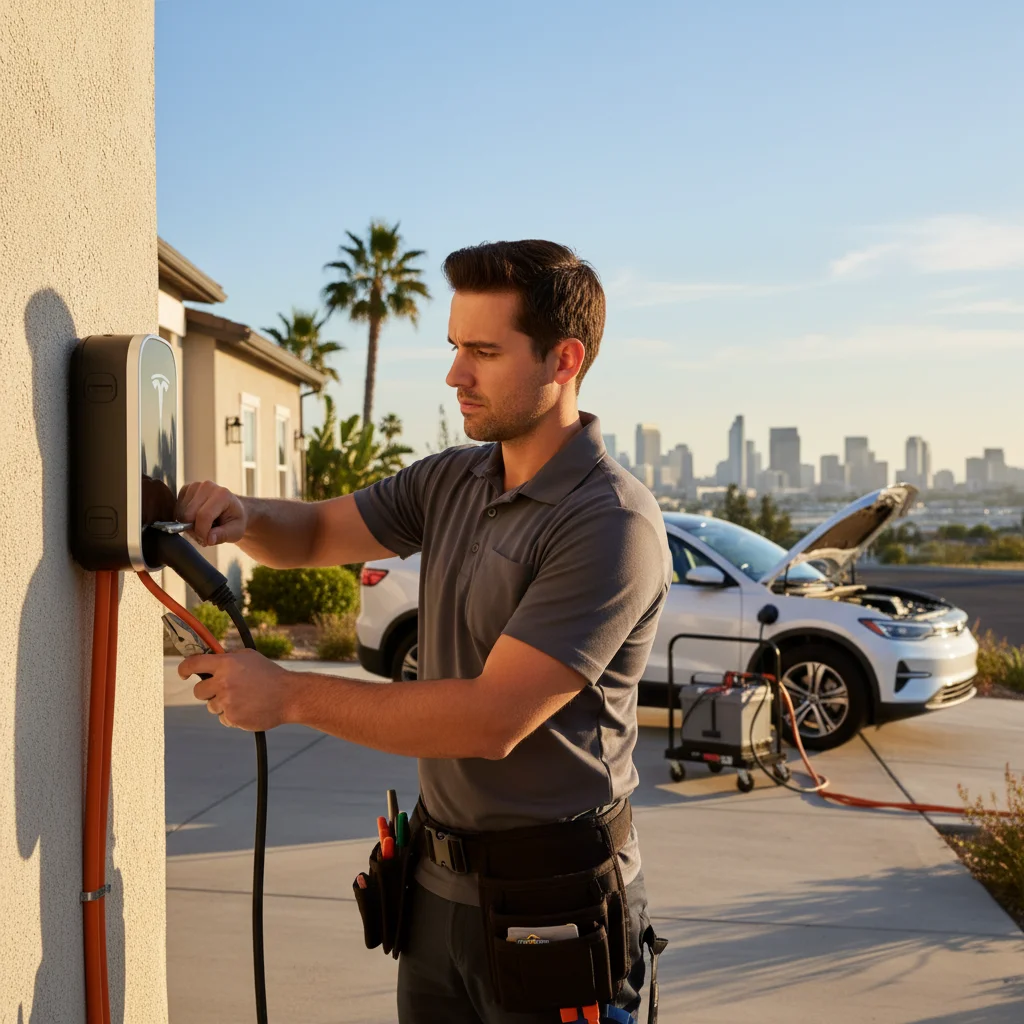
The Air is a luxury sedan. A small auxiliary battery sits on the wake-up circuit. That 12V feed powers the handles, the glass cockpit, and the center screen. It also powers the modules that tie the pack to the motors. None of that runs straight off high voltage. When the 12V can’t hold voltage, the handshake never finishes. The car stays mute.
This guide covers the dark-dash signs and the frunk jump posts. It also covers when it’s actually the pack. Last, it covers how a local operator helps across Riverside County and San Bernardino County.
What a dark Lucid Air is telling you
Use the first minute as a diagnosis.
A dead 12V usually looks like one of these:
- No lights, no chime, handles stay flush, and the fob is ignored
- Screens flash a 12V or system warning, then die before drive-ready
- The car half-wakes, then drops out before you can shift
All three point at the same fault. The low-voltage side can’t finish startup.
An empty traction pack looks different. The car still powers the screens. You see a range warning or a charge percent. Then it refuses to roll. If it never lit up, start with the 12V. If it warned you first, you need range on the curb, not a jump. That’s out-of-charge EV recovery.
Where this hits across the Inland Empire
The Inland Empire is not one parking habit.
Eastvale’s housing is almost all recent. ACS 2019-2023 puts pre-1980 homes at 2.2 percent. French Valley sits at 2.3 percent. Temecula is 6.5 percent. Newer garages sometimes have a wall unit. A car that sits through a long trip can still lose 12V. The DC-DC converter tops the auxiliary battery only when the car is awake. It also tops it when the car is plugged in. A dark garage for days does neither.
Ontario is older stock. ACS 2019-2023 puts 50.7 percent of Ontario housing before 1980. Riverside city is 56.4 percent. San Bernardino city is 60.9 percent. Older panels and missing home hookups mean some Airs never get a nightly top-up. The 12V then carries standby load alone. Keyless entry keeps listening. Telematics stay on. Sensors keep sipping power. That’s a slow drain. It’s not a sudden pack failure.
Long-stay parking around Ontario airport lots and warehouse rows fits the idle pattern. So do warehouse rows in Fontana after a late shift. Hillside driveways in Chino Hills do too, after a weekend out of town.
A stop on I-10 through Colton or Redlands can strand you. The car was fine ten minutes ago. Same on SR-60 in Jurupa Valley. Same on the 91 through Corona. Same on I-215 toward Perris and Moreno Valley. If the dash never came back after that stop, think 12V first.
A climb toward Yucaipa or Beaumont is more often a range problem. So is the Cajon Pass on I-15 toward Victorville and Hesperia. Grades eat the traction pack. A dark Air in the driveway the next morning is still usually the 12V.
Home power is split here, and that confuses people. Riverside Public Utilities serves the city of Riverside. Southern California Edison covers most of the valley. That includes Chino, Ontario, Fontana, Corona, and Temecula. Colton runs City of Colton Electric Utility inside city limits. Banning has its own municipal electric utility. Big Bear Lake and Big Bear City sit on Bear Valley Electric Service. Moreno Valley is split. SCE serves part of the city. Moreno Valley Utility serves newer development. It has over 6,500 customers. It publishes an address lookup. Rancho Cucamonga is mostly SCE. Rancho Cucamonga Municipal Utility covers a southeast pocket. It has over 3,900 metered businesses and residents. That pocket includes The Enclave and Day Creek Square. It also includes The Resort and the Victoria Gardens area. Apple Valley residents get delivery from SCE. Generation comes through Apple Valley Choice Energy. San Jacinto is similar. SCE delivers. San Jacinto Power supplies the generation. Victorville homes are on SCE. Victorville Municipal Utility Services doesn’t serve houses. It serves only the Southern California Logistics Airport and Foxborough Industrial Park.
None of those utilities jump a Lucid. None of them set a roadside price. If the house lights work, the Air’s dark dash isn’t an outage. You’re in a 12V failure.
How to get in, then jump the 12V
Flush handles need 12V to pop out. With a dead auxiliary battery, you open the door the old way.
- Use the mechanical key blade in the fob on the driver’s door. A physical key card works too.
- Open the frunk with the manual release. The powered button won’t work with a dead 12V. Lucid puts a pull or cable release on the Air. The exact path changes by model year. Read the owner’s manual for your year before you tug anything.
- Find the jump posts under the frunk. Lucid gives a dedicated positive post under a cap. The negative goes to a chassis ground.
- Hook up a jump pack in the usual order. Positive to the Air’s post, then to the donor. Negative to the donor, then to the Air’s chassis ground. Give it a couple of minutes.
Don’t clip onto random metal. The Air’s layout isn’t a Tesla layout. It’s not a German EV layout either. Wrong points can damage modules.
Once voltage returns, screens should boot. Handles should present. Give it a minute in drive-ready before you roll. If a 12V warning stays on, the battery is likely failing inside. A warning that won’t clear is a shop job. A roadside jump is only a wake-up.
Read how to jump start an electric car without frying the 12V for clamp order. See when the 12-volt dies, why the EV looks completely dead for the freeze.
Don’t keep cycling the fob hoping the handles appear. Don’t assume a public charger will wake a car that can’t boot. Don’t call a tow first if the car never lit up. A flatbed is for a mechanical failure. It’s also for a pack you can’t charge in place. A dark Air is usually a 12V call.
Charge Pro IE doesn’t install home chargers. It doesn’t pull permits. If the Air never gets plugged in, that’s a home wiring problem. That conversation belongs with a licensed electrician.
Heat, idle time, and what actually kills the 12V
Parasitic draw is the boring cause. It’s also the common one. Connectivity stays on. The car listens for the fob. Comfort modules sleep in a shallow way. Park it and leave town. You come back to a black interior.
Closed garages in the valley hold heat. Open lots in Victorville, Hesperia, and Adelanto bake a parked sedan. That’s geography. It isn’t a published Lucid failure rate. No verified year-count for Air 12V life turned up. Lucid’s public pages, as checked for this piece, don’t state a replacement interval. Ask a Lucid service desk for a load test. Treat early warnings as real.
A car that sits in Canyon Lake between weekend visits has the same idle story. So does one in Murrieta. So does one left in a Temecula-area lot after a long day. The traction pack can still show a healthy percent on the last drive. The 12V doesn’t care.
If the 12V takes a jump, watch the next morning. If it dies again, stop repeating jumps. That pattern usually means the battery can’t hold a charge. Or the car isn’t replenishing it. The next step is replacement, not another clamp.
What a local operator actually does
Charge Pro IE is a referral line. It matches you with an independent mobile rescue operator. It doesn’t own trucks. It doesn’t employ technicians. It doesn’t set a price. The operator quotes you before any work starts. Then the operator bills you directly. The pros we connect you with are licensed and insured.
For a dark Air, the operator brings jump gear to the dedicated post. The operator waits for recovery. Then the operator confirms the car boots and drives. Some operators can replace a dead 12V on site. That’s the operator’s job. It isn’t a Charge Pro IE crew.
If the pack is empty instead, you need range on the curb. The operator brings a 240V Level 2 source to the car. Lucid is a non-Tesla EV. The operator uses a CCS or J1772 adapter on a native NACS plug. Charging time is typically 15 to 30 minutes. That window adds about 10 to 20 miles of range. That’s charging time on the curb. It isn’t an arrival time.
Non-Tesla EV rescue covers the Air. It also covers Rivian, Ford, Hyundai, Kia, and other CCS or J1772 cars. Tesla owners have a parallel path. Luxury brands differ on the roadside here. See Tesla, Rivian, and Lucid roadside: how the three compare here.
Operators work cities across the Inland Empire. That includes Rancho Cucamonga, Temecula, San Bernardino, Corona, Menifee, and the High Desert. Confirm your spot when you call. The site doesn’t publish hours or a promised window.
When you shouldn’t jump
Skip the jump if the Air already woke up and showed low range. Clamps won’t put energy in the traction pack.
Skip it if you smell burning. Skip it if you see damaged wiring. Skip it if the car has been in a collision. That’s a tow and a shop.
Skip guessing under the frunk if you can’t find the labeled post. Wait for someone who knows the Air.
A tow still has a place. The 12V can be replaced and the car still won’t enter drive-ready. That points to a high-voltage or control-module problem. Rescue gets you to a charger or home. It doesn’t diagnose a failed inverter.
Frequently asked questions
Why won’t my Lucid Air start if the pack still has charge?
The percent on the last screen was the traction pack. The Air wakes on a separate 12V battery. When that 12V is flat, handles, screens, and control modules stay off. The pack can be full and the car still looks dead. A jump on the dedicated post brings the low-voltage side back.
How do I open a Lucid Air frunk with a dead 12V?
The powered frunk release won’t move without 12V. Use the mechanical key to get the driver’s door open. Then use the manual frunk release in the owner’s manual for your year. Once the lid is up, look in the frunk for the positive jump post. It sits under a cap. The negative goes to a chassis ground.
Is a dark dash the 12V, or did I run the pack empty?
If nothing lit, treat it as the 12V. If the screens came on and warned you about range, the pack is empty. An empty pack needs a mobile Level 2 charge, not jumper cables. An operator can handle either job. You pay the operator directly after the quote.
A dark Lucid Air in the Inland Empire is usually a 12V call. Call Charge Pro IE at (909) 250-2881. We’ll match you with a local operator.