When your electric car died on an inland grade, start with the dash. An empty traction pack after a pass climb usually means you need a charge. Dark screens after the car sat in heat often mean the 12-volt battery. An unknown fault or a blocked location usually means a tow. Don’t open a battery bay or clip cables yourself. The independent operator matches the car, the manual, and the roadside.
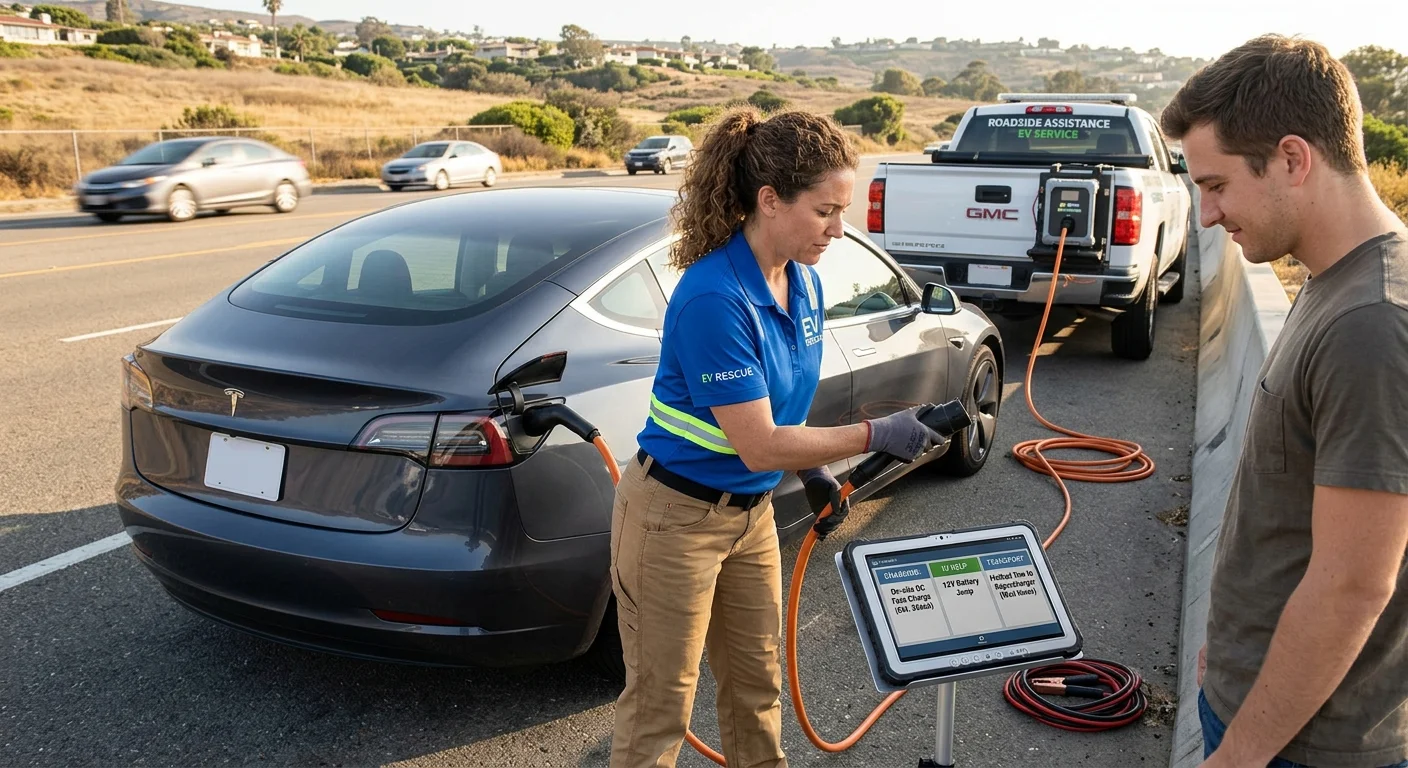
Empty pack after a climb is not a dead 12V
“Died” is a driver’s word, not a diagnosis. One car on I-15 over Cajon shows an empty-pack warning. That’s after the climb toward Victorville and Hesperia. Another sits dark in a Fontana warehouse row after a long shift. Those two scenes need different questions from the operator.
Read the dash exactly as it’s written. Note whether the cluster, cabin lights, locks, phone app, or charge port still respond. If a remaining range or percent still shows, say that figure without translating it. Tell the operator whether the car quit while moving, or wouldn’t wake after parking.
A displayed empty-pack warning supports a talk about out-of-charge recovery. Blank screens can lead the operator toward the 12-volt system. That still isn’t permission to pop a cover or clip on cables. Access points and approved steps differ by make, model, and year.
Use the current owner’s manual for your exact car. Search the roadside, low-voltage, charging, and towing sections. If you don’t have the manual, say so before any work starts. See how to tell a dead pack from a dead 12V to sort symptoms.
Pass climbs and desert sitting change the branch
Inland Empire driving is not one flat commute. The I-15 Cajon climb toward Hesperia and Victorville burns stored energy fast. So does the I-10 rise through Beaumont and Banning. The Ortega Highway near Wildomar does the same on another grade. If the car was moving, then showed an empty-pack message, start with charging. Our Cajon climb out-of-charge notes walk through that shoulder.
Warehouse lots in Fontana and airport rows in Ontario cook a 12-volt battery. High Desert curb time in Adelanto, Apple Valley, and Phelan does it too. The traction pack can still hold miles the car can’t use. That’s when a 12V jump, not a pack charge, is the first talk.
A downhill run from Lake Arrowhead can leave range on the display. Don’t assume you only need more miles in the pack. Report what the car shows, where it sits, and what still works.
Riverside homes sit on Riverside Public Utilities, not Southern California Edison. City of Colton Electric Utility and Bear Valley Electric Service cover their own cities. Most other valley cities sit on Southern California Edison. Moreno Valley Utility and Rancho Cucamonga Municipal Utility cover split pockets. None of those utilities roll a mobile charger to your bumper.
Get clear of moving traffic before anyone diagnoses
People and traffic come first on any inland shoulder. If the car is in immediate danger, call emergency services and follow them. Don’t use this page as a procedure for moving a disabled car.
If the car still responds, follow its warnings and the maker’s steps. Those sources may say whether you can still roll a short distance. If it won’t move, don’t invent a push, a roll, or a neutral-release trick. Tell the operator where the car sits and which controls still work.
A precise location pin changes the whole service call. Northbound I-15 on the Cajon climb toward Victorville is useful. A vague High Desert pin is not enough. The same goes for I-10 through Colton or Redlands. Name I-215 through Moreno Valley and Perris the same way. SR-60 in Jurupa Valley needs a direction and the nearest exit.
Describe the setting without leaving a protected spot. Say lane, shoulder, surface lot, driveway, curb, or parking structure. Mention gates, height limits, tight turns, or a security desk when they apply. The operator needs to know whether the service vehicle can legally reach you.
If emergency personnel already control the scene, say that first. Their directions beat any troubleshooting you try by phone. Diagnosis waits until people and the car sit where the operator can assess them.
Charge, jump, or tow from the facts you have
The right branch depends on confirmed symptoms, the manual, and the place. “My electric car died” is a start, not a diagnosis.
When charging is the conversation
Share the displayed charge level and the warning text word for word. Give the make, model, model year, and whether the charge port opens. The operator then checks whether a compatible mobile visit can work there. Don’t assume the plug, the method, or the access steps.
Independent operators typically bring a 240V Level 2 source to the car. Teslas take a native NACS plug at the bumper. Non-Tesla EVs use a CCS or J1772 adapter. A typical session adds about 10 to 20 miles of range. That’s in 15 to 30 minutes of charging time, not travel time. A mobile charge may not fit every stop. The car may be blocked, unable to accept energy, or showing a different fault. Compare that path with towing versus a mobile charge.
When a 12V jump is the conversation
Discuss a jump only after low-voltage trouble is actually on the table. The operator should check your symptoms against the maker’s current instructions. Don’t pick a jump only because the screens are dark. Don’t use generic battery-access steps written for another model. When an EV 12V looks completely dead lists symptoms to report.
Operators in this network can jump or replace a dead 12V on site. They still quote you before any work starts.
When a tow is the safer call
Discuss transport when on-site service isn’t a fit. That can happen when the cause is still unknown. It can also happen when the car can’t accept a mobile charge. The maker may require a tow for the displayed condition. Collision damage or a spot the truck can’t reach belongs in the first call.
The tow method must follow current instructions for that exact vehicle. Don’t tell a tower how to handle wheels, park systems, or release controls. Share the manual instead, and let them follow it.
Charge a confirmed empty pack, or talk through a confirmed 12V jump. Use a tow when on-site service doesn’t fit the car or the place.
What to tell the operator on the first call
Good detail keeps the operator from starting with guesses. Begin with make, model, model year, and the displayed charge level.
Explain what happened right before the car stopped responding. You might report it was parked, plugged in, or rolling on a named road. If you see impact damage, smoke, or unusual heat, tell emergency services.
Mention displays, locks, interior lights, the phone app, the charge port, and gear selection. “Nothing works” is weaker than a short list of controls you actually tried. Stop testing if the manual or emergency personnel tell you to stop.
Give a precise Inland Empire location, not a region nickname. Include the road, direction, nearest exit, cross street, lot name, or level. If you’re near the Cajon summit, downtown Riverside, or Adelanto, name that.
A gated complex, garage, paid lot, or warehouse gate can block a service vehicle. Say whether you have the keys and who can approve service.
How Charge Pro IE connects you with an operator
Charge Pro IE is a referral line for stranded EV drivers. We match you with independent local mobile rescue operators. We don’t diagnose the car, do the work, own trucks, or tow. We don’t employ technicians, set prices, or promise when someone arrives. We don’t hold a contractor license for the work. The pros we connect you with are licensed and insured.
When you contact us, share the vehicle and location details you’ve gathered. The independent operator then reviews symptoms, checks compatibility, and explains the fit.
Our EV roadside assistance page explains the referral for stranded drivers. It covers the valley, the High Desert, the passes, and the mountain towns.
You contract with the operator and pay that operator directly. Charge Pro IE doesn’t set the operator’s price. Ask the operator to confirm scope, current price, payment, and credentials before you authorize work.
A responsible referral starts with “unknown problem” when that’s the truth. The operator decides equipment after reviewing the car, the manual, and the place. If the selected service can’t fix it, ask what the maker requires next. Don’t authorize a different battery procedure from a generic roadside story.
When to call
Call when the car has stopped or the dash makes no sense. The independent operator decides whether mobile charging, a 12V jump, or a tow fits.
Call (909) 250-2881 and we’ll connect you with a local EV rescue operator.