A Mercedes EQE that won’t start is usually a dead 12-volt battery. That includes the stall you get after a slow 91 crawl through Corona. The high-voltage pack can still show a healthy percentage. The car just never reaches Ready. Flush handles stay flush. The MBUX screen stays black. Jump the dedicated underhood terminals first. Don’t assume the drive battery failed.
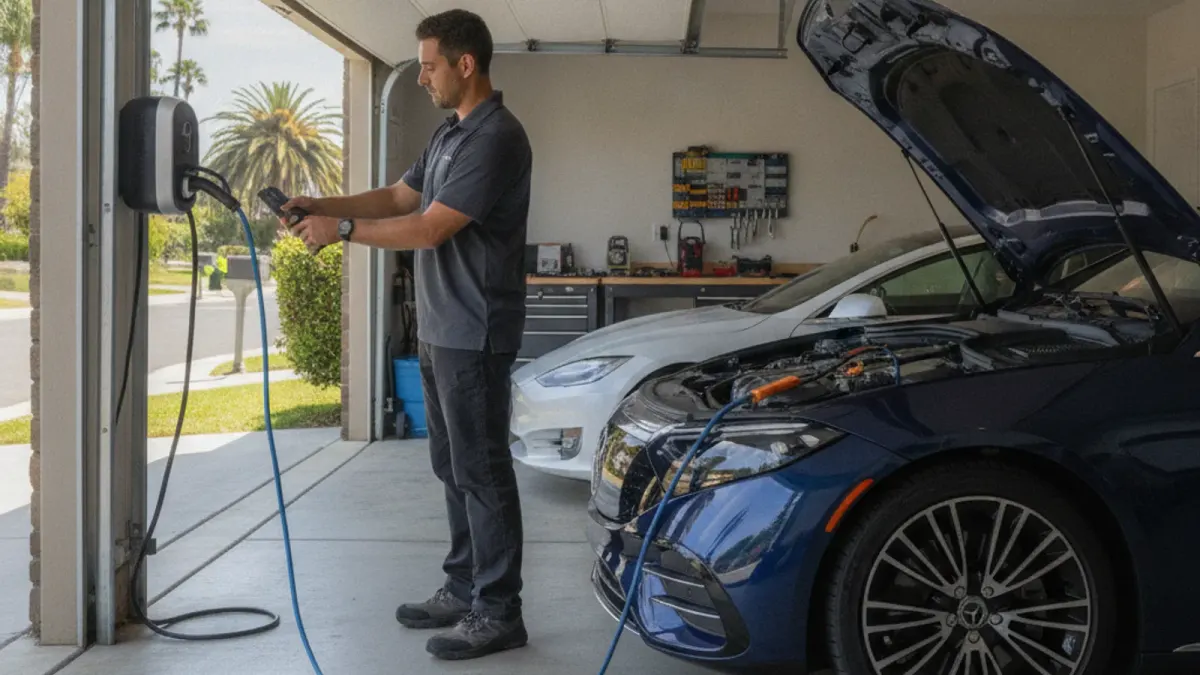
That stall is easy to misread. You spent a stretch in stop-and-go on the 91. Climate control was running. The screens stayed awake. Then you shut down in a lot. Or you try to restart on the shoulder. Nothing happens. Range was still on the display a minute ago. So it feels like a pack problem. It usually isn’t.
Stop-and-go on the 91, then a silent EQE
The 91 through Corona turns into a long, slow grind. An EQE in that traffic keeps low-voltage gear alive. Radar units stay ready. The camera stack stays ready. MBUX never really sleeps. All of that draws on the small 12-volt battery. It doesn’t draw on the drive pack you watch for range.
When you finally park, that 12-volt may already sit on the edge. A restart handshake needs a firm voltage. If it doesn’t get it, the EQE looks bricked.
Corona’s electric service is Southern California Edison. Riverside’s city power is Riverside Public Utilities. That utility has served the city since 1895. Neither one caused this stall. A dark EQE on the 91 is not an SCE outage. It’s not an RPU outage either. It’s the car’s own low-voltage side failing to boot.
If the pack itself were empty, you’d have watched range fall for miles. This is different. For an empty-pack stall on that freeway, see out of charge on the 91. A no-start with miles still showing is the 12-volt path.
EV roadside assistance in Corona covers that 91 corridor when you’re stuck. Charge Pro IE is a referral line. It matches you with independent mobile rescue operators. Those operators jump a dead 12-volt on site. They also bring a 240-volt Level 2 source for a dead pack. The operator quotes you before any work starts. The operator bills you directly.
The small battery is what turns the car on
Every EQE has two electrical systems. The big one moves the car. The small 12-volt one runs the computers. Those computers decide when the big pack may connect. Door handles live on the 12-volt side. So does ambient lighting. So do driver-assistance sensors. So does the MBUX display. So do the control units that close the handshake to the motors.
Take the 12-volt too low and the handshake never finishes. The drive pack can sit at a high percentage and never get used. That’s why a full-looking EQE can still look dead.
Background modules keep sipping power while the car sits. The connectivity gateway does it. OTA gear does it. Radar modules do it. A long idle in 91 traffic does the same thing with everything awake. Park the EQE for days without a drive cycle. The 12-volt can fall below the boot threshold. A multi-day sit in an Ontario airport lot will do it. So will a long stretch in a Chino Hills driveway. So will a warehouse shift in Fontana with no real drive.
The EQE and the EQS share the EVA2 low-voltage layout. They fail the same way. They jump the same way. The Mercedes EQS 12V battery write-up is the sibling version of this stall. The EQB and EQA sit on a different platform. Their 12-volt battery is in a different spot. A dead 12-volt still presents a dark car. A proper jump is still the first test.
Clues on the screen, at the handle, and in park
You don’t need a scan tool to see a dying 12-volt. The EQE tells you. It just doesn’t use one neat message.
A fully flat 12-volt gives you silence. No interior lights. Handles that won’t motor out. A fob that does nothing at the door. That’s a jump, not a public charger.
A half-dead 12-volt is sneakier. The screen may start to boot, then freeze. It may go black before Ready. You might see a 12-volt electrical-system warning. Then the display dies. The car may unlock and still refuse to leave park. Low-voltage modules never get a clean bridge to the high-voltage side.
None of those point at a failed drive battery. They point at voltage the control units won’t accept. For the same pattern on any EV, read when an EV 12-volt battery dies. It explains why the car looks bricked while the pack is fine.
Plugging into a public stall won’t fix this if contactors never close. The car has to wake before it can take a charge. A dark EQE in a Corona lot is still a 12-volt job first.
Hood terminals versus the battery in the trunk
The layout catches a lot of EQE owners. The 12-volt battery is not under the hood. It lives in the rear cargo area. It’s under a trunk floor panel. Swapping it means pulling the load floor. That’s a shop job. The car’s battery management usually needs a registration step. That step needs a compatible diagnostic tool. You don’t do that in a Corona shoulder lane.
For a jump, you never touch that rear battery. Mercedes put dedicated jump points in the engine bay. They’re there for this stall.
The interior hood release is a mechanical cable. It still works with a dead 12-volt. If the doors won’t motor open, pull the metal key blade from the fob. Unlock the driver’s door by hand. Then pop the hood.
On the driver’s side you’ll see a black fuse and relay box. Lift the cover. Under a red cap is a marked positive stud. That’s the jump positive. For negative, pick an unpainted chassis bolt. A strut-tower ground close by also works. Don’t run the negative lead back to the trunk battery.
Hookup order stays standard. Positive to the EQE stud, then to the donor. Negative to the donor, then to the EQE chassis ground. Give the low-voltage side a couple of minutes to recover. Then ask for Ready. The display should run its boot. The car should come up like itself again.
Keep this map in your head:
- Real 12-volt battery: rear cargo well, under the floor panel
- Jump positive: engine bay, driver’s-side fuse box, red cap
- Jump negative: nearby chassis ground, not the rear battery
- Typical type: 12-volt AGM lead-acid
- Dark screen: low-voltage network, not the drive pack
- Replacement: workshop, with battery registration
The EQE SUV uses the same split. Battery in back. Jump points up front. A powered tailgate that’s already dead doesn’t block the rescue. You work from the hood.
Generic jump-pack technique is in how to jump start an electric car. Use that with the EQE’s underhood studs. Don’t hunt for a conventional under-hood battery post. It isn’t there.
If you’re already on the shoulder or in a lot
Start with the doors. If they ignore the fob, use the mechanical key. Look for leftover 12-volt life. A dome light counts. Hazards count. A flicker on the screen counts. Total darkness means you need a jump.
Open the hood with the interior cable. Find the red-capped positive stud. It’s on the driver’s-side fuse box. Use a jump pack if you have one. Wait those couple of minutes after the clamps are on. Then request start.
If Ready comes back with a 12-volt fault, the battery is done inside. Driving it home is the goal. Booking a shop replacement is the next goal. A jump is not a new battery.
No jump pack in the Inland Empire means you need an operator. Charge Pro IE can connect you with one. That operator carries gear for those dedicated terminals. Non-Tesla EV rescue is the path for Mercedes CCS cars. That includes the EQE, EQS, EQB, EQA, and AMG EQ variants. Operators in the network handle Tesla and every major EV brand. For an empty pack they typically add 10 to 20 miles of range. That takes 15 to 30 minutes of Level 2 charging. That’s charging time on the hookup. It’s never a promise of when someone arrives. For this stall, the 12-volt jump is the job.
Ontario airport lots strand cars that sat too long. Warehouse rows in Fontana do the same. The car didn’t crawl the 91 and then die from an empty pack. It shut down with a tired 12-volt. Then it never came back.
Eastvale’s housing stock is mostly new. Only 2.2 percent of units there date before 1980, per ACS 2019-2023. A new street doesn’t protect the 12-volt. A car that sits between school runs still drains. Norco’s housing is much older. 68.8 percent of Norco units are pre-1980 in that same vintage. The 12-volt failure looks identical on those blocks.
Jurupa Valley sits next door on SCE as well. A stall on SR-60 is a different road. Run the same 12-volt test if the car won’t wake. Don’t wait on a utility to reset anything at the curb. SCE serves Corona, Norco, Eastvale, and Jurupa Valley. Riverside Public Utilities serves the City of Riverside. Moreno Valley is split between SCE and Moreno Valley Utility. Colton Electric Utility owns the system inside Colton. The City of Banning Electric Utility serves Banning. None of those utilities jump an EQE. They also don’t set the price of a mobile rescue. The operator on scene does.
After it starts, the 12-volt still has to hold
Once you’re in Ready, the DC-DC converter feeds the 12-volt. It pulls that feed from the drive pack. That’s how the system is supposed to recover on the drive home. An old or internally failed AGM won’t keep the charge. You can go dark again in a few days. Sometimes it happens after one more sit.
That’s the difference between a one-time drain and a battery that’s through. EV 12V battery replacement signs covers a jump that doesn’t last. Have the battery load-tested at a Mercedes dealer. An independent EV shop can load-test it too. Replacement stays a workshop job. The rear cargo location is why. The registration step is why.
A tow is the last resort for this failure, not the first. If the jump brings Ready, you drive. If it won’t hold even with cables on, you need a shop tow. Don’t drag an EQE on its drive wheels.
Chino Hills luxury EVs see the same 12-volt pattern after a sit. Corona commuters see it after the 91. Ontario travelers see it after the car sat in a lot. The pack isn’t the first suspect when the screen is black. Range was fine a minute earlier.
Mercedes EQ help across the Inland Empire
Charge Pro IE covers the Inland Empire. That includes Corona and the 91. It includes Ontario and the airport-area lots. It includes Chino Hills, Riverside, Fontana, and the rest of the two-county map. The brand doesn’t own trucks. It doesn’t employ technicians. It doesn’t hold a contractor license. It doesn’t perform the work. Independent local operators do. They quote before they start.
If your EQE crawled, sat, and then went silent, start with the 12-volt. The expensive pack is probably fine.
Frequently asked questions
How do you jump a Mercedes EQE that won’t start?
Use the underhood jump stud, not the battery in the trunk. Positive goes to the red-capped terminal in the driver’s-side fuse box. Negative goes to a chassis ground in the engine bay. Wait a couple of minutes, then request Ready. The real 12-volt battery stays under the rear load floor. It’s not a parking-lot jump point.
Where is the Mercedes EQE 12-volt battery?
It’s in the rear cargo well, under a trunk floor panel. The jump terminals you actually use are in the engine bay. That split matters when the powered tailgate is already dead. You still reach the hood release. You still reach the fuse-box stud.
Why won’t a Mercedes EQE start if the main battery still has charge?
Two batteries do two jobs. The high-voltage pack drives the motors. The 12-volt pack wakes the computers, the handles, and the screen. If the 12-volt is flat, those computers never authorize the pack. Jump the 12-volt. The EQE can then use the charge it already had.
Your Mercedes EQE won’t start in the Inland Empire. Call Charge Pro IE at (909) 250-2881. An operator in the network can jump the 12-volt on site. Confirm the quote before any work begins.