A Mercedes EQS 12V battery dead at the curb still needs a jump on site. Save the tow talk for after the car can wake. The Hyperscreen can stay black with the high-voltage pack still charged. Powered door handles may not extend. Ready mode never shows up. You might only get “vehicle being prepared, please wait” frozen on the glass. That’s a low-voltage handshake failing, not an empty drive battery. Wake the 12V first. Then you can tell whether a hook is even required.
An EQS puts more glass between you and that fault than most EVs. The pattern is still the same. If the Mercedes in the driveway is an EQE, the weakness is close. The bay layout is not. Start with Mercedes EQE won’t start: the 12V fix to try first. The EQB and EQA sit on another platform, so their jump points differ again.
The pack can be fine and the car still won’t roll
The EQS doesn’t wake like a gas S-Class. A 12V AGM battery in the rear feeds the whole low-voltage network. That feed runs the Hyperscreen, the powered handles, the air-suspension compressor, and the digital mirrors. It also runs the control units that connect the pack to the motors. When that 12V supply sags, those modules never finish their boot. The cabin looks dead, but the drive battery can still show a healthy percentage.
You’ll usually see one of three signatures.
Complete silence: no lights, no lock click, and a fob that does nothing. The “vehicle being prepared, please wait” loop that never clears. Or a brief Hyperscreen flash, a 12V warning, then a black display before Ready. All three mean the 12V can’t finish the handshake. None of them mean the pack is empty. For the same stall on other EVs, read When the 12-volt dies, why the EV looks completely dead.
The EQS carries a lot of modules that never fully sleep. Radar, the connectivity gateway, MBUX, and over-the-air update hardware can keep polling after you lock the car. Park it for a long stretch without a drive. The 12V can sag enough to block startup. Inland heat makes a tired battery worse. Standby electronics still draw while the cabin sits hot. A battery that’s never been load-tested is the one that fails in a lot, not on a hoist.
Where an Inland Empire EQS actually sits dark
The car doesn’t have to be on a grade to die this way: sitting is enough.
Ontario is a frequent version of that sit. Airport lots and warehouse rows keep an EQS still for hours or days. You come back to a cabin that won’t unlock. EV rescue around Ontario airport lots and warehouse rows is the local write-up for that pattern. Fontana warehouse shifts end the same way. The pack was never the problem.
Chino Hills is the hillside version. Homes sit on longer drives, and a luxury EV may only move on weekends. EV roadside assistance in Chino Hills for Tesla and other luxury EVs covers that west end of San Bernardino County. Eastvale is newer. Only 2.2 percent of its housing predates 1980, per ACS 2019-2023. New streets still don’t guarantee the EQS is plugged in every night. If it sits unplugged between school runs, the 12V can sag in the driveway.
Older neighborhoods are the other picture. In the city of Riverside, 56.4 percent of housing was built before 1980. San Bernardino is 60.9 percent. Redlands is 60.4 percent. Those are ACS 2019-2023 figures. A lot of those garages were never designed around an EV. The car may live unplugged even when the house has power. Riverside Public Utilities serves the city of Riverside. Southern California Edison covers most neighboring cities. Colton owns its electric utility inside city limits. Banning runs its own as well. Rancho Cucamonga is split. Southern California Edison serves most of the city. Rancho Cucamonga Municipal Utility covers a southeast pocket that includes Victoria Gardens. None of that changes the curb step. A dead 12V still gets jumped on site.
High Desert parking is a hotter sit. Victorville, Hesperia, Adelanto, Apple Valley, and Phelan leave a dark EQS in a cabin that cooked all afternoon. Mountain weekends swing the other way. Big Bear Lake and Big Bear City are on Bear Valley Electric Service. Lake Arrowhead and Crestline are on Southern California Edison. The 12V doesn’t care which utility feeds the cabin. It cares that the car sat.
Freeway stops can do it after a short shutdown. I-10 through Colton and Redlands is one version. The 91 in Corona is another. SR-60 in Jurupa Valley and I-215 through Moreno Valley and Perris see the same stall. So does I-15 at the Cajon climb toward Victorville. An EQS can shut down, then refuse Ready. A tow from those shoulders treats the wrong system. Jump the dedicated terminals first.
Temecula valley days and a long lot at Pechanga are the same stall with nicer landscaping. The car sat. The 12V sagged. The pack was never empty.
Jump points are under the hood, not in the trunk
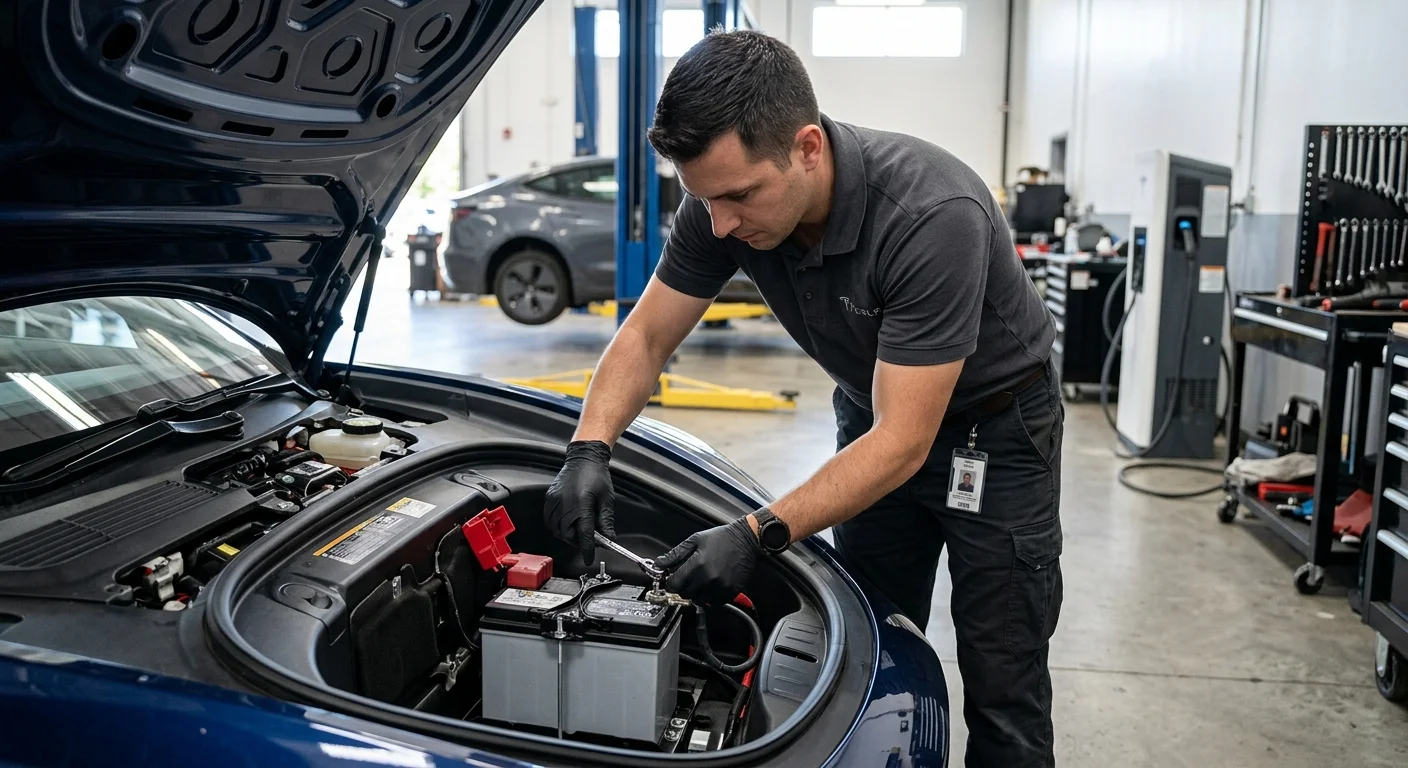
People look for the 12V in the front bay and come up empty. That’s not a miss on your part. The battery itself lives in the cargo area. It sits under the load floor on the driver’s side. You won’t reach it from the hood. Replacing it means pulling trunk trim and the floor panel. That’s shop work. A powered tailgate may not even open if the 12V is already gone.
Mercedes still put jump terminals up front for this exact stall. Clip there, and leave the trunk battery alone until a workshop can get into it.
| What you need | Mercedes EQS |
|---|---|
| 12V battery location | Cargo area, driver’s side under the load floor |
| Jump positive | Engine bay fuse box, red-capped stud |
| Jump negative | Unpainted chassis bolt, not the trunk post |
| Battery type | 12V AGM |
| ”Vehicle being prepared” | Low-voltage handshake, not a dead pack |
| Replacement | Workshop: trunk trim, then battery registration |
Get in, then wake it, then see if it holds
Start with the doors. If the handles won’t extend, use the mechanical key hidden in the fob. That key still opens the driver’s door when the 12V is gone. Once you’re in, look for any leftover 12V sign: a dome light, a hazard flash, a faint screen glow. If you get nothing, you’re jumping, not charging the pack.
The hood release still works with no 12V. It’s a mechanical cable near the driver’s sill. Open the hood. On the driver’s side of the bay you’ll see a black fuse and relay box. Lift that cover. Under it is a marked positive stud with a red cap. That’s the jump positive. For negative, pick an unpainted metal bolt or bracket on the chassis. Strut-tower area bolts are the usual choice. Don’t run the negative clamp to the trunk battery.
Clip in the ordinary order. Positive to the EQS stud, then positive to your jump pack or donor. Negative to the donor, then negative to EQS chassis ground. Wait two full minutes. Let the modules come back up. Then try to enter Ready. The Hyperscreen should run its boot and the car should come alive. For the cable sequence on any EV, use How to jump start an electric car without frying the 12V.
If a 12V fault stays on after the jump, the battery is likely done. The car may still roll you to a shop. It may not hold overnight. Replacement isn’t a parking-lot job. The new battery usually has to be registered to the car’s battery management system with a compatible diagnostic tool. Dealers and independent EV shops do that work. Confirm the current procedure with the shop before you book, because tooling and steps vary by year.
Once you’re moving, the DC-DC converter should recharge the 12V from the main pack while you drive. That only helps if the battery can still hold a charge. If it dies again after a jump, you’re not looking at a one-off drain. Read EV 12V dies again after a jump: what that usually means.
A published replacement interval for the EQS 12V couldn’t be confirmed from Mercedes materials available for this page. Ask the selling dealer or an independent EV shop to load-test it, especially if the car sits for long stretches. Don’t wait for a dark Hyperscreen on I-10 to find out.
Who actually shows up for a non-Tesla jump
Charge Pro IE is a referral line. It doesn’t own trucks or employ technicians. It matches you with independent local mobile rescue operators. Those operators jump a dead 12V on site. They handle Tesla and every major EV brand, including the EQS. If the pack is the real problem, they can bring a 240V Level 2 source to the car. Native NACS, plus a CCS or J1772 adapter for non-Tesla EVs. That charge typically adds 10 to 20 miles of range in 15 to 30 minutes of charging time. That’s charging time, never an arrival time. The operator quotes you before starting and bills you directly.
For an EQS with a dark cabin, the first ask is still the 12V jump. Non-Tesla EV rescue in the Inland Empire: who helps CCS and J1772 is the service page for that call. Don’t lead with a flatbed unless the car won’t wake after a proper jump, or unless a shop already said the battery must come out on a truck.
Frequently asked questions
Can you jump a Mercedes EQS at the curb, or does it need a tow?
Jump it at the curb first. Use the red-capped positive stud in the driver’s-side fuse box under the hood. Put the negative on chassis ground, not on the trunk battery. Wait two minutes, then try Ready. The 12V battery itself is under the cargo floor, so you’re not clipping the battery posts. A tow is for a car that won’t wake after a correct jump, or for a battery that has to come out at a shop.
What does “vehicle being prepared, please wait” mean on an EQS?
It means the control units started a boot and couldn’t finish it. Low 12V voltage is the usual cause. The car had enough power to paint that message, and not enough to reach Ready. Jumping the underhood terminals usually clears it. It’s not a message about the high-voltage pack being empty.
Why is the Hyperscreen dark if the main battery still has charge?
The Hyperscreen runs on the 12V network, not on the drive pack. When 12V voltage drops too far, the screens, handles, lights, and startup sequence all quit. The main battery can still be sitting at a high percentage. The car won’t move until the low-voltage side is awake.
If the EQS is dark in a lot or on an inland shoulder, call Charge Pro IE at (909) 250-2881. An operator we connect you with can jump the dedicated terminals on site. You get a quote before any work starts, and there’s no promised arrival window. The point is to wake the car before anyone hooks it.