Your EV can sit with miles left and still refuse to wake. That’s a 12-volt problem more often than a dead pack. EV 12V battery replacement is the lasting fix once a jump fades. Inland Empire drivers hit this in Fontana warehouse rows. They also see it in Ontario airport lots and after a Big Bear sit.
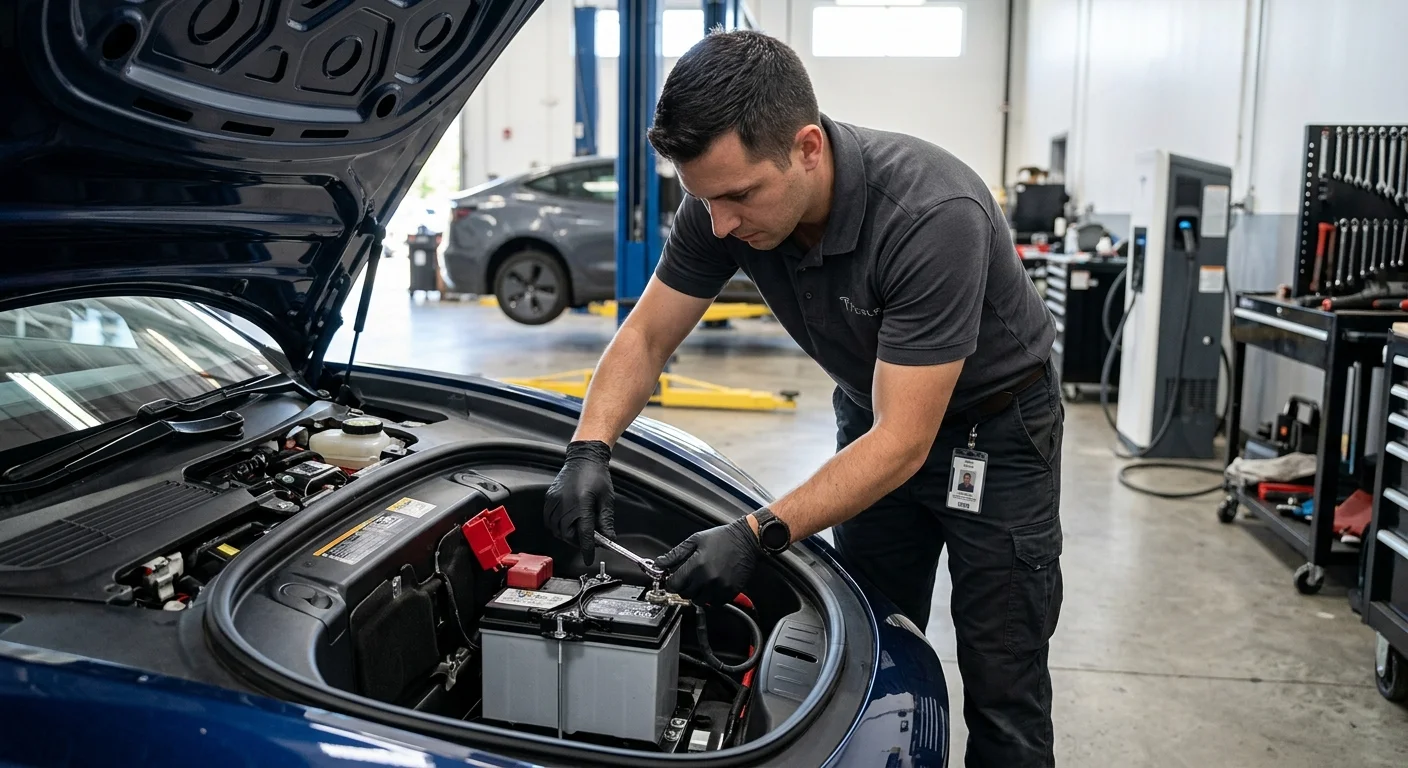
The 12-volt is what lets the pack do its job
The traction battery moves the wheels. The 12-volt runs the low-voltage side. That includes computers, locks, lights, windows, and the contactors. Contactors are the switches that connect the pack to the rest of the car. If they never close, drive never happens.
A dark dash doesn’t prove the pack is empty. It often means the computers never booted. The charge door may stay shut. The fob may do nothing. You can be locked out of a car that still has range.
That’s why people call the wrong help. They ask for a charger. They needed 12-volt power. For the shutdown itself, read when the 12-volt dies on the road.
This region is not one kind of stall
The Inland Empire spans two counties and several climates. ACS 2019-2023 puts Riverside County at 2,478,600 people. San Bernardino County is 2,197,104 on the same tables. Drivers cross valley freeways, mountain grades, and High Desert miles in the same week.
Valley lots in Fontana, Ontario, and San Bernardino sit in heat. A car can rest all shift in a warehouse row, then refuse to wake. Ontario airport-area lots and industrial streets add long sits between drives. Fontana’s ACS population is 214,169. Ontario’s is 180,547. That’s a lot of work-lot EVs waiting on a fob.
Up the hill, the pattern changes. Big Bear Lake and Big Bear City cars often rest longer between trips. Lake Arrowhead and Crestline sits can be the same. Cold overnight and a weak 12-volt is a bad mix. The car may have climbed fine. It just won’t wake for the drive down.
Victorville, Hesperia, Adelanto, and Apple Valley add long sits and long drives. A car that woke in Rancho Cucamonga can fail after the Cajon. I-15 toward Victorville is a common stage for that. I-10 through Colton, Redlands, Beaumont, and Banning is another. I-215 through Moreno Valley and Perris sees it too. So does SR-91 in Corona, and SR-60 through Jurupa Valley.
None of those roads are the diagnosis. The 12-volt is. An empty pack is a different failure. Don’t treat them as the same call.
Don’t confuse a dark car with a missed charge
Some Inland Empire homes sit on Southern California Edison. Riverside is different. Riverside Public Utilities has served the city since 1895. Colton owns its electric system inside city limits. Banning has its own electric utility. Big Bear Lake and Big Bear City sit on Bear Valley Electric Service. Rancho Cucamonga is split: SCE plus a municipal pocket. Moreno Valley is split between SCE and Moreno Valley Utility.
A dark house charger can leave the pack low. That’s not a 12-volt failure. A 12-volt failure can leave the pack full and the car still dark. Ask what the last state of charge was. Ask whether screens, locks, and the fob still work. Those answers pick the right truck.
Eastvale housing stock is young. ACS 2019-2023 puts its pre-1980 share at 2.2%. San Bernardino’s share is 60.9% on that same vintage. Older panels fail in their own ways. They still don’t explain a car that won’t wake with miles showing.
Signs the 12-volt is already slipping
Catch it before the car goes fully mute.
Tesla will often say the 12-volt needs service. Don’t swipe that away. Other brands hide it under a generic alert. A center screen that boots slow is an early tell. So is a screen that blanks, then returns. A key that works on the third try is another. Door handles that stay flush. Interior lights that dip. Windows that crawl.
Then it gets worse. You press the brake. Nothing happens. Drive never comes up. Or a pile of unrelated errors hits at once. Modules that starve for 12-volt power throw junk codes. The car looks haunted. The battery is just weak.
Tesla-only clues are in Tesla 12V warning signs before you strand. Every Tesla still has that small battery, including newer lithium units. Do Teslas have a 12V battery maps that by model.
We couldn’t confirm a published replacement interval in years for this page. Age alone isn’t a number we can print. Treat the warnings and the wake failures as the trigger. Have the battery tested when those show up.
A jump is a bridge, not the repair
A jump feeds the 12-volt circuit so the computers can boot. Once they’re up, the pack can support the low-voltage side while you drive. That doesn’t rebuild a battery that’s done. A shorted cell or a lithium 12-volt that’s out of spec will fail again.
If it dies a second time, stop repeating jumps. EV 12V dies again after a jump is the usual pattern. Plan the replacement. Don’t plan another lucky start.
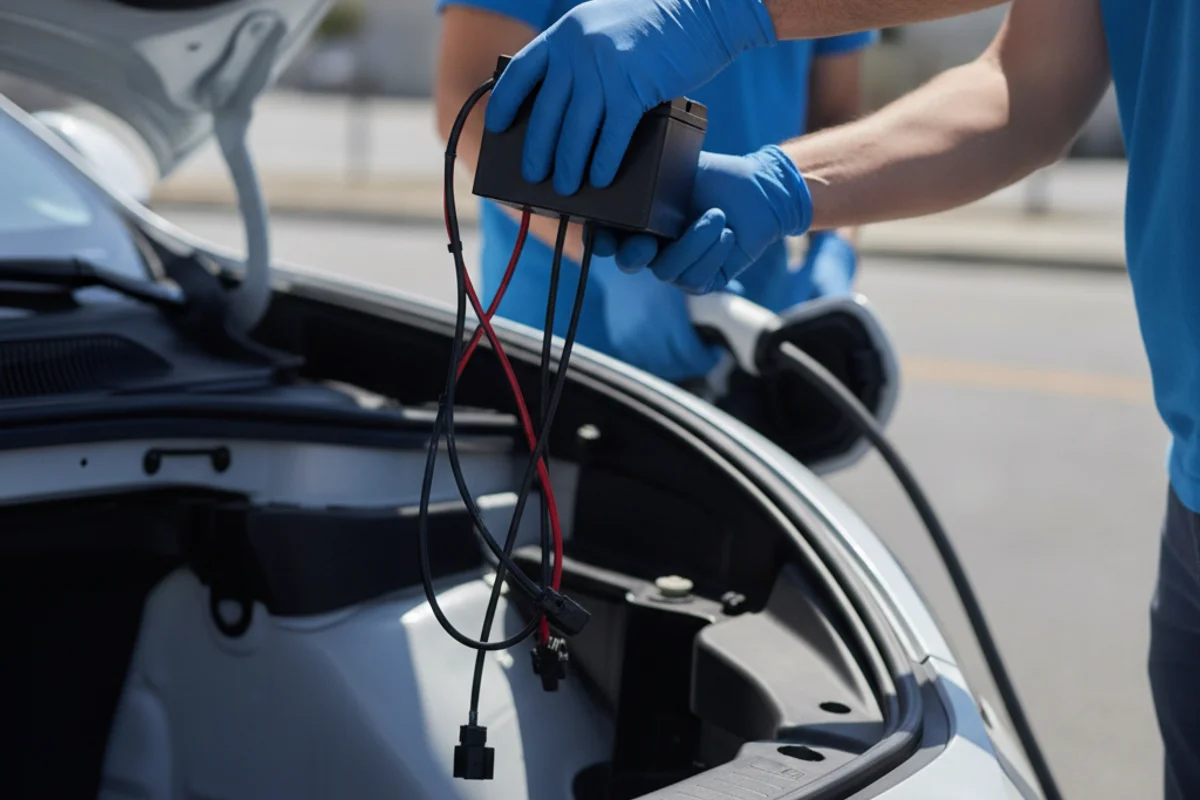
Operators we connect you with can jump a dead 12-volt on site. They can also replace it on site for Tesla and other major EVs. They bring the part and the tools to the car. You may not need a limp to a shop first.
If the pack is actually empty, that’s a mobile Level 2 visit instead. Those operators bring a 240V source to the car. Native NACS for Tesla. A CCS or J1772 adapter for everyone else. Charging time is typically 15 to 30 minutes. That usually adds about 10 to 20 miles of range. That’s charging time. It isn’t an arrival time. Charge Pro IE doesn’t promise when someone shows.
A live lane on I-10 in Colton isn’t a DIY moment. Get to a safe spot if you can. Then call. A no-power EV often needs a flatbed if it can’t be woken. Don’t drag it.
Tesla, Rivian, Mach-E, and the other trays
The 12-volt isn’t in the same hole on every car.
Many Model 3 and Model Y units sit under the frunk cowl. Trim comes off before you even see it. Newer Teslas may use a lithium 12-volt instead of an AGM. Rivian R1T and R1S still need that low-voltage battery to wake accessories. Mach-E placement is often the frunk or under a rear seat. That depends on year. Hyundai Ioniq 5, Kia EV6, and VW ID.4 follow the same logic. So do BMW i4, Nissan Leaf, and Chevy Equinox EV.
Jump posts are model-specific too. Many hide behind a front cover, a tow-hook door, or a frunk panel. Use those posts. Never try to jump from the high-voltage system. That’s not a 12-volt jump. For the safety path, see how to jump start an electric car.
The owner’s manual is the authority, not a forum thread. Tesla owners mapping the swap, not a price, can use replacing a Tesla 12V here.
What a mobile operator can do at the curb
Charge Pro IE is a referral line. It matches you with independent local mobile rescue operators. It doesn’t perform the work. It doesn’t own trucks. It doesn’t employ technicians. It doesn’t hold a license. It doesn’t set prices.
The operators we connect you with are licensed and insured. They handle Tesla and every major EV brand. They jump or replace a dead 12-volt on site. They can also recover an out-of-charge car with that Level 2 source.
The operator quotes you before starting. They bill you directly. If they can’t replace it where you sit, they’ll say so. Then the next step is a shop or a flatbed, not a guess.
For a Tesla that’s dark, the matching service page is Tesla 12V battery jump. Non-Tesla CCS and J1772 cars still need the same 12-volt logic. The adapter on the charge cable doesn’t fix a mute computer.
Home swap versus a shoulder swap
Some owners can change a 12-volt in a driveway. A shoulder on the 215 through Moreno Valley is a different job. So is a tight downtown Riverside curb, or a packed lot in Cabazon.
If you still want to do it at home, start with the manual. Battery location, terminal hardware, and service-mode steps change by model. A generic video will skip your car’s warnings.
Park it. Follow the listed wake or service-mode steps before any cable comes off. Conventional terminals usually isolate the negative first. Some EVs want a named service mode before that. Keep metal off the posts. The hold-down clamp isn’t optional. A loose 12-volt becomes a new problem on the first bump.
Set the new unit in the same orientation. Reconnect in the order the manual gives. Then wait. Modules can take a minute to boot. Temporary faults sometimes clear after a short, calm drive. If the car stays dark, stop. Recheck the posts. Don’t keep cycling power.
A curb jump is a different skill from a driveway swap. Use the marked 12-volt posts only.
Valley heat and mountain overnights are part of how these cars get used here. That doesn’t give us a year figure we can cite. Don’t ignore early signs through a Temecula summer. Don’t ignore them after a Big Bear weekend either.
What this page cannot quote
The instinct is to print a parts-and-labor range. We won’t. No Inland Empire dealer published a 12-volt replacement figure we could verify. Tesla Service, Rivian, and independent shops didn’t either, for this page. AGM and lithium 12-volt units aren’t the same part. Access time isn’t the same across a Model Y and an R1S.
Confirm the current parts price with the shop or operator before they order. Confirm labor before they start. Charge Pro IE doesn’t set that number. A page that invents a neat range would be wrong.
OEM versus aftermarket is a shop conversation. So is programming or registration, if your brand requires it. We couldn’t confirm a single Inland Empire rule that covers every make. Ask the operator or the dealer for your VIN.
After the new 12-volt is in
A healthy 12-volt should let the car wake, lock, and close contactors. Screens should come up. Drive should engage. If it still won’t take a charge, that’s a different problem. Look at the port, the station, the app, or the pack.
If a brand-new 12-volt dies fast, look past the battery. A drain can drop a fresh 12-volt. So can a charging-system fault, or the wrong spec unit. That’s a diagnosis, not another roadside jump.
Keep the old failure in mind on the next mountain sit. A Lake Arrowhead overnight is a long rest. A car that needed a jump last month is trying to tell you something.
Call the right help, and say it’s the 12-volt
Tell the operator what you see. Dark screens and a dead fob point at 12-volt. A display that still shows a low pack points at range. Wrong truck wastes the visit.
We serve cities across both counties. That includes Chino Hills to Yucaipa, and Temecula to Victorville. When you need a match, call Charge Pro IE at (909) 250-2881. The operator quotes before they start. We don’t publish an arrival clock, and we don’t do the work ourselves.