An EV maintenance schedule in the Inland Empire is short. You won’t be booking oil changes. Heat, long grades, and cars that sit for hours are what you actually need to watch. Those three show up as a dead 12-volt battery or a pack that won’t cover the next climb.
Your owner’s manual still owns the mile intervals. This page is the local overlay. A week of warehouse shifts in Fontana isn’t a weekend parked in Big Bear Lake. A new Eastvale driveway isn’t an older San Bernardino block. That difference belongs in how you care for the car.
The Inland Empire is several maintenance climates
Start with the valley floor. Riverside, Ontario, San Bernardino, Fontana, Rialto, and Colton put cars in heat and in lots. Electronics stay half-awake while you work. The 12-volt feels that more than the traction pack does.
Then the High Desert. Victorville, Hesperia, Adelanto, Apple Valley, and Phelan add heat plus long, open miles. A weak 12-volt or a soft tire shows up far from a shop. Hesperia and Victorville also sit after the Cajon climb on I-15. Range planning is maintenance. Don’t roll out on a tired 12-volt either.
Mountain towns are a third pattern. Big Bear Lake, Big Bear City, Lake Arrowhead, Crestline, and Running Springs share steep grades. Cars can sit for days between trips. Bear Valley Electric Service serves Big Bear Lake and Big Bear City. Its service-area page also names Moonridge, Fawnskin, and Sugarloaf. Lake Arrowhead and Crestline sit on SCE’s tariff index. Your home charging plan follows that split. The grade doesn’t care which utility printed the bill.
South county newer housing is a fourth pattern. Eastvale’s pre-1980 housing share is 2.2 percent, ACS 2019-2023. Temecula is 6.5 percent. French Valley is 2.3 percent. Murrieta is 6.2 percent. Panels are newer on average. Cars still sit. New streets and long commutes still drain a 12-volt that nobody tested.
Drop the gasoline checklist, keep the EV one
There’s no engine oil and no oil filter. Spark plugs are gone. There’s no fuel filter and no timing belt. Many EVs use a single-speed drive unit, so a transmission flush isn’t a routine stop. Some models do call for drive-unit fluid at high mileage. That line is in the glovebox book. It’s not a number we’re going to invent.
What’s left is easy to skip because it feels like nothing. Skip it, and a full EV can still sit dead in a Chino work lot.
Watch the 12-volt before you watch anything else
Every EV still carries a small 12-volt battery. It powers locks, lights, the screen, and the computer that wakes the high-voltage pack. When that battery is tired, the car looks fully dead. The big pack can still hold plenty of range.
Heat and idle parking are the local tell. A van that sits through a Fontana warehouse shift keeps modules awake. So does a car in an Ontario lot for a long day. A Tesla that barely moved for a week in a Hemet driveway can do the same. You may see slow screens. Doors may not unlatch on the first try. The start button may do nothing.
Get the 12-volt tested when the car is already in for tires or inspection. Replace it when the test says it’s weak. Don’t wait for a silent morning. The traction-pack warranty usually doesn’t cover this small battery. Confirm that in your own warranty booklet. We’re not restating warranty years here.
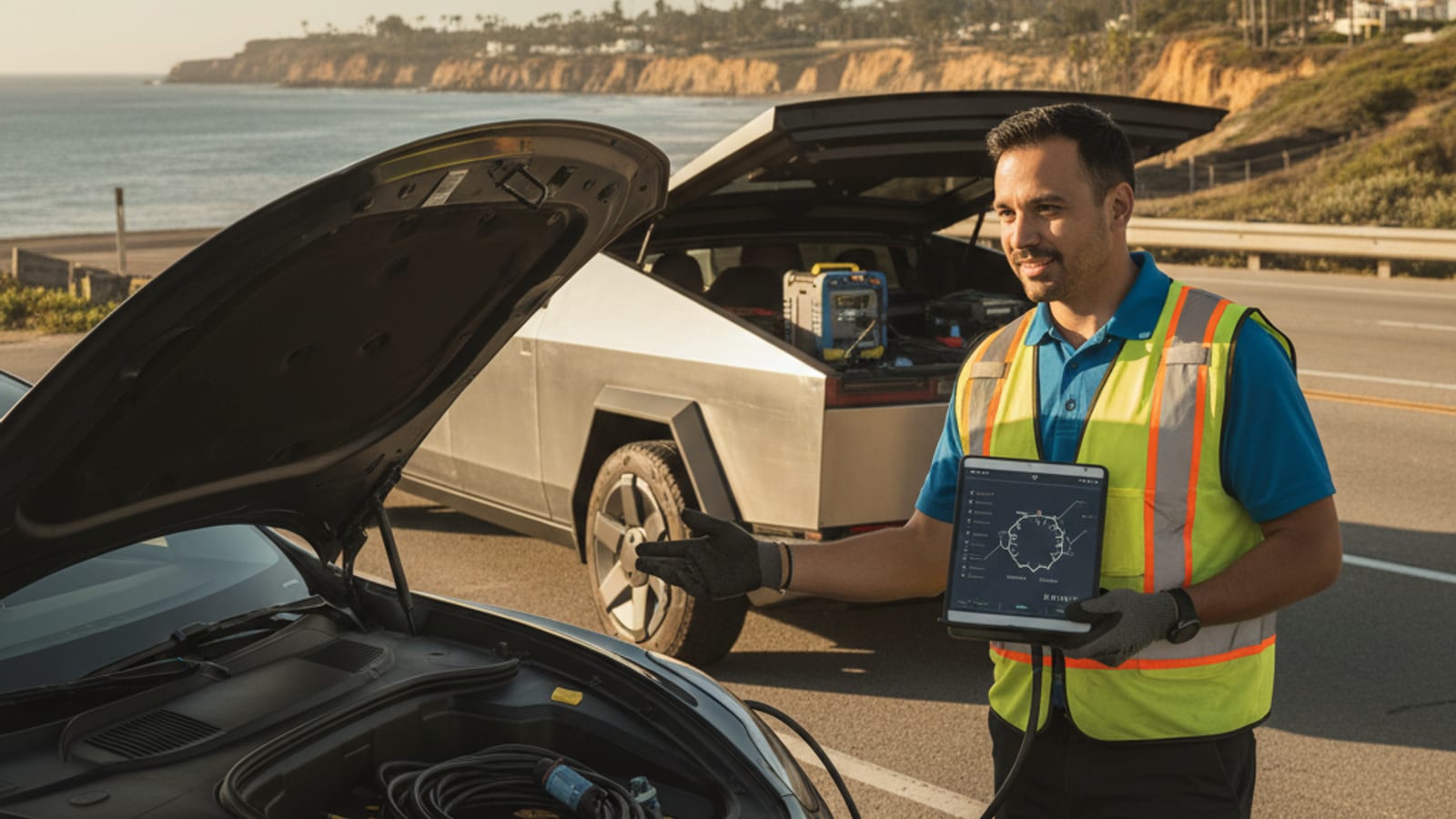
If the car won’t wake, the first move is often a 12-volt jump or on-site replacement. The signs an EV 12-volt is going are worth learning before you strand. Charge Pro IE doesn’t do that work. We connect you with independent operators who do.
The traction pack: limits, cooling, and updates
The high-voltage pack is the expensive piece. Day-to-day care is how you charge and how hot the cabin sits.
Many makers want daily charging below a full 100 percent. Use the charge-limit control in the car. Read the model-specific note in the manual. A trip toward Yucaipa may need a higher limit that morning. So can a run up I-10 through Beaumont and Banning, or over Cajon. That’s a trip setting. It isn’t how the car should live every night.
Cooling loops work harder on inland afternoons. Park in shade when you have it. If the car can precondition while plugged in, use that before you leave. We couldn’t confirm a published local temperature cutoff. We also couldn’t confirm a fixed summer range-loss percent. Treat heat as a reason to believe the mile estimate less, especially before a grade. How to care for an EV battery in Inland Empire heat goes deeper on pack habits.
Keep software current. Battery logic on many models arrives over the air. A skipped update is skipped maintenance.
Tires take the grades and the weight
EV tires work harder than gas-car tires. Instant torque plus a heavy pack loads the tread. Regular rotation belongs on the interval in your manual. Check pressure when the weather swings. Look at inner shoulders after a lot of I-10, SR-60, or I-215 miles.
Alignment matters on a heavy vehicle. A warehouse curb or a broken mountain patch can knock it off. Uneven wear is a warning. Cabin filters clog with inland dust too. High Desert wind and dry lots push grit into the HVAC. Change that filter on the book’s calendar, or when airflow smells like dust.
Brakes and the other fluids
Regen saves the pads. It doesn’t cancel inspections. Calipers can stick when a car sits in a Menifee garage or a Corona driveway. Brake fluid still absorbs moisture. Makers put that flush on a time interval. Follow the book even if the pads look thick.
Battery and electronics loops use coolant. Some packs are sealed. Some aren’t. Your manual says which. Washer fluid still matters. The air conditioner still uses refrigerant. None of these are weekly guesses. They’re shop checklist lines.
The port you touch every night
Look at the charge port. Dust and grit collect there. Heat works the seals. Seat the connector until it latches. If a cable won’t release, stop pulling. Forcing the latch is how a simple plug becomes a tow.
A plugged-in night that added no energy is a maintenance miss. Check the app, the breaker, and the utility outage map before you blame the pack.
Home charging belongs on the same calendar
A schedule that ignores the wall is incomplete here. San Bernardino County has 43.8 percent of housing built before 1980, ACS 2019-2023. Riverside County is 30.2 percent on that same vintage. Inside San Bernardino city the pre-1980 share is 60.9 percent. Ontario is 50.7 percent. The city of Riverside is 56.4 percent. Montclair is 68.5 percent. Bloomington is 62.5 percent. Norco is 68.8 percent. Crestline is 77.7 percent.
Newer cities look different. Eastvale is 2.2 percent pre-1980. Temecula is 6.5 percent. French Valley is 2.3 percent. Murrieta is 6.2 percent. Perris is 12.4 percent. Lake Elsinore is 13.6 percent. Victorville is 19.6 percent. Fontana is 28.9 percent.
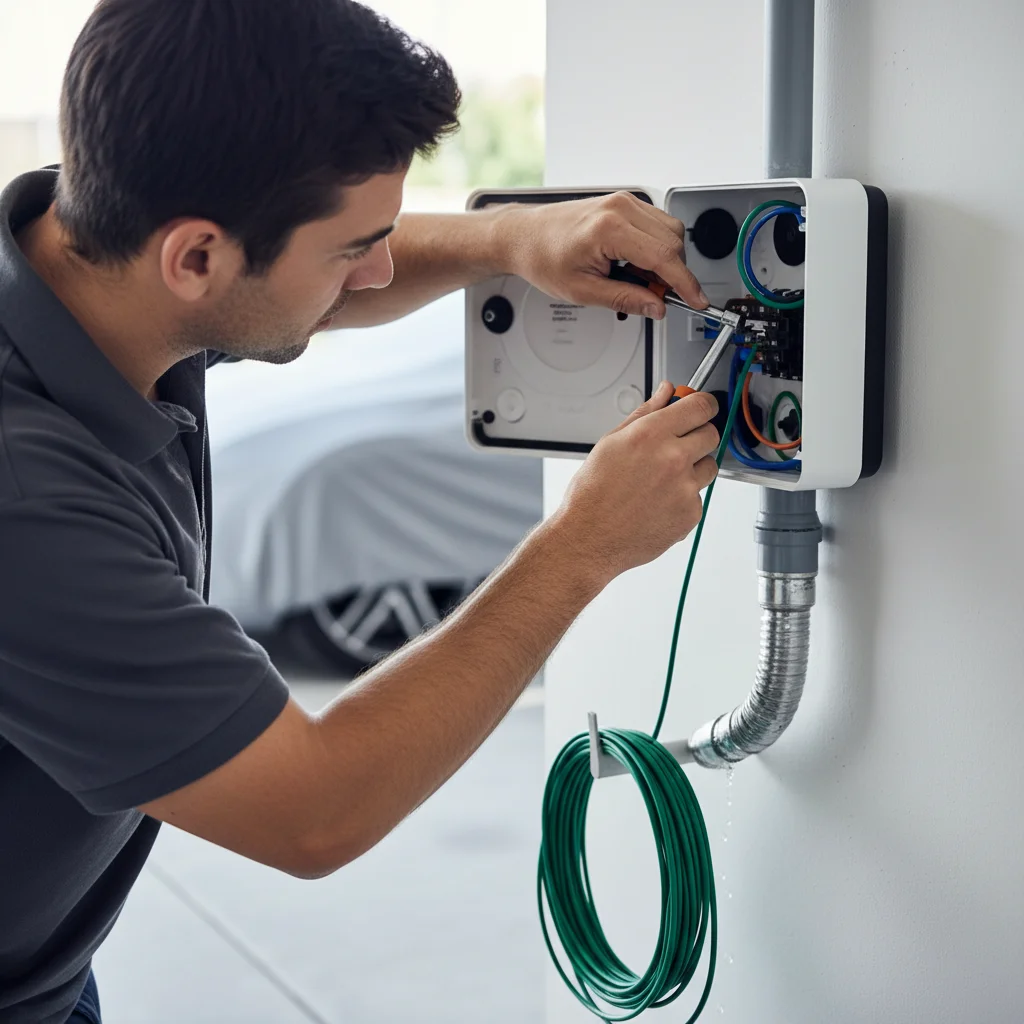
Older panels trip. Overnight charging fails. You wake with less pack than you planned, then you still have to climb. That’s why older Inland Empire panels and EV chargers belong next to the tire rotation, not in a separate life.
The electric bill isn’t one company. Southern California Edison serves a large share of the market. That list includes Fontana, Ontario, Chino, Chino Hills, and Upland. It also includes Corona, Norco, Eastvale, and Jurupa Valley, plus most pass and desert towns on SCE’s served-cities list. Riverside Public Utilities serves the city of Riverside and has done so since 1895. The City of Colton Electric Utility owns the electric system inside Colton. Banning runs its own electric utility. Bear Valley Electric Service covers the Big Bear communities named above.
Two cities are split. Rancho Cucamonga is SCE plus Rancho Cucamonga Municipal Utility in a southeast pocket. RCMU says it covers over 3,900 metered businesses and residents. Named areas include Victoria Gardens, The Enclave, Day Creek Square, and The Resort. Moreno Valley is SCE plus Moreno Valley Utility. MVU says it has over 6,500 customers. It has served newer development since 2004. San Jacinto Power is a community choice aggregator on SCE’s wires. Apple Valley Choice Energy procures while SCE delivers. Victorville homes are on SCE. Victorville Municipal Utility Services serves the Southern California Logistics Airport and Foxborough Industrial Park. It states it doesn’t provide residential utility service at this time.
SCE publishes a residential EV plan named TOU-D-PRIME. Riverside Public Utilities publishes an Electric Vehicle Rate. Those pages change. Confirm the current plan with the utility that actually meters your house. We’re not publishing dollar figures. The maintenance point is when the car charges. Overnight charging is how most owners keep enough pack for grades.
A watch list, not a fake factory schedule
We’re not going to invent mile numbers your maker didn’t put in the book. Use this as the Inland Empire overlay.
Between shop visits
Watch 12-volt clues: slow screens, weak locks, odd low-voltage alerts. Glance at tire wear and pressure. Keep the port clean. Confirm the car actually added energy after a plugged-in night. Before Cajon, look at estimated miles with heat and speed in mind. Do the same before the I-10 pass, the Ortega near Wildomar, or a mountain run. The dashboard number is an estimate.
When the car is already in for service
Tire rotation and a brake look. Coolant and brake-fluid levels. Cabin filter. A 12-volt load test. Wipers when they smear. Steering and suspension wear on a heavy EV, especially after rough lots or mountain pavement.
When the manual calls a long interval
Brake fluid on the time line. Battery coolant if your loop isn’t sealed. Drive-unit fluid if your model lists it. A high-voltage health readout if Tesla Service or the dealer can run one. The key-fob battery when the fob gets flaky.
Tesla publishes maintenance notes on its support site. Rivian, Ford, Hyundai, Chevrolet, and the rest put the real schedule in the owner’s PDF. EV maintenance by brand is the companion for those differences. Follow the maker. That’s how warranty terms stay intact. We’re not quoting warranty years or mile caps. Those belong in your booklet.
When care didn’t prevent a stall
A tight schedule reduces surprises. It doesn’t erase an empty pack on I-10 in Colton. It doesn’t erase a 12-volt that died after a long sit in Redlands. It doesn’t erase a car that won’t wake in a Temecula driveway. Charge Pro IE is a referral line for the Inland Empire. We match stranded drivers with independent local mobile rescue operators. We hold no trucks, no yard, and no technician roster. We set no prices.
The operators we send bring a 240-volt Level 2 source to the car. They use a native NACS plug, plus a CCS or J1772 adapter for non-Tesla EVs. A typical hookup adds 10 to 20 miles of range in 15 to 30 minutes of charging. That’s charging time, never an arrival time. They can jump or replace a dead 12-volt on site. They handle Tesla and every major EV brand. The operator quotes you before starting and bills you directly.
If you’re already stuck, mobile EV charging is the call. For charging context by city, start at EV charging in the Inland Empire.
If you want a person on the phone, call (909) 250-2881. We match you with a local operator. We don’t promise when that operator arrives.