Pass winds and the I-10 climb take range you didn’t budget. High Desert heat does the same after the Cajon grade. Electric vehicle battery maintenance in the Inland Empire starts there. Your maker’s manual still sets the pack rules. A Riverside driveway and a Victorville driveway are not the same afternoon. Care means charge limits, heat, grade, and which battery actually failed.
Valley heat, High Desert heat, and mountain grades
The Inland Empire is not one climate at all. Ontario, Fontana, San Bernardino, and Colton sit in a hot inland basin. Eastvale, Menifee, and Temecula add long suburban loops in that same heat. Cross I-15 at the Cajon and the day changes. Victorville, Hesperia, Apple Valley, and Adelanto sit on the High Desert side. Those towns have open miles and little shade.
The climb toward Lake Arrowhead or Crestline is a long grade, then a descent. Highland sits at the foot of that climb. Yucaipa is another grade before the hills. Big Bear Lake and Big Bear City sit higher still. Their power company is Bear Valley Electric Service, not Southern California Edison. That utility also names Sugarloaf, Moonridge, Fawnskin, and Boulder Bay. We have no verified temperature for any of those places. We also have no verified range-loss number for your pack. Heat, cabin cooling, and climbing still appear in maker battery notes. A High Desert summer car should be checked against those notes more often. So should a car that regularly climbs I-10 toward Beaumont and Banning.
The I-10 climb and pass winds
I-10 through Colton and Redlands is already a working grade. Past Beaumont, Banning, and Cabazon, the pass winds pick up. I-15 through the Cajon toward Victorville is the same kind of day. The car works harder, and climate control runs longer. The pack’s cooling runs with it on those miles. We can’t publish a verified mile cost for your model. Leave with more buffer than a flat map suggests.
I-215 through Moreno Valley and Perris adds stop-and-go heat. SR-60 through Jurupa Valley and the 91 through Corona add the same. Check a current charging map before you go. Confirm the stall is listed and your connector matches. That’s not a claim that any corridor lacks charging. It’s a claim that you should look first.
See Tesla range through Inland Empire heat and grades. Cajon stalls are covered in out of charge on I-15 at the Cajon. City-by-city context lives on the Inland Empire charging hub.
Your maker still sets the charge limits
Tesla, Rivian, Ford, Hyundai, Chevrolet, and Kia each publish pack guidance. Charge caps, software updates, and service timing live in those documents. They differ by model and by battery chemistry. They also change when a maker revises the app.
No verified source gives one degradation rate for every Inland Empire EV. A page that assigns a percentage to heat, wind, or grade is guessing. Your owner’s manual and the manufacturer’s app are written for your vehicle. Use those first, before a blog post.
Keep tires, cabin filters, and brakes on their own calendar. Valley heat and mountain descents still wear those items. This article stays on the traction battery itself. It also covers what to do when the car won’t wake.
Overnight charging is pack care, and Edison isn’t the only utility
Most Inland Empire homes sit on Southern California Edison, but not all. Riverside is Riverside Public Utilities, serving the city since 1895. Colton owns the electrical infrastructure inside city limits. Banning has its own city electric utility. Big Bear Lake and Big Bear City stay on Bear Valley Electric Service.
Rancho Cucamonga is split, and SCE covers most of the city. Rancho Cucamonga Municipal Utility covers a southeast pocket. That pocket has over 3,900 metered businesses and residents. It includes The Enclave, Day Creek Square, The Resort, and the Victoria Gardens area. Moreno Valley is split between SCE and Moreno Valley Utility. MVU has served newer development since 2004, with over 6,500 customers. San Jacinto takes delivery from SCE, and San Jacinto Power supplies generation. Apple Valley takes delivery from SCE, and Apple Valley Choice Energy procures the power. Victorville homes take power from SCE at this time. Victorville Municipal Utility Services serves the Southern California Logistics Airport and Foxborough Industrial Park only. It doesn’t serve residential areas at this time.
Those splits change when you plug in at home, not the pack chemistry. SCE publishes a residential EV time-of-use plan named TOU-D-PRIME. Riverside Public Utilities publishes its own electric vehicle rate. Confirm the current plan with the utility that bills you. Rates and programs change, and we aren’t quoting a price here.
The house can limit overnight charging more than the pack can. ACS 2019-2023 figures put pre-1980 housing at 43.8% in San Bernardino County. Riverside County sits at 30.2% on the same vintage. San Bernardino is 60.9% pre-1980, and Ontario is 50.7%. Redlands is 60.4%, and Upland is 55.9%. Temecula is 6.5%, and Eastvale is 2.2%. An older panel is a house problem, not a pack-chemistry problem. If the wall charger keeps tripping, start with older Inland Empire panels and EV chargers.
Two batteries fail in two different ways
People say “the battery” and mean two different parts.
The traction pack moves the car and shows as range on the dash. As it empties, the car still wakes and the screen still lights. Doors still lock, and the miles still tick down. Then the car won’t roll under its own power.
The 12V battery is the small auxiliary one. It runs locks, the screen, and the computer that wakes the high-voltage system. When that 12V is dead, the car can look fully dead. Locks, the screen, and start all stay dark.
A low pack on I-10 or I-15 is a charge problem. A silent car in a driveway is often the 12V. A silent car in an Ontario warehouse row is often the 12V too. A jump on site may never touch the main pack. If the car won’t wake, start with the 12V. That’s the likely cause when range looked fine when you parked.
Empty pack, dead 12V, or a shop visit
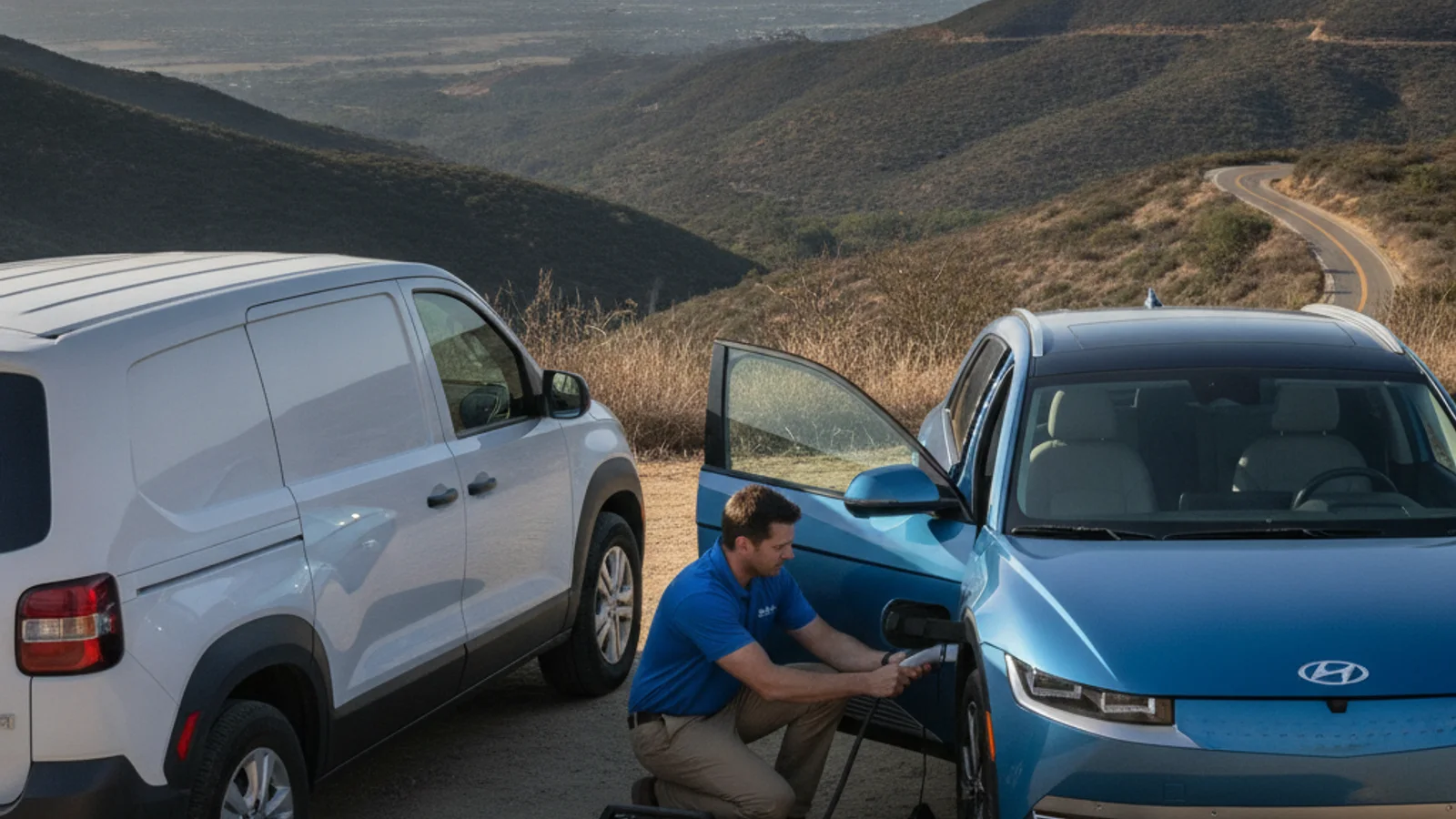
If the traction pack is empty and you can wait safely, request out-of-charge recovery. Charge Pro IE is a referral line only. It matches stranded EV drivers with independent local mobile rescue operators. It owns no trucks and employs no technicians. The operators we connect you with bring a 240V Level 2 source to the car. They use a native NACS plug on Teslas. Non-Tesla EVs get a CCS or J1772 adapter. A visit typically adds 10 to 20 miles of range. That’s 15 to 30 minutes of charging, never an arrival time. The operator quotes you before starting, and bills you directly. On scene, the operator decides the next move. That may be enough charge to reach a compatible charger. It may be a tow instead of more charging.
If the 12V is the issue, ask for a jump on site. EV roadside assistance is the page for that stop. It also covers other on-the-spot EV problems away from home.
If the car charges, drives, and wakes, skip the roadside call. A long-term health readout belongs at a service center. State of health and warranty questions belong with the maker or an authorized shop. A roadside operator’s job is to get you moving, not pack-life diagnostics.
If you’re already watching the miles fall, follow what to do before you strand.
If you’re already on the shoulder
An empty pack anywhere in the Inland Empire is a roadside call. So is a car that won’t wake at all. Call (909) 250-2881 and we’ll connect you with a local EV rescue operator.