You get back to a Model Y after a Fontana warehouse shift. The handles stay flush and the app never connects. The car isn’t necessarily out of pack charge. A dead 12-volt battery has locked you out, and this sequence is how you get back in.
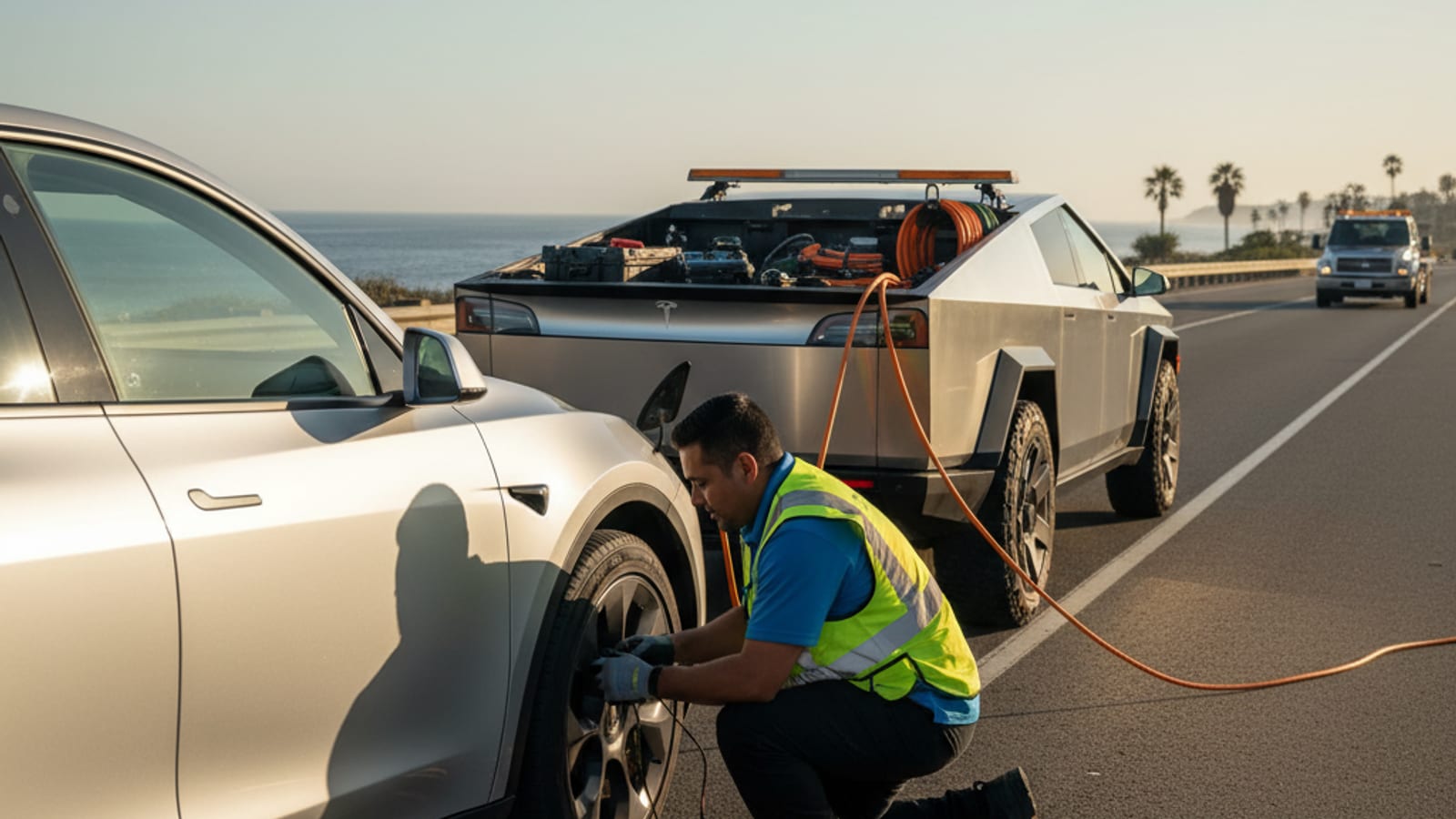
That stall is familiar around Ontario’s airport lots, and on overnight streets in San Bernardino. It happens after a long day in a Cabazon lot. The Tesla looks fully dead, but the pack often still holds range.
The 12-volt battery is what actually holds the doors
Every Tesla still has a 12-volt battery. It wakes the computers, latches, lights, and your phone link. The large pack turns the wheels. It doesn’t directly run those small systems. Tesla’s manuals describe that split. For the layout by model, read Do Teslas have a 12V battery? A model-by-model guide.
When the small battery dies, the car stops listening. Your key card does nothing against the pillar. Handles never present and the app stays blank. You can have miles in the pack and still stand outside. That’s a lockout, not an empty tank.
If you’re unsure which battery failed, start with Dead Tesla: how to tell 12V failure from a dead pack. A dark cabin and a silent app usually mean 12-volt. A car that wakes, then shows zero miles, is a pack problem. Treat those as two different rescues.
Inland heat, warehouse shifts, and a battery that sits in the sun
Parking lots in Ontario, Fontana, and Moreno Valley bake through inland afternoons. A 12-volt battery in that sun has a harder life than one in a garage. Tesla doesn’t publish a failure rate by county. We won’t invent one. Heat still belongs on your checklist. How to care for an EV battery in Inland Empire heat is written around the pack. The small battery lives in the same weather.
Sentry Mode and cabin-overheat protection draw on the 12-volt while they run. A car left watching a warehouse aisle all shift can drain it. Your last app snapshot may still look fine until the handles never move. Highland driveways at the foot of the climb see the same pattern after a hot sit.
Catch the warnings early when you can. Tesla 12V battery failure: when it hits and what to do lists the clues before a full lockout. A low-voltage alert in Rancho Cucamonga is easier than a dark lot in Rialto.
Stay out of the travel lane before you pop a cover
If you’re on the I-15 Cajon climb toward Victorville, stay put. Don’t kneel on that shoulder to pry a bumper cover. The same rule holds on I-10 through Colton and Redlands. It holds on I-215 through Moreno Valley and Perris. It holds on SR-91 in Corona and SR-60 in Jurupa Valley. Opening jump posts next to freeway traffic is a crash risk, so call an operator first.
A quiet driveway, a warehouse stall, or a neighborhood street is different. You have space to work, and you still follow Tesla’s steps for your year. Reverse polarity can damage the low-voltage system. If you don’t have a jump pack, don’t borrow mystery cables from a stranger’s trunk. On the Ortega near Wildomar, treat it as a shoulder job too.
Power the frunk first. The doors come second.
Your first job isn’t a full swap. You only need enough 12-volt power to release the frunk. Tesla support and your owner’s manual show the exact points. Use those diagrams, and skip a random video that may be the wrong year.
Model 3 and Model Y
These cars don’t hide a mechanical door key in the fob. You apply 12-volt power at the front jump posts. Those posts sit behind the tow-eye cover on the front bumper. Tesla marks positive and negative, so connect matching sides. Hold the connection until the frunk latch clicks, then disconnect. Don’t keep feeding power after the lid is free.
Model S and Model X
These models still hide a small mechanical key in the fob. On many years that key opens the driver’s door. Once you’re in, you can work from a safer spot. Newer S and X cars also have 12-volt jump points near the nose. Older years may use a manual frunk cable. It might sit in the wheel well or under the bumper. The spot changes by year, so check Tesla’s page for your car before you pry anything.
You need a portable 12-volt jump pack or another car with jumper cables. If you carry neither, stop there. An Inland Empire operator can jump or replace the 12-volt on site.
Jump the battery in the frunk, then see if it holds
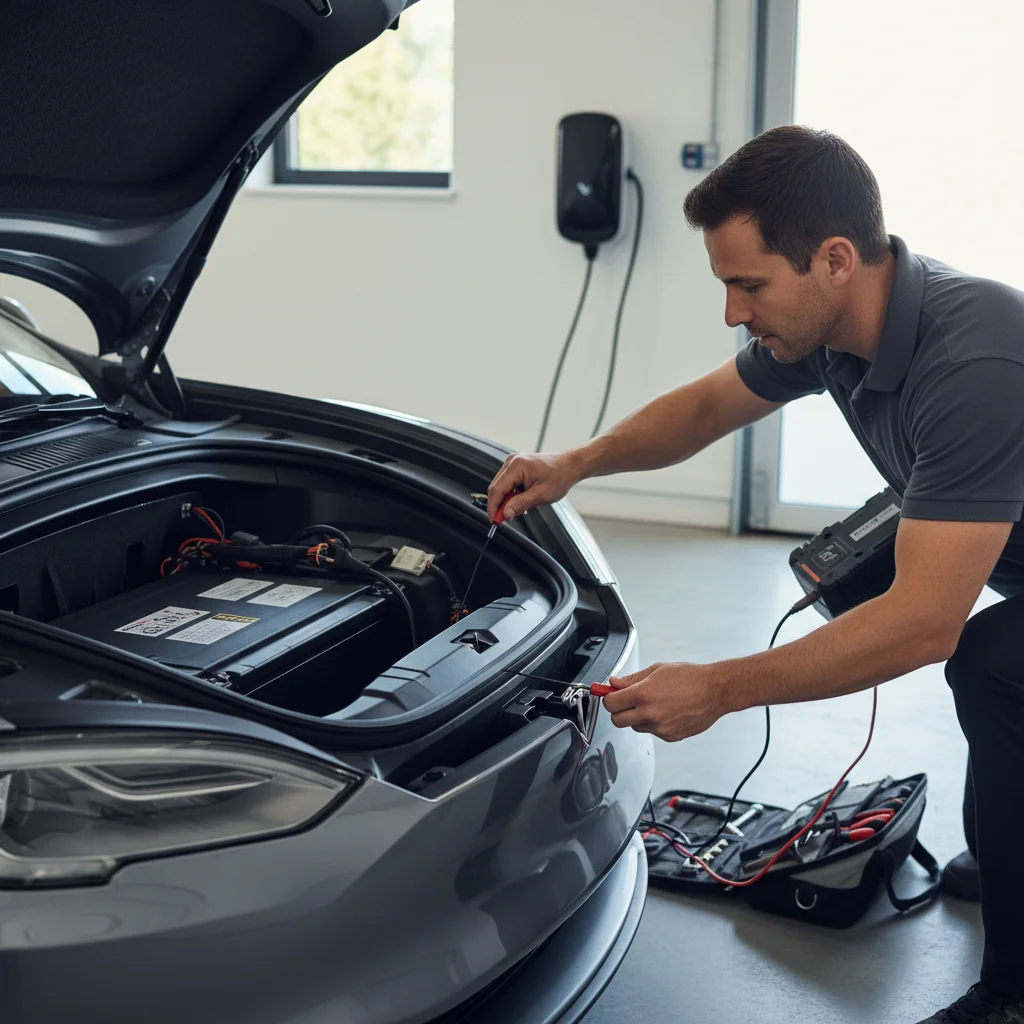
The 12-volt unit sits under a cover in the frunk. It looks like a small car battery. Lift the cover, then move the clamps from the bumper posts to the battery itself. Match polarity again and give it a few minutes. Handles should present, or the key card should wake the latches.
If the car wakes and dies again, that battery isn’t holding a charge. A jump is a bridge, not a repair, so plan on a replacement. Independent operators in this network can jump or swap it on site. They quote you before they start, and they bill you directly. Charge Pro IE doesn’t do that work. We match you with the pro. Start with the Tesla 12-volt jump on site path when you need that match.
For clamp order on every current Tesla, use How to jump a Tesla Model 3, Y, S, or X the safe way. Stay with Tesla’s polarity marks.
Once you’re inside, read the pack before you drive
When the doors work, look at the screen. If the high-voltage pack has range, the car should drive. That’s the usual ending. You go home, then replace the small battery before it locks you out again.
If the screen shows the pack is empty, a 12-volt jump won’t move you. The big battery still needs energy. Operators we connect you with bring a 240-volt Level 2 source to the car. Teslas get a native NACS plug. Other EVs use a CCS or J1772 adapter. Typical charging time adds 10 to 20 miles in 15 to 30 minutes. That’s plug time, not an arrival time.
Towing a Tesla with no power is a different job. The car has to sit in the right transport mode. Say so if a jump won’t be enough. Don’t start with a hook by default. Use a tow if the pack and the 12-volt are both gone. Use a tow if the car can’t be made safe.
A Tesla that sat all afternoon near Pechanga can fail the same way. So can one that cooled on a Beaumont street before the I-10 climb. The sequence doesn’t change with the city.
Call a local operator when DIY stops being safe
Call if you’re on a freeway shoulder. Call if you have no jump pack. Call if the frunk never releases. Call if a jump dies again in the same hour. Call if the pack is empty too.
Operators in this network handle Tesla and every major EV brand. They can jump a 12-volt. They can replace it on site. They can add that short Level 2 charge. They set the price. Charge Pro IE only makes the match. We don’t own trucks, and we don’t send technicians of our own.
You’ll see this lockout around Ontario airport lots and Fontana warehouse rows. EV rescue around Ontario airport lots and warehouse rows is the local version of that stall. It also shows up after a Lake Arrowhead day. The car sits in heat, then it won’t wake for the drive down. Same sequence every time. Confirm it’s 12-volt, get the frunk open, and jump or replace. Charge the pack only if it’s actually empty.
If you need that match, call (909) 250-2881. Tell the operator your city, the model, and whether the app is totally dark. Stay out of the travel lanes while they quote the job.