A daily Tesla charge here lasts as far as the remaining estimate. Slow miles on the 91 eat into that number. So does the Cajon climb toward Victorville. Plan from the car, not from a brochure.
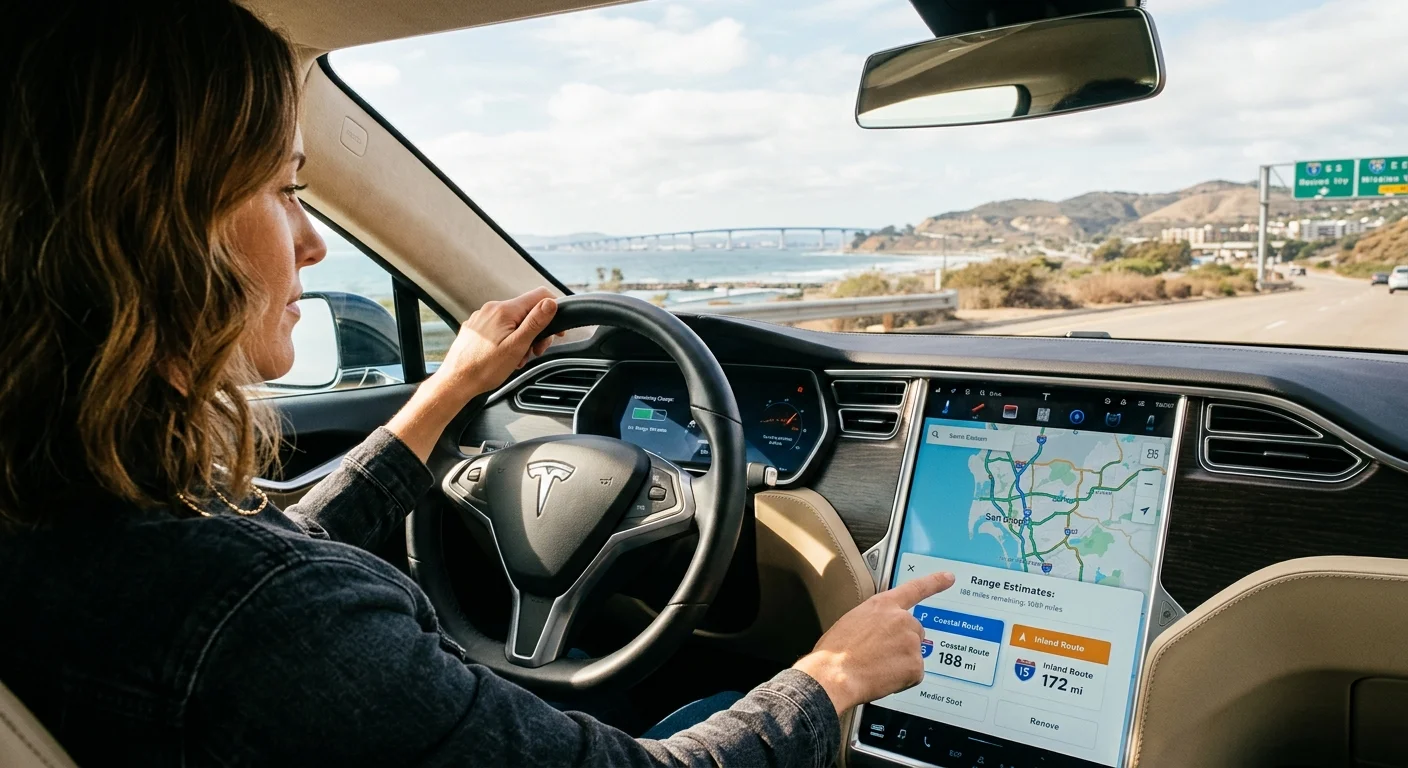
Two searches live in one phrase
Searchers ask how long a Tesla battery lasts in a day. They often mix two questions. One is today’s remaining drive. The other is pack life over years of ownership.
Your model sets part of the answer. So does the percent on the display. So do the miles still ahead. A factory range figure doesn’t.
Pack lifespan over ownership is a different question. Our guide to how long Tesla batteries actually last in 2026 covers that meaning. One low-charge afternoon doesn’t mean the pack is failing. A healthy pack also doesn’t guarantee tonight’s trip home.
Open Tesla’s current documentation for that exact model and configuration. Don’t copy another owner’s screenshot.
What a local Tesla day actually looks like
An Inland Empire day isn’t one kind of drive. A Fontana warehouse shift is one energy problem. A Corona commute on the 91 is another. A hop over Cajon into the High Desert is a third.
Start with the full loop, not the farthest pin. Count outbound miles, errands, and the return. Then count the last stretch to wherever you’ll plug in. Street parking after a long day is one plan. A driveway with a 240-volt hookup is another.
Riverside Public Utilities serves the city of Riverside. Southern California Edison serves most of the rest of the valley. Colton and Banning each run a city electric utility. Bear Valley Electric Service covers Big Bear Lake and Big Bear City. Moreno Valley is split between SCE and Moreno Valley Utility. Rancho Cucamonga is split between SCE and Rancho Cucamonga Municipal Utility. Your overnight refill depends on which of those serves the meter. Confirm the current rate with your utility. Don’t treat a published number as yours until you do. Charge Pro IE doesn’t set home rates. No verified daily charging cost belongs on this page.
Housing age varies hard across this market. Eastvale’s ACS 2019-2023 figures put pre-1980 housing at 2.2%. San Bernardino city’s share is 60.9%. That doesn’t tell you your pack’s morning percent. Don’t copy a neighbor’s charging routine from a newer tract. An older street can start the day differently.
Read the screen before you leave
Write down the model, the percent, and the estimated miles. Recheck when you add a stop. Recheck when you leave a lot after hours of cabin climate. Treat that estimate as a planning input, not a promise. A review, a forum post, or a different wheel package can describe another Tesla.
Match the estimate to the whole day. A commute that ends at a known plug is one kind of day. A drive that ends in a work lot without an overnight cord is another. Confirm connector type with the site operator. Confirm access before you count on that stall.
Put the next charger in the car’s navigation if you’re already close on miles. Let the Tesla recompute from the real destination, not from a guess. If the trip planner warns you, believe it. Change the day while you still can.
There’s no verified miles-per-hour figure here for Level 1 or Level 2 charging. Don’t plan today’s drive from a generic speed chart. Plan it from the remaining estimate and a charger you can actually reach.
If the number already looks tight, change the plan while you still have options. Add a stop you can reach, or cut a later errand. Use another ride for the extra miles.
The 91 idle and the Cajon climb
This is the local part a generic Tesla range page misses.
SR-91 through Corona can sit still in both directions. Cabin cooling, creeping, and stop-and-go all draw from the same pack. Your displayed miles will move, so watch them. This page can’t publish a verified idle penalty for the 91. No verified idle-mile figure turned up in the research for this page. If the remaining estimate no longer covers the next exit, change the plan. Include a charger you can still reach. Our note on running out of charge on the 91 walks through that shoulder decision.
The Cajon climb on I-15 toward Victorville and Hesperia is a different drain. Grade, speed, and heat stack on the same battery. No verified mile-cost for that climb turned up for this page. Don’t subtract a round number you saw online. Watch the estimate as you climb. If it won’t cover the remaining corridor plus a reachable plug, stop adding destinations. Out of charge on I-15 at the Cajon climb is the backup read for that stretch.
I-10 through Colton, Redlands, and the Beaumont grade follows the same logic. So does I-215 through Moreno Valley and Perris. So does a mountain day toward Lake Arrowhead or Big Bear. The downhill return is its own energy question. In each case the car is the meter. Geography tells you where to watch. It doesn’t tell you how many miles to subtract.
A driver looping Ontario and Rancho Cucamonga on surface streets lives one kind of day. A driver clearing Cajon lives another.
South county has its own version. Temecula and Murrieta add longer rural stretches. The Ortega near Wildomar is a grade, not a flat errand. Watch the estimate there the same way.
Heat, hills, and the miles you still have left
Inland Empire heat and long grades change what a full day feels like. They don’t come with a published, verified percent-off figure here. How to care for an EV battery in Inland Empire heat stays on care. It doesn’t invent range math.
Keep climate use honest in the cabin. Recheck the estimate after a long sit in a lot. Warehouse rows around Ontario and Fontana let a car cook. So do airport lots and a day parked at a destination. The pack you left with isn’t always the pack you return to.
Don’t assign a fixed weather or traffic haircut. Tesla’s documentation for your model is the place for official guidance. Your display is the place for today’s decision.
If the remaining estimate no longer covers the route
Act while a reachable charger is still in range. Stop stacking extra stops. Pick a compatible stall the car can still reach. Confirm that stall is online with the network that runs it. Then drive there without adding a side trip.
Getting near the right freeway exit isn’t the same as reaching the plug. Count the last surface streets and the lot entrance.
If you’re already very low, note the road, direction, nearest exit, and a landmark. Share that with whoever you call. Don’t stop in a live lane just to make the description easier.
Follow what to do when an EV is running low for this stage. Don’t keep rolling toward a charger you can no longer reach.
A Tesla that won’t wake can be a 12-volt problem, not an empty pack. Share the exact screen, lights, and warnings. Don’t guess from one symptom.
Charging, a mobile visit, or a tow
If usable charge remains, ordinary charging can be the simplest next step. The stall still has to be reachable and compatible. Confirm the stall, then watch the estimate on the way.
If you can’t reach a stall, ask about a mobile Level 2 visit. The operator needs your exact spot. Independent operators we connect you with bring a 240-volt source to the car. Tesla uses a native NACS plug. CCS or J1772 adapters cover non-Tesla EVs. A typical visit adds about 10 to 20 miles of range. That takes 15 to 30 minutes of charging. That’s charging time, never an arrival time. The operator quotes before work starts and bills you directly. Out-of-charge recovery explains the referral. It isn’t a promise that a truck is around the corner.
Transport may fit when charging at your pin isn’t possible or safe. It can also be the call when something besides state of charge is wrong. Let the operator describe the options. Don’t try electrical or tow work yourself.
Charge Pro IE is a referral line. It doesn’t hold a contractor license, own trucks, or perform the work. The pros we connect you with are licensed and insured. You pay the operator. Ask the operator for the service and the price. Get payment terms and any warranty before you authorize the visit.
Tesla roadside rescue is the Tesla-specific referral page if you want that path.
When to call
Call when the remaining estimate no longer supports a safe drive to a reachable charger. Call when you need an operator to sort charging versus a tow. Call Charge Pro IE at (909) 250-2881. We’ll connect you with a local EV rescue operator.