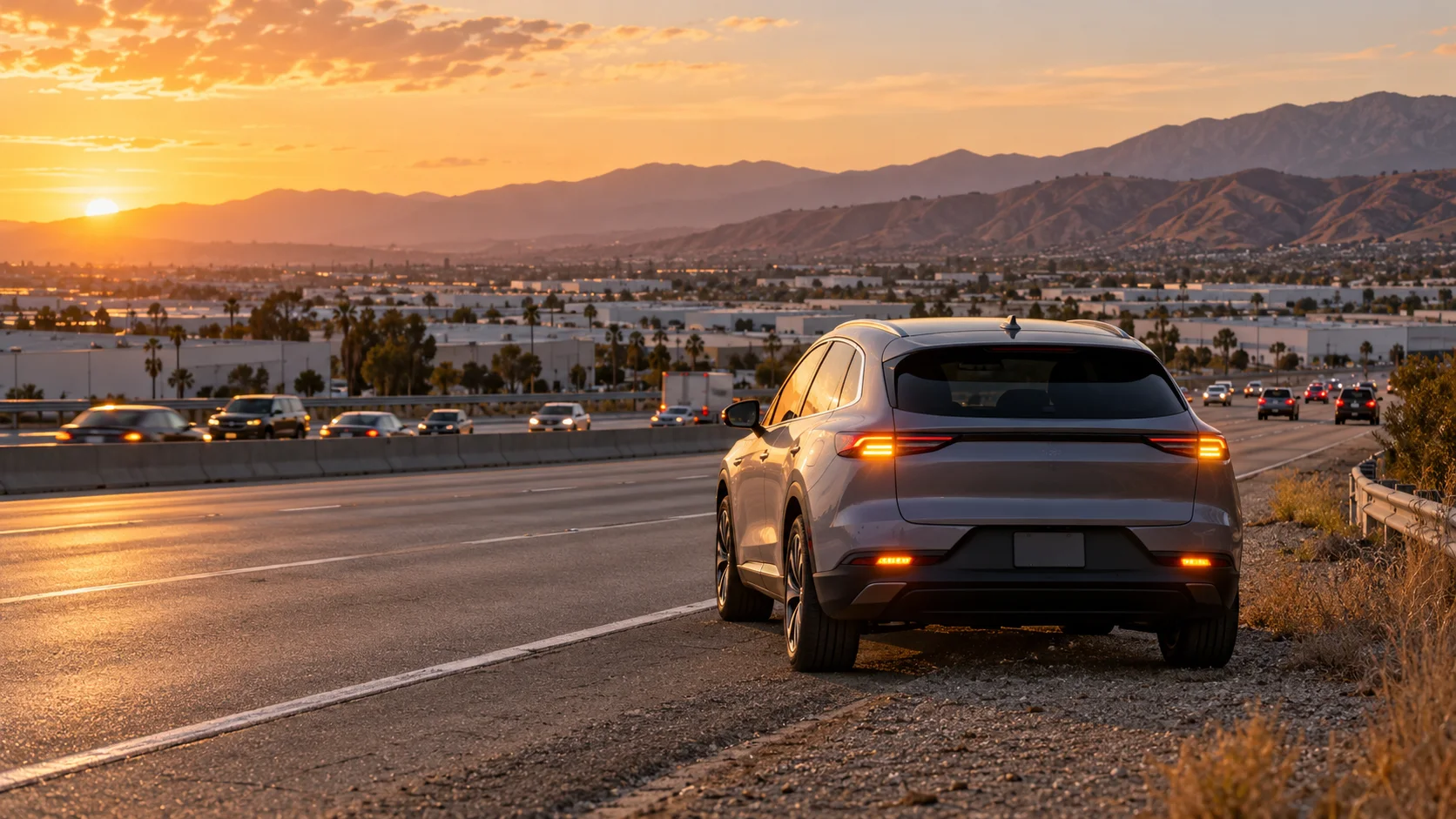
Running out of charge on SR-210 in Fontana is a freeway problem before it is a charging problem. Get out of a travel lane if the car can still move, turn on the hazards, and describe your location precisely. Once the car is in the safest available position, decide whether freeway assistance, a mobile charge, or a tow fits the condition of the vehicle.
SR-210 is its own Fontana call
Do not describe this stop as “near the 10” or “by the 15” unless that is truly where your pin lands. SR-210 crosses the northern side of Fontana and meets I-15, but those roads create different approaches. Direction of travel, the last exit, and whether you are east or west of the interchange are more useful than a city name alone.
The Fontana stretch also serves industrial and warehouse travel. A driver leaving a long shift may begin the trip with less range than expected. That is a different situation from a car that stopped after the Cajon climb or on I-10 through Colton. For the industrial-lot version of the problem, see mobile EV charging in Fontana warehouse lots. For neighborhood and surface-street calls, use EV roadside assistance in Fontana.
Fontana had 214,169 residents in the 2019–2023 American Community Survey. That scale helps explain why “Fontana” is not a complete location. It does not tell an operator which side of SR-210 you are on. Share the map pin and then say the road, direction, and nearest named exit aloud.
What to do while the car can still move
If the low-range warning appears before the car loses propulsion, take the next safe exit only when the vehicle shows enough remaining range to reach it. Do not cross lanes aggressively to chase a charger. A legal parking area off the freeway gives you more options than a narrow shoulder, but an uncertain last-mile gamble can leave the car in a ramp lane.
If the vehicle has already stopped, switch on the hazards. Keep passengers away from moving traffic. Do not stand between the car and a live lane, and do not walk along the freeway looking for a plug.
San Bernardino County’s Freeway Service Patrol includes SR-210 among its published patrol corridors. Its published role includes helping motorists and, when a vehicle cannot be fixed quickly, moving it to a location designated by the California Highway Patrol. The agency pages do not list on-site EV charging as an FSP service. Freeway help may improve safety or move the car, but do not assume it will add energy to the traction pack.
The California Highway Patrol FSP page says motorists can seek FSP help through 511 or a freeway call box. Call 911 if the vehicle is stopped in a live traffic lane or anyone is in immediate danger.
Check the simple things before requesting a charge
An EV that appears dead does not always have an empty traction pack. Look at what happened immediately before the stop.
- If the car stayed awake and the range estimate fell to zero, the traction pack is the likely reason you cannot continue.
- If the screens, locks, and normal controls went dark while the car still showed driving range, report a possible low-voltage battery problem.
- If the car shows a collision warning, high-voltage fault, smoke, unusual heat, or visible damage, move away from it and use emergency or towing guidance instead of trying to charge it.
Do not experiment with unfamiliar jump points on a freeway shoulder. Give the year, make, and model when you request help so the independent operator can determine whether the call is for pack energy or a low-voltage issue.
A public plug only helps if the car can reach it
Charger maps are useful before the pack reaches zero. Check the vehicle navigation, the network’s app, and a current map such as PlugShare before leaving a safe location. A map pin is not proof that a stall is open, compatible, or working at the moment you need it.
Once the car cannot move, a nearby station is no longer the immediate answer. You need either energy brought to the vehicle or a tow to a confirmed destination. That distinction is the point of out-of-charge recovery.
A mobile Level 2 rescue charge is intended to provide a limited driving buffer, not a full refill. The verified typical range is about 10 to 20 miles added during 15 to 30 minutes of charging. That is cable time only, not an arrival estimate. Use the recovered range to leave the freeway and reach a charger you have confirmed, not to restart a long trip with no plan.
Mobile charge or tow on this stretch
A mobile charge can fit when the car is otherwise healthy, safely positioned, and able to accept power. A tow is the better route when the vehicle is damaged, will not accept charge, has a serious fault, or sits where roadside charging cannot be done safely.
The independent professional makes the on-scene service decision and quotes the work. Charge Pro IE is a referral service. It matches drivers with licensed independent local EV charging professionals, but it does not perform the work, own a truck, set prices, or promise an arrival time. The customer contracts with and pays the professional directly. The mobile EV charging service page explains that referral path.
This is not the same task as a dead EV on I-10. If your pin is south of SR-210 and closer to Colton, use the I-10 Colton shoulder guide instead.
The location details to send
Before requesting a match, collect the details that reduce confusion:
- SR-210 eastbound or westbound.
- The nearest exit or interchange.
- Whether the car is fully on the shoulder, on a ramp, or in a parking lot.
- A dropped map pin, vehicle color, year, make, and model.
- The last range or battery reading and whether the screens still turn on.
Those details let the professional evaluate the call without pretending every “dead EV” needs the same response. On SR-210 in Fontana, getting the road and direction right is the first useful step.