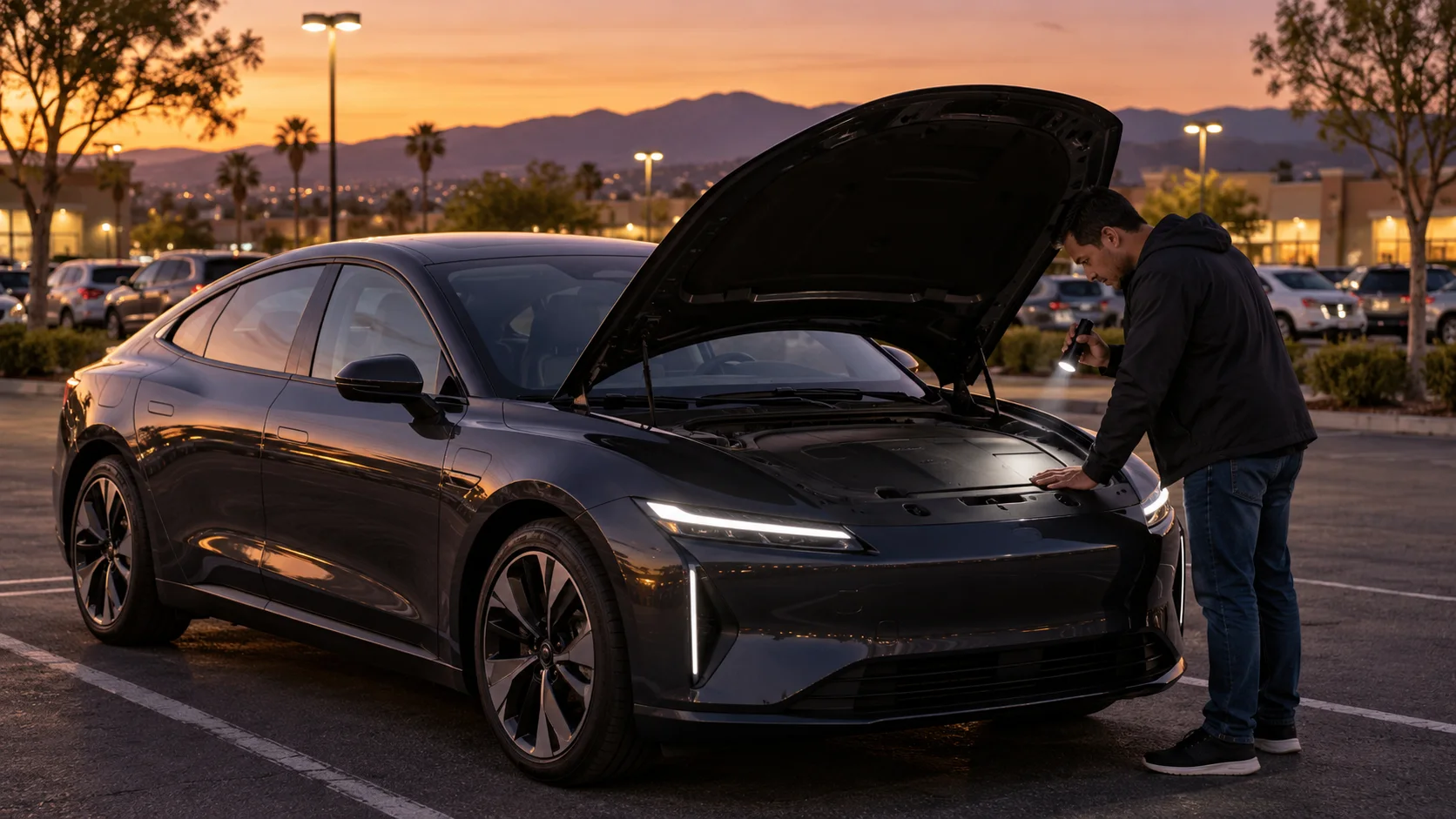
The official owner path for a 2024 or 2025 Polestar 2 uses the documented 12V jump points under the hood. It does not use a fireman’s loop, responder cut loop, service disconnect, or orange high-voltage hardware. Those responder terms lead owners toward the wrong equipment and the wrong procedure.
The search term and the owner procedure are different
Drivers often search “Polestar 2 fireman’s loop” when the car is dark and they need 12V access. Polestar’s current owner-facing instructions do not use that term for the jump-start connection. The 2024 and 2025 manuals describe charging points beneath a protective panel at the front-left area under the hood.
That wording matters. Emergency-response documents are written for trained responders managing collision and extrication hazards. An owner trying to wake a discharged 12V system has a narrower task. Do not pull, cut, bridge, probe, or connect to responder hardware. Do not touch orange cables or high-voltage components.
If your Polestar’s exact model-year manual does not describe a part as an owner jump point, leave it alone.
What the 2024 and 2025 manuals support
Polestar publishes matching high-level access for the 2024 Polestar 2 and 2025 Polestar 2. Both direct the owner to a protective panel at the front-left under the hood. The panel is retained by five plugs. Beneath it are the specified 12V charging points used for jump-starting the Polestar itself.
The 2025 instructions identify the positive point and a forward chassis-ground bolt. The 2024 manual warns that contact anywhere other than the described points can cause a short circuit. That is enough reason to stop improvising once the panel is open.
These source pages support 2024 and 2025 US vehicles. They do not justify extending the same trim layout to every earlier or future Polestar 2. Before removing anything, select the model year in Polestar’s current manual and compare the illustration with the car in front of you.
A safe access checklist
This page identifies the owner path. It is not a substitute for the illustrated connection sequence in your exact manual.
- Confirm the car is a Polestar 2 and identify its model year.
- Open the matching US owner-manual jump-start page.
- Find the front-left protective panel shown by Polestar.
- Confirm that the panel and five-plug layout match your vehicle.
- Use only the positive point and chassis ground identified in that manual.
- Keep clear of orange wiring and every unlabeled connection.
Stop if the hood cannot be opened normally, the panel differs from the manual, a point is damaged or corroded, polarity is uncertain, or the area is wet or unsafe. A wrong connection can create a short circuit. Guessing is not a roadside shortcut.
Polestar also limits the documented points to jump-starting the Polestar. Do not use the vehicle as a donor for another car.
What a low-voltage failure can look like
A discharged 12V battery can leave a Polestar unable to start. That does not prove the high-voltage drive battery is empty. Record what happened before the shutdown: the last range reading, any warnings, whether the screens respond, and whether locks or exterior lights work.
Those observations help separate a low-voltage wake-up problem from a depleted traction pack. The distinction matters because a jump and a mobile charge solve different problems. Our broader Polestar 2 no-start guide explains that diagnosis. This page stays focused on where the official owner jump points are and what not to use.
In an Ontario shopping lot, a Riverside garage, or a Fontana warehouse row, start with the same model-year check. Heat and location do not change the connection points. The matching owner manual does.
Never turn responder hardware into a DIY path
Polestar’s 2023 general charging guidance says not to touch anything the owner’s manual does not clearly describe. It also reserves work on orange high-voltage parts for trained, qualified service personnel. Read the current Polestar 2 charging safety guidance if you encounter unfamiliar hardware.
A responder loop may appear in emergency-service material, online discussions, or mislabeled videos. That does not make it a 12V charging point. Cutting or manipulating isolation hardware can disable systems, expose hazards, or complicate recovery. Consumers should never use or cut it.
If you reached this page because a first-responder diagram appeared in search, close that diagram and open the owner manual for the vehicle’s model year.
When roadside help is the better choice
Stop DIY work if the vehicle was in a collision, shows smoke or unusual heat, has damaged orange components, or does not match the manual. Use emergency services for an active hazard. Use Polestar support or a qualified tow when high-voltage damage or an internal fault is possible.
A safe, undamaged car with a confirmed discharged 12V may fit a low-voltage roadside visit. A car with an empty traction pack needs charging or towing instead. Non-Tesla EV rescue explains that service split, and safe curbside EV jump checks cover the general preparation boundary.
Charge Pro IE is a referral service. It does not jump the vehicle, cut hardware, repair the car, or own roadside equipment. It can match a driver with a licensed independent operator. The operator confirms scope, quotes the work, and bills the driver directly.
For manufacturer roadside versus local help, see Polestar roadside assistance in the Inland Empire.
Frequently asked questions
Is the Polestar 2 fireman’s loop the 12V jump point?
No. Polestar’s 2024 and 2025 owner manuals describe 12V charging points beneath a front-left protective panel. They do not identify an owner jump point as a fireman’s loop.
Should an owner cut or pull a responder loop to wake the car?
No. Never cut, pull, bridge, probe, or connect to responder or high-voltage isolation hardware. Use only the points documented in the owner manual for the exact model year.
Does this access apply to every Polestar 2?
No. The cited layout is supported for the 2024 and 2025 US manuals. Check the current manual for your model year and stop if the vehicle does not match its illustration.