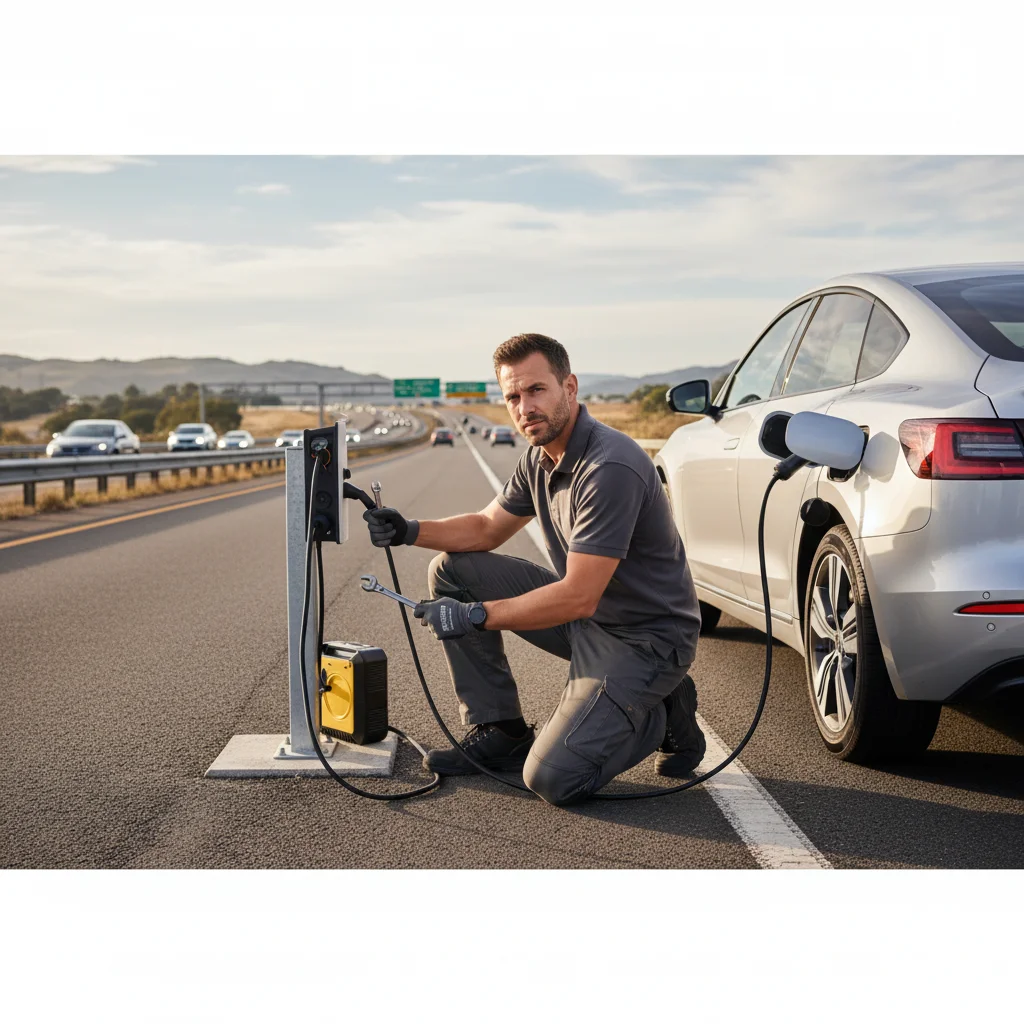
Your EV just died on I-10 in Colton. Pull fully onto the right shoulder before anything else. Turn the hazards on and stay with the car. Don’t walk toward an exit on this interchange. A mobile Level 2 charge adds range at the car. You don’t have to sit at a tow lot first. Colton owns its electric utility, and I-10 still leaves packs empty.
Two interstates meet in a small valley city
Colton is a compact city in San Bernardino County. Land area is 15.63 square miles. The ACS 2019-2023 population is 53,772. The 2024 estimate is 53,528. I-10 and I-215 cross inside that small map. SR-60 sits close enough to feed the same valley floor. Two interstates plus local ramps is the Colton problem. Empty packs show up on this shoulder because of that mix.
The Colton Crossing rail flyover sits in the same tight grid. It’s one of the busiest rail junctions in the western United States. Trains, trucks, and commuter lanes share a few square miles. Downtown Colton feeds those ramps every day. So does the Valley Boulevard corridor. The Mount Vernon corridor does the same from another cut. South Colton and the Cooley Ranch area add neighborhood trips. Those trips dump onto the same asphalt. Fiesta Village and Pellissier Ranch are names people here know. You can’t coast to them on an empty pack.
San Bernardino borders Colton on the north. Rialto and Bloomington sit to the west. Grand Terrace and Loma Linda sit close on the east and south. The Santa Ana River corridor runs along the city’s southern edge. Riverside is the next name across that edge. Those neighbors help you describe a stop. They don’t replace a direction and a last exit.
I-10 and I-215 feel similar from the driver’s seat. They’re not the same call. If you passed a Colton-named exit on I-215, say I-215. If you passed one on I-10, say I-10. A mixed pin wastes the operator’s first turn.
Colton Electric is not Southern California Edison
Most Inland Empire cities take power from Southern California Edison. Colton doesn’t. This city runs Colton Electric instead. The City of Colton Electric Utility owns the electrical infrastructure within city limits. Colton is absent from SCE’s served-cities list. If you live here, don’t call SCE about an EV home rate. You’re asking the wrong utility.
Confirm any current EV plan with Colton Electric. This page won’t invent a rebate name or a per-kWh figure. Programs change, and funding runs out, so confirm before you count on one. The city utility is the authority that sets those details.
SCE publishes home EV programs under its own name. Charge Ready Home is one of them. Those forms are for SCE meters. A Colton house inside city limits isn’t on that list. Don’t fill an SCE rebate form for a Colton Electric meter. Ask the city utility what it offers this year.
Riverside sits across the Santa Ana River corridor. That city has Riverside Public Utilities. That’s a second municipal system, not Colton’s. Don’t call RPU about a Colton meter either. Utility names get mixed on this valley floor. Your bill stub is the check.
A city-owned grid still can’t roll a charger onto I-10. Home rates are a kitchen-table issue. An empty pack on the shoulder is a roadside issue. Charge Pro IE is a referral line. We match stranded EV drivers with independent local mobile rescue operators. We don’t perform the work, and we employ no technicians. We set no prices and own no trucks. We own no yard and no parts inventory. The operator quotes you before starting. They bill you directly.
The true network claim is simple. The pros we connect you with are licensed and insured. That’s about the operators. It’s not the brand doing the work.
I-10 through Colton is an interchange, not a long empty pull
This stretch is short, busy, and not a high-desert grind. Eastbound traffic is already thinking about Redlands. Westbound traffic is thinking about Bloomington. I-215 dumps north-south trips into the same ramps. The local hazard is merge speed and a short window to decide.
If you still have a few miles, take a Colton exit. Do it while the car still steers. Valley Boulevard and Mount Vernon Avenue meet this freeway. So do La Cadena Drive and Washington Street. Local research names those surface routes. Use them to get out of a live lane. That list isn’t a tour of plugs.
If the gauge is already at zero, stay on the shoulder. Coasting into a merge with no power is how collisions start.
Callers often lead with a ZIP. 92313, 92316, and 92324 all touch Colton. They also overlap neighbors. A ZIP is a weak pin on I-10. Direction, last exit, and vehicle color are stronger. Say I-10 or I-215 out loud. Those are different approaches for the operator we connect you with.
Valley floor heat is the range tax in this city. Reche Canyon adds a second one. The canyon climbs south toward Moreno Valley and holds heat. The climb is short, and it still spends range you thought you had.
Reche Canyon is the Colton road that isn’t the freeway
Reche Canyon Road leaves town on a narrow two-lane climb. Local research notes no services and a limited shoulder. People use it between Colton and Moreno Valley. Leave Downtown Colton with a thin buffer, and that grade can stall you.
Turn back toward town if you still can. If you can’t, stay with the car. Don’t walk the two-lane. Tell the operator you’re in the canyon. A freeway pin sends them to the wrong pavement.
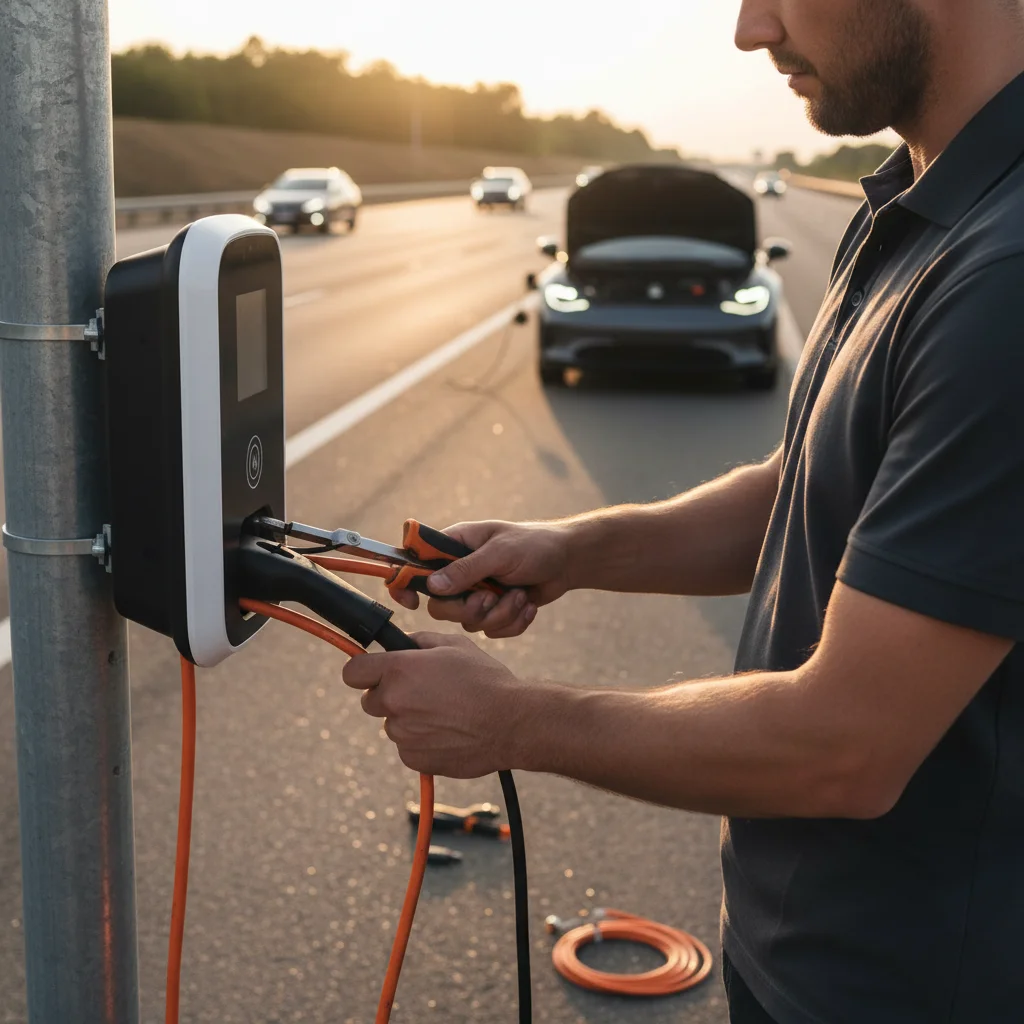
In-town stalls have their own write-up. See EV roadside assistance in Colton for neighborhood stops. This page is the I-10 and canyon version of the same call.
Shoulder steps that keep you off the paint
Start moving right as soon as the low-range warning looks real. Don’t wait for a silent stop in a travel lane. Ramps on this interchange come up fast. A slowing EV in the right lane is already in the way.
Get the whole car onto the right shoulder. Put as much pavement as you can between you and traffic. If a barrier is there, sit closer to it than to the lane. Switch hazards on while you’re still rolling. Other drivers need that cue before they close on you.
Leave through the passenger door when you can. The driver’s door opens into I-10. Stay between the car and the barrier. Never stand between the car and the lane. Don’t walk the shoulder toward the next exit. You’re hard to see, especially after dark.
Report the stop to 511 or CHP. Give direction of travel, last exit, and a vehicle description. That logs a welfare check. It doesn’t charge the pack. Then call for a mobile rescue.
If a couple of miles remain, a Colton off-ramp can be the cleaner ending. Only take that bet if you’re sure. A dead car in a merge is worse than a dead car already parked.
Empty pack, or a 12V that just quit
A dark EV isn’t always an empty traction pack. Teslas and most other electric cars still use a 12V battery. That small battery runs computers, contactors, and door logic. When it dies, the car can look fully dead. The pack can still hold miles.
Dark screens and a charge port that won’t open point at 12V first. A jump or a 12V replacement on site is a different job. It’s not a Level 2 hookup. Operators in this network handle both. They work on Tesla and every major EV brand. If the dash is confusing you, read dead Tesla pack or 12V.
If the range number truly hit zero, you need energy in the pack. Jumping the 12V won’t create miles. Passersby mean well, and they often jump the wrong problem.
A tow off I-10 isn’t the same as a charge
A flatbed can clear the shoulder. It doesn’t put miles in the pack. Most modern EVs need a flatbed, not a wheel-lift. Drive units and regenerative braking don’t like being dragged. On a live interstate, CHP may need to clear the stop. Then a tow truck can sit there. That’s procedure, and this page won’t invent a wait time for it.
The drop-off is the second problem. A tow lot is convenient for the truck. It may not be a place you can plug in and leave. You still have an empty car. You still need a charge.
Frame the choice as a mobile charge versus a tow. The operator quotes you before any cable goes in. They bill you directly. Charge Pro IE doesn’t set that price. Typical charging time is 15 to 30 minutes at the car. That window is for adding about 10 to 20 miles. It isn’t an arrival clock. This line doesn’t promise one.
If you want the service page, start with out-of-charge recovery. For what the visit is, see mobile EV charging.
What the operator brings to the shoulder
Independent operators bring a 240V Level 2 source to the car. Tesla owners get a native NACS plug. Other brands use a CCS or J1772 adapter. This is roadside energy, not a Supercharger stall. It’s enough to leave the shoulder and take a Colton exit.
Have direction of travel ready when you call. Add the last exit or a milepost. Give year, make, model, and color. Give the displayed battery percent. Say whether the car still powers on. Then give one clear place phrase. Use I-10, I-215, or Reche Canyon.
Non-Tesla drivers are in the same network. Rivian, Ford, Hyundai, Kia, and GM cars take the CCS or J1772 path. The person who stops is an independent pro. Charge Pro IE doesn’t run a fleet. Ask for the quote before work starts.
Once you can roll again
Ten to 20 miles is a get-off-the-freeway budget, not a canyon budget. Take the next safe Colton exit. Don’t point the car up Reche Canyon on a thin charge. Older housing is a later conversation. ACS 2019-2023 puts 51.8% of Colton homes as built before 1980. Confirm home-charger questions with Colton Electric, not with SCE.
Eastbound, the next corridor note is out of charge on I-10 through Redlands. For the city page, use EV charging in Colton. We serve Colton and every other city in the Inland Empire service area.
Frequently asked questions
What should I do first if my EV dies on I-10 in Colton?
Get fully onto the right shoulder with hazards on. Stay with the car. Report the stop to 511 or CHP. Then call for a mobile Level 2 charge at the vehicle. A charge at the car puts range in the pack. A tow clears the lane and still leaves you empty.
Does Colton use Southern California Edison?
No. Colton has its own municipal utility, Colton Electric. The city owns the electrical infrastructure inside city limits. SCE’s served-cities list doesn’t include Colton. Ask Colton Electric about any current EV home rate or rebate. Don’t call SCE for a Colton residential plan. None of that charges a car already stopped on I-10.
Can an operator charge a non-Tesla on this shoulder?
Yes. Operators bring a 240V Level 2 source with a native NACS plug. They also carry CCS and J1772 adapters. Tesla and the other major EV brands are in scope. That includes Rivian, Ford, Hyundai, Kia, and GM. The operator quotes before they start. They bill you directly.
If the pack just hit empty on I-10 in Colton, make the call. Charge Pro IE is at (909) 250-2881. The same number covers a Reche Canyon stop. We’ll connect you with an independent operator. That operator can bring a Level 2 charge to the car.