A trunk box isn’t a mobile EV charger for roadside use. On Inland Empire shoulders, help is an operator with 240-volt Level 2 at your bumper. Your portable cord still needs a wall. A freeway lane doesn’t offer one. Neither does a Fontana warehouse row or the Cajon climb.
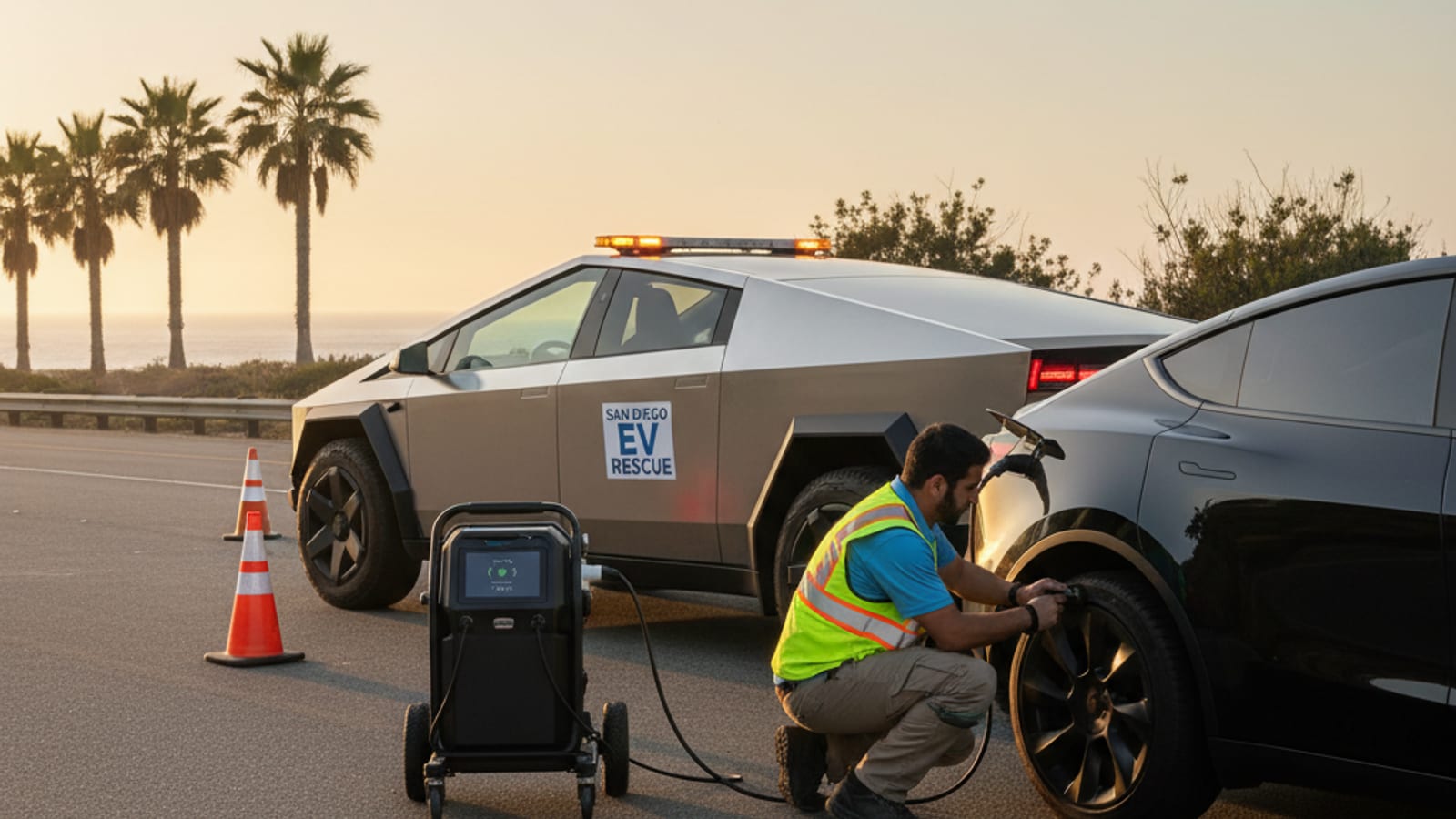
What that search actually means
Owners type this phrase for two products. One is a suitcase unit you keep in the frunk. The other is a person who arrives with a 240-volt source. They share a name in search. They don’t share a job.
If you’re comparing cables and NEMA plugs, you’re shopping hardware. If the pack is already empty on I-10 through Colton, you need a visit. Charge Pro IE is a referral line for that second case. We match stranded drivers with independent local operators. We don’t own trucks. We don’t set prices. The operator quotes you before any charge starts. Then the operator bills you directly.
A hardware kit can still earn a place in the car. It belongs at houses, shops, and known pedestals. It doesn’t replace a roadside visit. Mix the two jobs and you’ll stand on the 215 holding a cord with nowhere to go.
The portable unit you can buy
A personal portable charger is a cord plus a small control box. Most live in a bag. Owners pack one for a friend’s garage, a hotel dryer outlet, or a house that never got a wall unit. That’s a real use. It’s just not a freeway use.
Level 1 in the bag
Level 1 gear plugs into a 120-volt household receptacle. That’s the same outlet that runs a lamp. On a traction pack, the trickle is slow. You might sit for hours. You still may lack the range to climb toward Yucaipa. You still may lack the range to clear Cajon. Overnight at a driveway, it can help. On a live shoulder, it doesn’t.
Level 2 in the bag
Level 2 portable units want 240 volts. That’s dryer, range, or shop power. At a house with the right receptacle, they add useful miles. On SR-60 in Jurupa Valley, there’s no dryer outlet on the right-of-way. On I-215 through Moreno Valley and Perris Valley, the same rule holds. The hardware isn’t the bottleneck. The missing wall is.
Some kits include NEMA adapters. Those adapters still need a live 240-volt socket. An RV park, a shop bay, or a warehouse dock might have one. A closed industrial lot after shift change might not let you in. Don’t count on borrowing power you haven’t confirmed.
Read home 240-volt charging vs a roadside Level 2 hookup before you treat a travel charger as a rescue plan.
Why the shoulder is a different problem
Roadside use means the car already stopped. Hazard lights are on. You’re in a live lane, a frontage road, or a packed lot. The portable unit in the trunk can’t invent a circuit.
A professional visit is built for that scene. The operator brings the 240-volt Level 2 source to you. Native NACS for Tesla. A CCS or J1772 adapter for other brands. Typical charging time, not travel time, adds about 10 to 20 miles of range in 15 to 30 minutes. That window is for the plug. It’s not a promise about when someone shows up.
You stay with the car. The car stays on its wheels. You’re not waiting on a flatbed. You’re not taking a second stop just to reach a public post.
What a mobile EV charging visit actually is, and isn’t walks through the sequence without treating the suitcase and the operator as the same tool.
Inland roads that change the math
The Inland Empire isn’t one climate or one grade. Valley heat, mountain grades, and High Desert miles each tax a pack in a different way. Advice written for a flat coastal loop doesn’t travel here.
The Cajon and the High Desert
Northbound I-15 toward Victorville is a long climb. Drivers heading for Hesperia, Apple Valley, Adelanto, or Phelan feel it in the estimated range. After the summit, the High Desert opens up. Victorville covers about 73.7 square miles. Apple Valley covers about 77. Adelanto covers about 52.9. Phelan, unincorporated, spreads across about 60.1. Those are large places with long connecting roads. A suitcase charger doesn’t shrink them.
Residential power in Victorville comes from Southern California Edison. Victorville Municipal Utility Services serves the Southern California Logistics Airport and Foxborough Industrial Park only. It doesn’t serve residential areas. If you live in town, your home rate is SCE. That fact matters when you plan overnight charging. It doesn’t put an outlet on the Cajon shoulder.
Apple Valley splits in a different way. SCE delivers the electrons. Apple Valley Choice Energy procures generation. The meter on the house still isn’t a plug on the shoulder north of the pass.
Oak Hills sits at the top of that same approach. Wrightwood is a mountain community on the north slope. Don’t assume every unincorporated pocket uses the same utility story. Confirm the bill on your own meter.
The 10, the 60, and the 91
I-10 cuts the valley through Colton, Redlands, Calimesa, Beaumont, Banning, and Cabazon. SR-60 crosses Jurupa Valley. SR-91 feeds Corona. These are commute spines. If the car dies in a travel lane, you need power at the bumper.
Colton isn’t on SCE’s served-cities list. The City of Colton Electric Utility owns the electrical infrastructure inside city boundaries. Riverside is also absent from SCE’s list. Riverside Public Utilities has served the city since 1895. Banning runs the City of Banning Electric Utility. Home charging rules and rebate names change at those city limits. None of that puts 240 volts on the shoulder.
SCE customers can look up the TOU-D-PRIME residential EV plan on SCE’s site. Riverside Public Utilities publishes its own Electric Vehicle Rate. Names and program pages change. Confirm the current tariff with your utility before you plan around it. A rate plan still isn’t a roadside outlet.
Mountains and the Ortega
Lake Arrowhead and Crestline appear in SCE’s community index and in mountain outage notices. Big Bear Lake and Big Bear City sit on Bear Valley Electric Service. That utility also names Moonridge, Fawnskin, Sugarloaf, Lake Williams, Erwin Lake, and Boulder Bay. A day trip to the rim, then a downhill run with fading range, is a common local pattern. Regenerative braking helps on the way down. It doesn’t rebuild a pack you emptied on the way up.
South county has its own grade: the Ortega near Wildomar and Lake Elsinore. Menifee, Murrieta, Temecula, and French Valley sit in that orbit. French Valley is a census-designated place of about 45,269 people. Only 2.3 percent of its housing was built before 1980. Eastvale is similar: about 70,633 people, and 2.2 percent pre-1980 stock. New streets and new panels still fail. Construction power gets pulled. A wall unit isn’t finished. The car sits in the driveway with an empty pack. A portable Level 1 cord on a temporary construction outlet is a weak plan.
Canyon Lake, Hemet, San Jacinto, and Winchester add more south-county miles. Temecula’s ACS count is 111,167. Murrieta’s is 112,064. Pre-1980 housing is 6.5 percent in Temecula and 6.2 percent in Murrieta. Newer towns still strand cars. A suitcase charger doesn’t care how new the subdivision is.
Heat, older panels, and why the pack was already low
San Bernardino County’s ACS 2019-2023 figures show 43.8 percent of housing built before 1980. Riverside County’s share is 30.2 percent. Inside cities the vintage swings hard. San Bernardino: 60.9 percent pre-1980. Redlands: 60.4. Riverside city: 56.4. Upland: 55.9. Ontario: 50.7. Crestline: 77.7. Montclair: 68.5. Norco: 68.8. Bloomington: 62.5. Big Bear Lake: 59.6. Temecula: 6.5. Corona: 25.0. Fontana: 28.9. Victorville: 19.6.
Older panels are why many inland owners still trickle on Level 1 at home. Some skip a wall charger entirely. If the house can’t host a 240-volt circuit, the car leaves every morning closer to empty. Then a detour, warehouse overtime, or a hot afternoon takes the rest.
Summer heat in the valleys isn’t a coastal marine layer. The pack spends energy on cooling. Mountain air at Big Bear is a different thermal story. Don’t treat a Temecula wine-country loop like a Crestline grocery run. Plan the day you’re actually driving.
Moreno Valley is a split-utility city. SCE covers much of it. Moreno Valley Utility serves newer development since 2004, more than 6,500 customers, with an address lookup on the city’s site. Rancho Cucamonga is split too. SCE covers most of the city. Rancho Cucamonga Municipal Utility covers a southeast pocket of over 3,900 metered businesses and residents. That pocket includes The Enclave, Day Creek Square, The Resort, and the Victoria Gardens area. San Jacinto has SCE delivery with San Jacinto Power as the community choice aggregator for generation.
Those splits change home rates and rebate names. They don’t change the physics of an empty pack on I-215.
SCE publishes Charge Ready Home and a Pre-Owned EV Rebate Program for eligible customers. Riverside Public Utilities publishes Electrify Riverside. Funding runs out. Rules change. Confirm the live page with your utility. A rebate on a wall unit still isn’t a plug on the 10.
What the operator actually brings
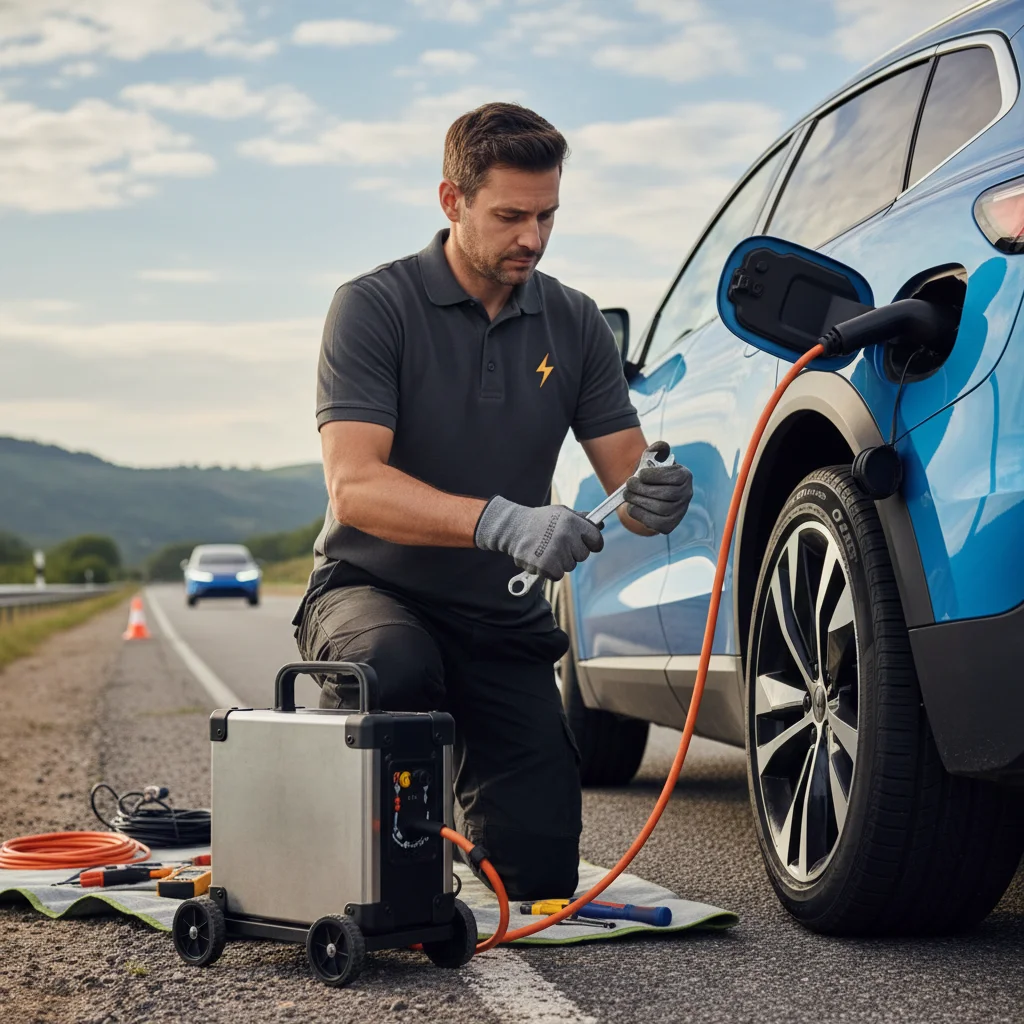
The operators we connect you with bring a 240-volt Level 2 source to the car. Tesla owners get a native NACS plug. Other brands use a CCS or J1772 adapter. The stop is a range bump, not a full DC fast-charge session. Typical charging time adds 10 to 20 miles in 15 to 30 minutes. That’s usually enough to roll to a public post or a home circuit you already trust.
What’s actually on a mobile EV charger truck at the roadside shows why this isn’t a suitcase. The power lives on the operator’s vehicle. Your portable kit doesn’t duplicate that.
For the empty-pack job, start with mobile EV charging. If you already can’t roll, out-of-charge recovery is the same kind of visit.
Compatibility, not guesswork
North American cars in this market use NACS, CCS, or J1772 at Level 2. Tesla uses NACS. Ford, GM, Hyundai, Kia, BMW, Mercedes, Rivian, and most others in the CCS family need the adapter path. Confirm the plug when you call. Don’t assume a Tesla-only lead can feed every Chevy. Don’t assume a CCS-only lead fits a newer Model Y without NACS.
What we don’t promise
We don’t publish arrival times. We don’t publish hours. We don’t quote a price from this page. The operator on the call quotes before work starts. We don’t perform the work. We don’t hold a contractor license for it. Independent operators do the plug, the 12-volt jump when that’s the real fault, and the billing. The pros we connect you with are licensed and insured. Charge Pro IE isn’t the licensee and isn’t the crew.
Empty pack, or a 12-volt that killed the car
Many dead-EV calls aren’t an empty traction pack. They’re a 12-volt battery that dropped out. Lights, computers, and contactors ride that small battery. When it fails, the car looks fully dead. A portable Level 2 suitcase won’t wake it. You need a 12-volt jump or a replacement on site. Then you need a diagnosis of why it failed.
Operators in this network handle Tesla and every major EV brand on that 12-volt job. They also handle the 240-volt top-off. If the dash is dark and the charge port won’t open, treat it as 12-volt until someone proves otherwise. Plugging a travel charger into a car that can’t close its contactors wastes the evening.
Charge on site, or call a tow
A tow moves the car. A mobile charge tries to make the car move itself. For a depleted pack with a working 12-volt system, on-site Level 2 is the direct fix. You get enough miles to reach a charger you choose. A tow is the right tool when the car can’t take a charge, a wheel is damaged, or a flatbed is already required.
EVs often need a flatbed, not a wheel-lift. That’s extra handling. A charge that leaves the car on its tires avoids that. Neither option has a price on this page. Compare the two paths in mobile EV charging or a tow: which gets you moving. Then let the operator quote the charge if that’s the job.
Don’t treat a tow as faster. Don’t treat a charge as faster. Traffic on the 10, the 15, the 215, and the 91 changes by the hour. Nobody honest publishes a clock from a blog post.
Warehouse lots, airport rows, and shift-end stalls
Ontario’s airport-adjacent lots and warehouse grid produce a specific stall. So do Fontana’s logistics parks and Bloomington’s industrial edges. The van or commute EV sat through a long shift. ACS puts Fontana at 214,169 people. Ontario sits at 180,547. Bloomington, unincorporated, sits at 25,698. These are work geographies. A portable charger in the cargo area still needs a receptacle the site will let you use. Many lots won’t.
Glen Helen event parking, Cabazon destination lots, and a long day at Pechanga create the same pattern. The car sat. The pack fell. The suitcase in the trunk still wants a wall. If you manage a small fleet, a shared travel charger isn’t a dispatch plan. Pair depot 240-volt charging with a referral number for the days the plan fails.
Chino, Ontario, and Rancho Cucamonga warehouse belts sit on SCE for most meters. That still doesn’t mean a dock will hand you a 240-volt outlet at 11 p.m. Ask the site before you need it. Don’t invent permission at the moment of failure.
Your utility isn’t the whole valley
People assume the whole Inland Empire is Southern California Edison. It isn’t. Most profiled cities are on SCE’s served-cities list: Chino, Chino Hills, Ontario, Montclair, Upland, Fontana, San Bernardino, Rialto, Highland, Loma Linda, Grand Terrace, Redlands, and Yucaipa. Corona, Norco, Eastvale, Jurupa Valley, Perris, Menifee, Lake Elsinore, Wildomar, Canyon Lake, Hemet, Temecula, Murrieta, Beaumont, and Calimesa are on that list too. Hesperia and Adelanto are SCE. Cabazon and Phelan show up on SCE’s tariff index.
The exceptions are the part worth memorizing. Riverside Public Utilities. City of Colton Electric Utility. City of Banning Electric Utility. Bear Valley Electric Service in the Big Bear communities. Moreno Valley Utility in a slice of Moreno Valley. Rancho Cucamonga Municipal Utility in a southeast pocket. San Jacinto Power as a community choice aggregator. Apple Valley Choice Energy as a procurer while SCE still delivers.
If you’re buying a portable Level 2 kit because your house still has no wall unit, start with the name on the bill. Panel work, rebates, and time-of-use plans follow that name. The kit still won’t charge the car on I-10 in Redlands without a receptacle.
How to shop a portable unit without fooling yourself
If you still want hardware in the car, buy it for places that have outlets. A Level 2 portable with the correct NEMA plug is useful at a house, a shop, or a reserved RV pedestal you’ve already checked. Read the manual for ground-fault behavior and adapter limits. Store it where it can’t cook in a closed frunk all summer.
Don’t buy it as your only roadside plan. A live shoulder isn’t an outlet, on the Ortega or on I-10 through Banning or on long High Desert miles near Adelanto. That’s about the pavement under a car that already stopped. It isn’t a map of public stations. The Department of Energy’s Alternative Fuels Data Center locator is where you map public posts before a trip. PlugShare and your in-car map are the other two. Check them while you still have range.
Level 1 overnight at a relative’s house in Hemet or San Jacinto can save a planned stay. It won’t save a stop already in progress. For why a wall outlet is a weak inland backup, see Level 1 charging: why a wall outlet won’t save a stranded EV here.
Upland, Montclair, and Chino Hills add west-end miles on SCE. Chino Hills covers about 44.7 square miles of hillside streets. Highland sits at the foot of the mountain climb. Loma Linda, Grand Terrace, and Colton sit in the valley seam. Each of those drives can flatten a pack that left home already thin. A travel charger helps only if you reach a known 240-volt receptacle. Otherwise you’re shopping for an operator visit, not a longer cord.
Corona’s ACS population is 159,670. The 91 through town is stop-and-go more than scenic. Norco sits next door with 68.8 percent pre-1980 housing. Older houses and horse-property lots don’t automatically have a 240-volt wall unit. A portable Level 2 kit helps at those houses. It doesn’t help in a travel lane. Chino city is 92,652 people with 39.1 percent pre-1980 housing. Upland is 79,257 with 55.9 percent pre-1980 stock. Montclair is 37,810. Those west-end cities are compact compared with Victorville. The pack still dies at grocery lots and freeway ramps. You still want 240 volts at the bumper, quoted and billed by the operator.
Who’s actually driving these cars
Riverside County has 2,478,600 people in the ACS 2019-2023 count. San Bernardino County has 2,197,104. Hispanic or Latino share is 50.6 percent in Riverside County and 54.6 percent in San Bernardino County. By raw count, large Spanish-speaking audiences sit in San Bernardino, Fontana, Riverside, Ontario, Moreno Valley, Jurupa Valley, Rialto, Corona, Perris, and Victorville. If you’re writing instructions for a household, write them so a spouse or a teen driver can follow them. Save the referral number in more than one phone.
Charge Pro IE serves the Inland Empire. That includes every city in this two-county market. The operators we connect you with are licensed and insured. The brand itself isn’t the licensee and isn’t the crew.
A simple order of operations when the car stops
Get out of the travel lane if you can do it safely. Stay with the vehicle if you can’t. Decide whether the car is silent from a 12-volt failure or from an empty pack. A dark dash and a frozen charge port lean 12-volt. A working screen with zero miles leans empty pack. Don’t start assembling a suitcase charger on a live shoulder. You still have no outlet. Call for a mobile visit if the pack is empty and the car can accept charge. Call for a 12-volt jump if the car won’t wake. Let the operator quote before the lead goes in. You approve, or you don’t. Once you have 10 to 20 miles, drive to a public post or home circuit you already know. Don’t treat the roadside bump as a full fill.
Frequently asked questions
What is a mobile EV charger for roadside use?
It isn’t the bag in your trunk. For roadside use, it’s an operator bringing a 240-volt Level 2 source to the car. The stop adds range where you sit. A personal portable unit still needs a wall, which a freeway shoulder doesn’t provide.
How much range does a roadside Level 2 visit add?
Operators in this network typically add 10 to 20 miles in 15 to 30 minutes of charging time. That’s plug time, not the time to arrive. It’s meant to reach a public charger or a home outlet, not to fill the pack.
Can Tesla and non-Tesla cars both use it?
Yes. Operators bring a native NACS plug for Tesla. They carry a CCS or J1772 adapter for other major brands. Confirm your inlet when you call. Charge Pro IE refers the job. The operator on scene does the plug.
When the portable box can’t help, call (909) 250-2881 and we’ll connect you with a local operator for a quote on the spot. Start on the mobile EV charging page if you want the service path in writing first.