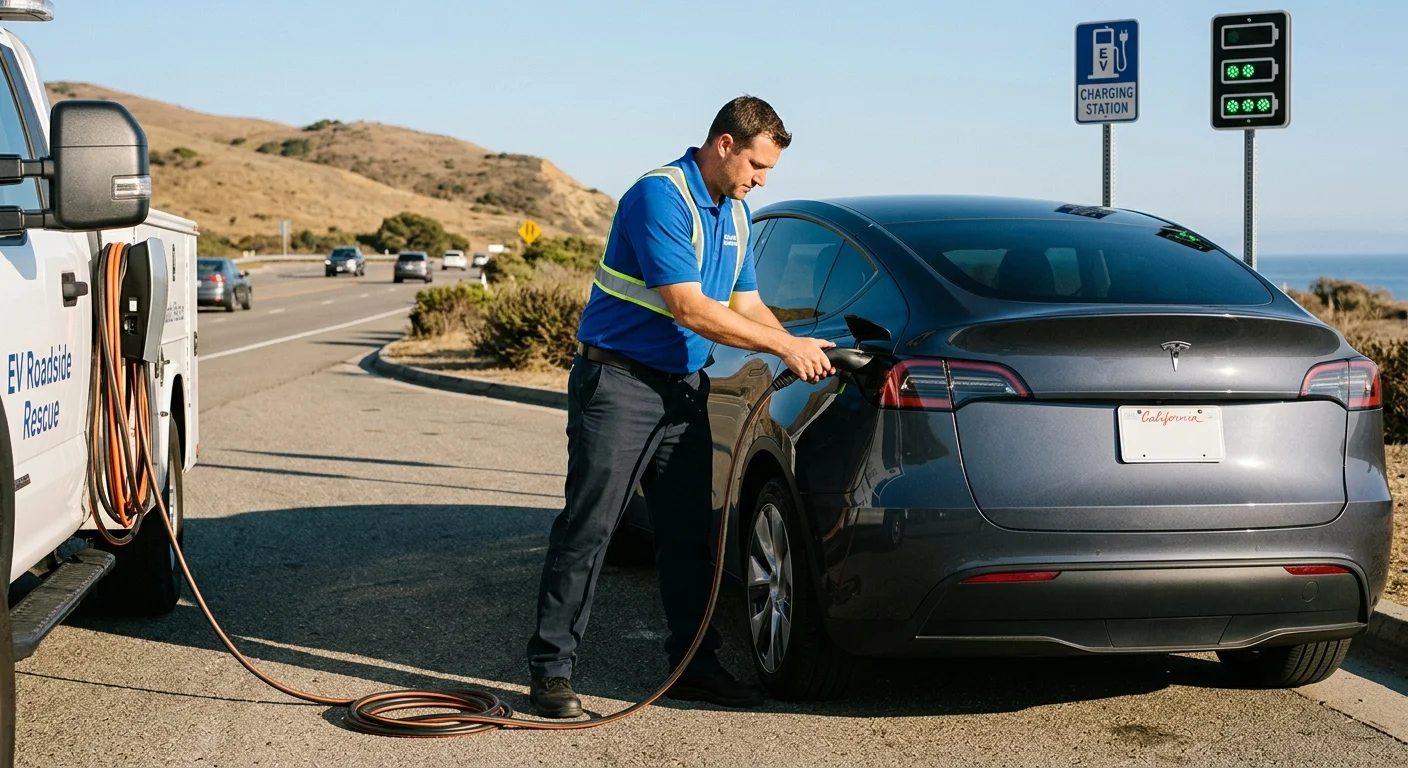
When you’re already stranded, EV charging levels stop being a spec sheet. They decide if a 240V curb hookup can roll you. They also decide if you need a tow. Charge Pro IE matches you with independent local operators. Those operators bring a 240V Level 2 source to the car. A typical session adds 10 to 20 miles of range. That takes 15 to 30 minutes of charging. That’s charging time, never an arrival time.
The chart can wait until you’re safe
You’re not comparing stall stickers in a quiet garage. You’re on a shoulder, a warehouse row, or a dark driveway. You need the power that can reach this car. That means this spot, this port, and this pack.
Start with the dashboard, not a charging diagram. An empty pack on a car that still wakes is a charging problem. A silent dash, locked doors, or a 12V warning is a different job. Then look at where you stopped. A Fontana warehouse aisle is not the I-15 Cajon climb. Downtown Riverside is not a High Desert mile near Adelanto. The range you need depends on the next grade.
What 240V Level 2 actually does here
Roadside rescue in this market is Level 2. It’s 240V AC, the same voltage class as a home wall connector. It’s not a Supercharger on a truck. It’s not a 120V outlet on an extension cord.
Operators typically add 10 to 20 miles of range. Plan on 15 to 30 minutes of charging once they’re hooked up. That’s enough for many valley hops. It may not cover a remaining mountain climb. Match those miles against your remaining route before you assume you’re done.
Tesla cars take a native NACS plug. Other EVs use a CCS or J1772 adapter the operator brings. Confirm make, model, and port when you call. Don’t assume a Tesla-looking plug fits a Kia, a Rivian, or a Bolt.
What a mobile EV charging visit actually is, and isn’t walks through the stop itself. The matched operator quotes you before starting. They bill you directly. Charge Pro IE doesn’t set the price, own the truck, or hold the work.
Why a 120V outlet is the wrong rescue
Level 1 is 120V AC. That’s a common household receptacle. It can trickle range overnight at home. It’s a poor answer on a live shoulder.
See Level 1 charging: why a wall outlet won’t save a stranded EV here. Heat, grades, and freeway miles eat that trickle before it helps. Don’t treat an unknown receptacle as approved because the plug fits. Check the manual. If the spot isn’t yours to use, skip it.
Home 240V and a roadside 240V hookup are cousins, not twins. Home 240-volt charging vs a roadside Level 2 hookup spells out that split. Your house may sit on Southern California Edison. Riverside Public Utilities serves the City of Riverside. Colton owns its own electric system inside city limits. Banning runs a municipal utility. Moreno Valley is split, with Moreno Valley Utility on newer development since 2004. Rancho Cucamonga Municipal Utility covers a southeast pocket around Victoria Gardens. None of that changes the truck’s 240V. That changes how you charge once you’re home.
DC fast charging stays at the stall
Drivers often call DC fast charging Level 3. It’s high-voltage DC at a fixed site. It’s not AC from a mobile unit. Tesla Superchargers sit in that family. So do CCS fast stalls.
A high advertised kilowatt number is a ceiling for the hardware. Your car decides what it will accept. Pack temperature, state of charge, and the stall’s actual output all cut that number. No verified per-stall output figure turned up for this market. Check the station app and your owner’s manual. The DOE Alternative Fuels Data Center publishes the federal equipment categories.
If the pack is already at zero, a farther stall is not a plan. Read a rapid charger near you, or a roadside Level 2 visit. Don’t guess a distance to the next plug.
A dead 12V is not a charging-level problem
Plenty of dead EV calls are not empty packs. The 12V battery still runs computers, contactors, and door latches. When it fails, the car can look fully dead. The traction pack can still hold energy. No charging level fixes that. The port won’t magically wake.
The operators we match can jump or replace a dead 12V on site. They handle Tesla and every major EV brand. Tell them what the dash showed before it went dark. If the car wakes after a 12V jump, check the pack. If the traction pack is truly empty, Level 2 is back in play.
The port still has to match the cable
Level labels don’t override the charge port. J1772 is the common AC inlet on many non-Tesla cars. CCS adds DC pins on that same family of hardware. NACS, also called J3400, is Tesla’s connector and is spreading. CHAdeMO still shows up on some older DC inlets.
A familiar-looking plug can still be wrong. Adapters vary by model year. Tell the operator the exact vehicle. If you know the port name, say it. If you don’t, describe what you see and stay on the line.
Inland miles change the math, not the voltage
The Inland Empire is two counties, not one climate. Riverside County and San Bernardino County share the freeways. Then they split into valley floor, south-county towns, High Desert, and mountains.
On I-10 through Colton or Redlands, that range can be a town hop. On the Cajon climb toward Victorville, the same miles fight elevation. On I-215 through Moreno Valley and Perris, heat and traffic both tax the pack. SR-60 through Jurupa Valley has the same empty-pack problem. So does the 91 through Corona, on crowded lanes. The Ortega near Wildomar is a different shoulder than a Temecula lot. An Ontario airport row has access rules a freeway shoulder doesn’t.
ACS 2019-2023 figures put pre-1980 housing at 60.9% in San Bernardino. Eastvale sits at 2.2% on the same vintage. That gap shows up when a home charger never got installed. It doesn’t change what Level 2 means at the curb.
Lake Arrowhead and Crestline sit on SCE. Big Bear Lake and Big Bear City sit on Bear Valley Electric Service. A downhill run can look cheap on the display. You can still come up short for the next climb. Plan the remaining elevation against those 10 to 20 miles. Don’t treat a typical session as a full recharge.
For a map of the market, start at EV charging in the Inland Empire. Use it before the pack is empty, not after.
When charging is the wrong call
Mobile EV charging fits when the traction battery is depleted. The car also has to accept the operator’s equipment. The vehicle has to sit in a workable spot. The operator confirms all three before they start.
A charge port that won’t latch is a different problem. Check the manual. Don’t invent a diagnosis from a level chart.
If you’re creating a hazard, contact the appropriate emergency authority and follow their instructions. Don’t walk equipment across live lanes. The operator still has to decide whether the scene is workable.
When charging can’t proceed, out-of-charge recovery is the next conversation. The independent operator evaluates charging, recovery, or transport. EV tow methods are model-specific. Don’t copy another car’s flatbed steps. Use the manufacturer’s instructions and confirm them with the person moving the vehicle.
Charge Pro IE doesn’t perform the work or own trucks. We connect stranded Inland Empire drivers with independent local operators. The pros we connect you with are licensed and insured. You contract with the operator and pay them directly. Ask them to confirm method, compatibility, scope, and price before they start.
What to say when you call
Have the make, model, and year ready. Read the dash message out loud. Name the road, the direction, and a nearby exit or cross street. Say whether this is I-15, I-10, or I-215. Name the 60, the 91, or a surface street if that’s where you are. Mention a parking structure, a gated warehouse, or a steep shoulder.
If the car is a Tesla, say so. If it isn’t, say the brand and the port if you know it. If the 12V is the suspect, say that too.
A mobile rescue operator may fit when the pack is empty. The car has to be reachable, with Level 2 equipment that can connect. If charging isn’t the right tool, the operator can talk through a tow. Call (909) 250-2881 and we’ll connect you with a local EV rescue operator.