SCE and Moreno Valley Utility restore power to a house meter. They don’t roll a Level 2 truck to a stranded EV. EV roadside assistance in Moreno Valley is an independent operator. That operator brings 240 volts to the car. The operator quotes you before starting, then bills you directly. Charge Pro IE is the referral line that makes that match.
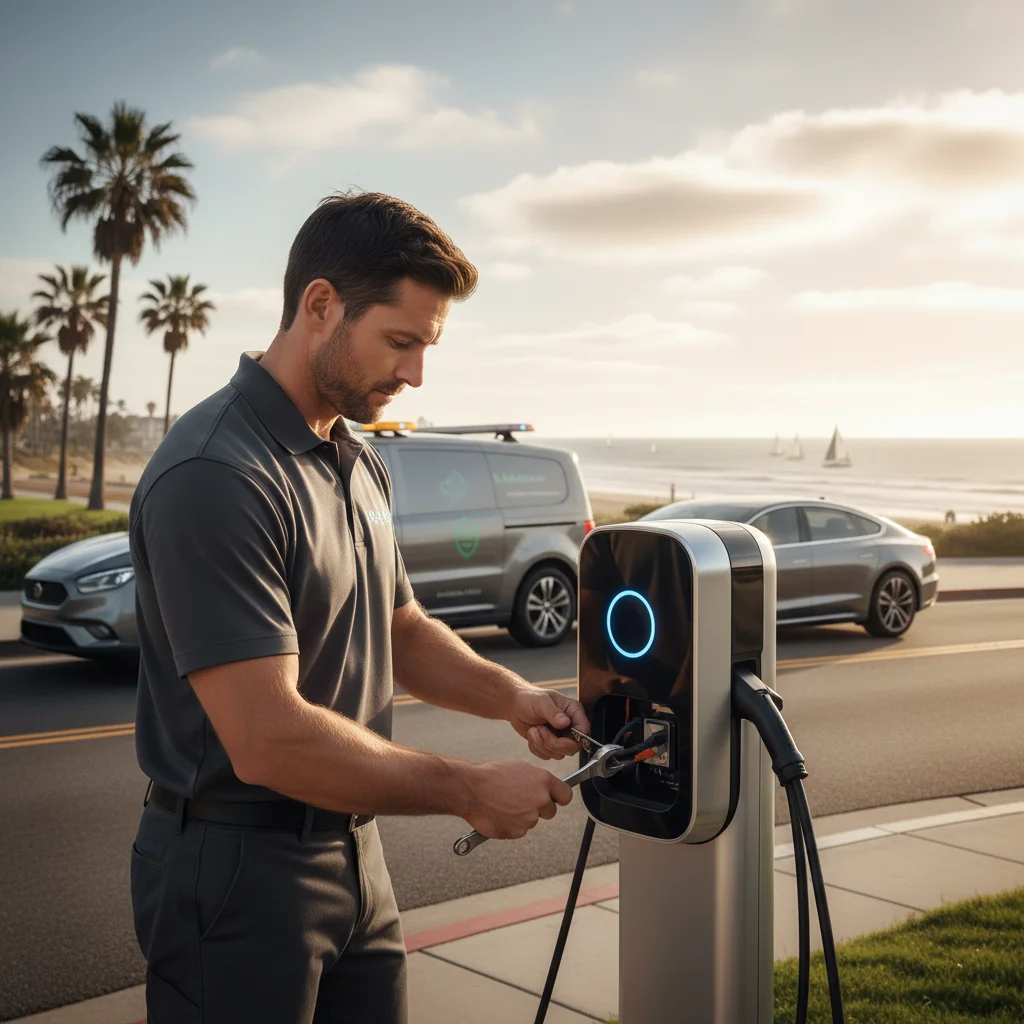
Two power companies share this city. Neither one charges the car.
Moreno Valley sits in Riverside County on 51.31 square miles of bowl-shaped land. Census ACS 2019-2023 puts the population at 211,666. The 2024 estimate is 213,919. Size isn’t the local story. The split electric map is.
Southern California Edison serves part of this city. Moreno Valley Utility serves another part. MVU states it has over 6,500 customers. Those accounts sit mostly in newer development since 2004. Edison covers the remainder.
You can’t read the split from a ZIP code. Census overlap files list 92551, 92553, 92555, and 92557 for this place. Those ZIPs also spill past the city line. Two neighbors can still sit on different utilities. Trust the bill. A county-wide Edison assumption won’t settle it.
SCE’s published EV pages cover home rates, rebates, and charger programs at the panel. MVU’s published pages cover territory and an address lookup. The lookup lives on the city’s MVU site at moval.gov/mvu. We checked SCE’s EV pages and MVU’s service pages. The access date is September 5, 2026. Neither source describes a Level 2 truck that meets you. Not on SR-60, Alessandro Boulevard, or a warehouse stall.
If you think the utility added field charging later, call them and confirm. Waiting on a shoulder for a house-side program wastes daylight. A dark wall charger is a meter or panel problem. A dark EV is a vehicle problem. Those are different phone trees.
Mobile EV charging is the vehicle problem. Charge Pro IE doesn’t hold a contractor license. We don’t perform the work. We connect you with independent local operators. We own no trucks, no equipment, and no yard. Operators set the price. We don’t.
Look up the address. Then call the right kind of help.
Use MVU’s lookup if the house is in a newer tract. Their site is the authority. If MVU doesn’t claim the address, you’re likely on SCE. Edison’s served-cities list names Moreno Valley because Edison is here. That list doesn’t erase MVU.
Home charging is realistic in much of this city. Only 18.7% of housing units were built before 1980, ACS 2019-2023 vintage. The 1980s and 1990s boom left a lot of modern panels. A wall unit at home is a normal setup here.
That fact doesn’t rescue a car that already stopped. When the wall unit works, you rarely think about a truck. When it trips, you still don’t call the power company for the bumper. Same if the HOA stall is down. They restore the circuit. They don’t meet you at Moreno Valley Mall with a plug.
We couldn’t verify a citywide count of assigned apartment EV stalls. Building rules differ by complex. If a shared charger is down, confirm the building’s process. If the car already won’t roll, you need the operator. Another ticket on the house meter won’t move it.
Sunnymead, Sunnymead Ranch, Edgemont, and Moreno Beach sit in this pattern. So do Rancho Belago, Hidden Springs, Towngate, and the Alessandro corridor. Newer tracts skew MVU. Older pockets skew Edison. Confirm, then decide whether you’re calling about a house or a car.
Heat in the bowl, and the SR-60 climb out of it
The city sits near 1,600 feet, higher than Riverside to the west. The Box Springs Mountains close that rim. The Badlands close the east. Heat stacks in the bowl and holds.
Cabin cooling on a parked Tesla draws from the pack you need later. Same for a Mach-E or Ioniq 5. A cool morning range number is a poor afternoon plan. That matters at Riverside University Health System Medical Center. Recalculate before you leave the lot.
The distinctive local risk is eastbound SR-60 over the Badlands toward Beaumont. That climb is a sustained grade. Corridor research notes no services on that stretch. Gilman Springs Road is the same problem in reverse. It’s a long pull and a pack that felt like enough.
The no-services note here means the grade itself, not a charger inventory. We don’t guess the next stall. We don’t call this city a gap. If you still have motion, use the AFDC station locator. The map in the car works too. If you don’t have motion, stay put and request a mobile charge.
Lake Perris State Recreation Area sits just south of town. A full day at the lake plus the drive back toward Sunnymead drains the pack. Check remaining range before the return, not after the first rise.
West of town, the Box Springs rise toward Riverside. Redlands sits over the hill. Neither drive is a mountain pass. Neither drive is the flat warehouse grid either. Range you learned on Perris Boulevard won’t copy onto that climb.
Freeways, surface streets, and the lots that hold a dead pack
I-215 is the north-south cut on the west side. It ties this city to Perris and the rest of the valley. If propulsion dies there, pull as far right as you can. Turn on the hazards. Call 911 if you’re in a travel lane or on a blind curve. Then request EV roadside assistance.
Read out of charge on I-215 through Moreno Valley for that sequence.
SR-60 is the east-west spine. It serves the mall, the medical center, and the Badlands climb. Ramp shoulders are tight. A dead EV in a merge is a hazard. It isn’t a waiting room for a utility truck.
Named surface corridors include Alessandro, Sunnymead, and Perris Boulevards. Also Moreno Beach Drive, Cactus Avenue, Day Street, Nason Street, and Gilman Springs Road. Limited pull-outs are the shared problem. Don’t sit in a through lane. Don’t assume a wide dirt shoulder is legal or safe. Get out of traffic first. Call second.
Moreno Valley Mall is a long-dwell lot. Hospital and retail lots along those arterials are the same. Climate mode can shave the pack while you wait. So can cabin overheat protection or a forgotten camp setting. That drain is the car. It isn’t an MVU outage.
March Air Reserve Base, and the warehouse east side
March Air Reserve Base occupies the western edge. March Field Air Museum sits beside it. An operator can’t enter the installation. If the car dies inside, the meet is the gate area. Say that on the call. Don’t expect a truck at a hangar or a flight-line lot.
Edgemont and the March perimeter streets are ordinary city streets. Operators we connect you with treat those like any other Moreno Valley block.
East of the residential grid is fleet ground. That means the World Logistics Center development and the warehouse belt. Shift-end vans and work EVs die in rows that aren’t public plazas. You don’t push a loaded van toward a plug you haven’t confirmed. The operator comes to the stall.
Neighbors shape the next drive. Riverside is west. Perris is south. Beaumont is the SR-60 east climb. Nuevo sits off the southeast. Redlands is over the hill. The same referral network covers those cities. The grade and the lots still change what you do first.
Service-area detail for this city is on the Moreno Valley EV charging page. For the visit itself, read how mobile EV charging rescue works.
When the dash is dark, think 12-volt first
Heat in this bowl hits the small battery as well as the pack. Every current EV still uses a 12-volt battery for computers, locks, and the screen. When that battery dies, the car can look fully dead. Miles can still sit in the traction pack.
No fob, no unlock, a flicker then a black screen: that pattern is the 12V. It isn’t MVU. It isn’t SCE. Jumping it isn’t the same as jumping a gas bumper. The post is often in a frunk or a marked under-hood point.
Operators we connect you with jump or replace a dead 12V on site. They handle Tesla and every major EV brand. If you aren’t sure where the post is, wait. A wrong clamp on an EV 12V can add a repair.
Read when an EV 12V battery dies on the road for the sequence.
If the dash is awake and the number is zero, you want Level 2. If the car is silent, start with the 12V path.
What shows up, and what this page won’t invent
The operators in this network bring a 240V Level 2 source to the car. Native NACS for Tesla and other NACS vehicles. A CCS or J1772 adapter for everyone else. Typical charging adds 10 to 20 miles of range. That takes 15 to 30 minutes of charging. That clock starts when they plug in. It isn’t a promise of when they arrive. We don’t publish arrival times.
Ten to twenty miles often reaches a charger you already meant to use. It’s also enough to get home to a live wall unit. We won’t name a nearest stall. Plug maps change. Use AFDC, the car, or your app.
A tow is still the right tool after a crash. It’s also right for a mechanical failure. Same if the car won’t accept a charge. An empty, healthy pack is the charge case. The operator tells you which one they’re looking at.
This page has no price. The operator quotes before work starts. Home charging cost across SCE and the municipal utilities is a different question. That writeup is what shapes Tesla charging cost across Inland Empire utilities.
Frequently asked questions
Can SCE or MVU send a truck to charge my EV?
We couldn’t verify that dispatch on their published pages. The check date is September 5, 2026. SCE writes about home rates and rebates. MVU writes about territory and an address lookup. Ask the utility if you want their current policy. For a car that already won’t move, request a mobile operator.
What happens if I stall on March Air Reserve Base?
Operators can’t enter the installation. They meet you at the gate area. Get to that handoff if you can do it safely. Charge Pro IE still covers the city around the base. That includes Edgemont and the perimeter streets.
My EV won’t unlock. Is that an empty pack?
Usually it’s the 12-volt battery. The traction pack can still have range. Operators jump or replace that 12V on site for Tesla and other major brands. If the dash is on and range reads zero, ask for Level 2.
The utility won’t meet you on Alessandro
Moreno Valley’s split map is the local fact. MVU on newer tracts, SCE on the rest. Neither one is a Level 2 rescue. If the EV is dead on SR-60 or I-215, we make the match. Same for a warehouse row or a driveway in Rancho Belago. Call (909) 250-2881. The operator quotes before they plug in.