An EV that dies on the I-10 climb through Banning needs a local operator. That call is EV roadside assistance in Banning, not a guess from the dash. Charge Pro IE matches you with independent mobile rescue operators. They quote you before they start and bill you directly.
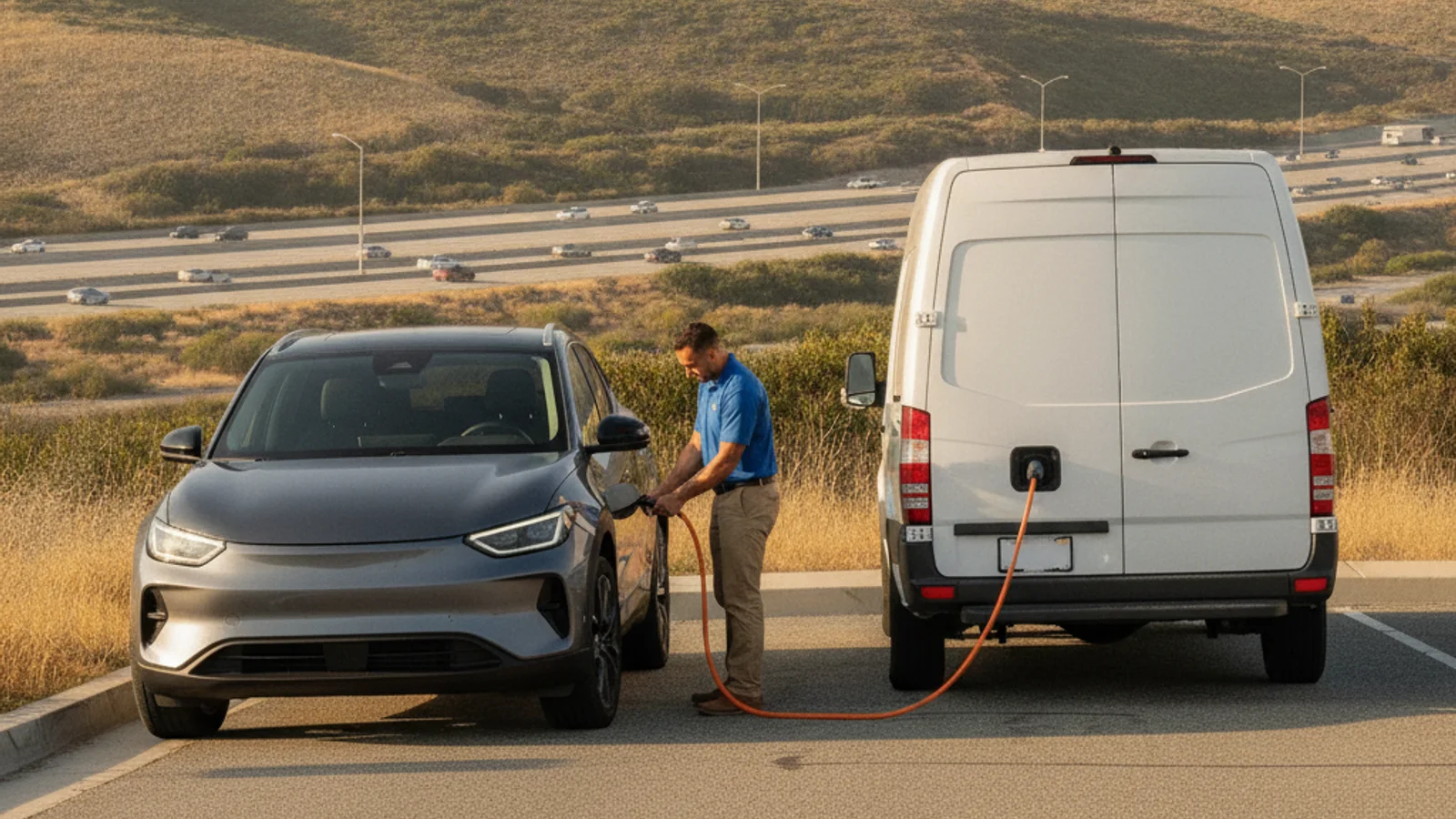
The I-10 climb through the San Gorgonio Pass
Banning sits in the San Gorgonio Pass in Riverside County. Census ACS 2019-2023 puts Banning at 31,093 residents. The 2024 Census city estimate is 31,929 people. Mount San Gorgonio and Mount San Jacinto frame the pass. The San Gorgonio Pass wind farm is the landmark through-drivers already recognize. I-10 runs both directions through town with a climb and a descent. You’ll feel that same grade load in Beaumont next door.
Pass wind and elevation still spend range on this stretch. Banning sits slightly lower than Beaumont, and it’s marginally hotter. A range number that looked fine near Calimesa can shrink on the Banning grade. That’s the corridor talking, not a defect in your car.
Ramsey Street is the old highway through downtown Banning. Highland Springs Avenue, Sunset Avenue, Hargrave Street, and Wilson Street make the local grid. If you left I-10 for a lot, name that street. A pin beats a vague “somewhere in Banning” every time.
Downtown Banning runs along Ramsey Street toward the older core. Sun Lakes Country Club, the Highland Springs corridor, and Smith Creek are named areas. So are the Hathaway Street area and the Morongo boundary streets. The Morongo Band of Mission Indians reservation sits immediately east. Cabazon is the next named place in that direction.
Banning Electric isn’t SCE, and it publishes no EV rate
Most Inland Empire drivers assume Southern California Edison sets every home rate. Banning doesn’t sit on the Edison map. The City of Banning Electric Utility serves this city. Banning is absent from SCE’s served-cities list.
That fact matters at the house, and it still matters after a stall. SCE publishes a residential EV rate plan for its customers. Banning Electric publishes no EV rate plan. It publishes no EV rebate and no charger rebate either. That was checked against five separate pages on banningca.gov. No verifiable EV rate or rebate program turned up. Confirm the current residential rate with Banning Electric before you assume a discount. The utility sets the rate, and this page can’t quote one.
Beaumont next door is an SCE city. Unincorporated Cabazon is on SCE as well. Banning remains its own municipal electric utility. Housing stock here is older than the neighbor to the west. ACS 2019-2023 puts 44.8% of Banning housing before 1980. Beaumont is 16.8% on that same vintage. That’s the sharpest contrast between these two I-10 neighbors. Older panels and a utility with no published EV program are a home issue. They don’t change who you call from the I-10 shoulder.
Banning’s median household income is among the lowest in the Inland Empire. Only Hemet sits lower in the ACS 2019-2023 city figures. A long-distance tow is a real financial event for many households here. Ask the operator for a quote before any work starts.
Our notes on what shapes Tesla charging cost across Inland Empire utilities cover the Edison side of the market. That post doesn’t invent a Banning EV tariff the city never posted.
Name the ramp, not just the town
Operators need a pin, not a city name. The city covers 23.24 square miles of pass land. Saying ZIP 92220 or 92223 only describes the mail route.
Give your direction of travel on I-10. Name the last exit you actually passed before you stopped. Highland Springs Avenue and Sunset Avenue help if you left the freeway. If you’re still on the shoulder, say which side. Say how much room sits beside the car.
A narrow shoulder or a live lane is a safety call first. Put the hazards on and get as far right as the pavement allows. If the stop isn’t safe, call 911 or CHP before any charging talk. EV roadside assistance is the first conversation once you’re in a reachable spot.
Gated lots, apartment codes, and business yards add a step. Sun Lakes and other restricted entries need a code or a gate meetup. A locked lot the operator can’t enter isn’t a workable site. Say that restriction up front in the first call.
The SR-243 climb toward Idyllwild
I-10 is the through-traffic stall in both directions. SR-243 is Banning’s other common stall pattern. The Banning-Idyllwild Panoramic Highway climbs south out of town. It heads into the San Jacinto Mountains on a steep, narrow, twisting road. That climb gains thousands of feet in a few miles. Winter brings snow and chain controls on SR-243. A range estimate from downtown Ramsey Street doesn’t describe that road. If you stalled on SR-243, say you’re on the mountain highway. Grade, width, and weather change what an operator can set up.
Gilman Historic Ranch is the landmark on that side of town. Idyllwild is the destination up the climb. Cherry Valley sits toward Beaumont on the local streets. None of those names replace a mile marker or a cross street.
Empty pack or a dead 12-volt
“My EV died on I-10” names two different failures. An empty traction pack usually shows a low-range or zero-range warning first. A car that goes fully dark is a different problem. No dash and no controls often point at the 12-volt battery.
Read the screen word for word if anything is still lit. Share what still works: locks, interior lights, the phone app, and the charge-port release. Don’t guess a battery-access step from a generic EV article. Layouts differ by brand and sometimes by year. The owner’s manual or the maker’s app is the reference.
Teslas and every major EV brand show up on this pass. Operators bring a 240-volt Level 2 source to the car. Tesla owners get a native NACS plug. Other EVs use a CCS or J1772 adapter. A typical roadside session adds 10 to 20 miles of range. That takes 15 to 30 minutes of charging. That’s charging time on the clock, never an arrival time.
A 12-volt jump or replacement on site is the other common fix. If the 12-volt is the problem, more pack miles won’t wake the car. Tell the operator you can’t tell which failure you have, if that’s the truth. Our walkthrough of what a mobile EV charging visit actually is keeps that line clear.
What the operator has to hear first
Make, model, model year, and the connector on the car come first. Tell them whether the car sits on a shoulder, a lot, or a grade. Then the symptom, not your diagnosis of the pack.
Charge Pro IE doesn’t own trucks, set prices, or employ technicians. Independent local operators do the work on site. They confirm the car, the plug, and the site. They quote the job, then they bill you.
Mobile EV charging is the conversation for an empty pack. If the 12-volt is the suspect, say that on the same call. The operator decides what equipment fits your car and the site. The Banning charging overview is the planning page if you’re still at home.
When a tow is the right tool
Some cars won’t take a charge even with a compatible plug. Some sites aren’t reachable: a live lane, a blocked structure, or a locked yard. In those cases the operator may recommend transport instead.
That’s a different tool, not a lesser one. Out-of-charge recovery is the path when on-site charging isn’t the fit. Don’t force a mobile charge onto a car that refuses the plug. Fault codes belong to the manufacturer docs and the operator on scene.
Heat and grades on this pass still spend range on a full pack too. Plan that on a later trip, not from a live shoulder. The DOE Alternative Fuels Data Center keeps general station data. Use it at the kitchen table when you plan the next trip. Don’t use it as a reason to wait on a live shoulder.
How to get a local operator on the line
Call when you’re stopped on I-10 through Banning. Call from Ramsey Street or from the SR-243 climb too. Call for an empty pack, a dark dash, or a message you can’t parse. We’ll connect you with an independent EV rescue operator. Call (909) 250-2881 and the operator quotes the work before it starts.