A tesla charging service search after a stall usually mixes two jobs. Tesla’s published path for an empty pack is a tow. It isn’t a charger rolled to your bumper. Confirm that wording in Tesla’s app and support pages. Then decide whether you need transport, a 12V jump, or energy at the car.
Tesla charging service is several jobs with one name
The phrase sounds like one product, and it isn’t. It can mean a home wall connector that stopped delivering. It can mean a Supercharger stall that never starts a session. It can mean a Tesla that already sat down on the shoulder. Those three calls aren’t the same truck.
The U.S. Department of Energy explains charging levels in plain terms. Level 1 is 120-volt AC. Home Level 2 uses 240 volts. Some commercial equipment uses 208 volts. Tesla cars use the J3400 connector, also called NACS, for AC charging. None of that picks the operator. Location and symptoms do.
A Model Y with range left in a Rancho Cucamonga driveway is a charger problem. A Model 3 stopped on the I-15 Cajon climb is a mobility problem.
Tesla’s empty-pack answer is transport
Tesla roadside assistance isn’t a mobile charging truck. For a depleted traction battery, Tesla’s published handling has been transport. That usually means a tow toward a Supercharger or a Tesla service stop. It doesn’t mean 240-volt energy at your charge port.
This page couldn’t confirm Tesla’s live coverage terms or dispatch rules for 2026. Tesla sets those, and they change. Open the Tesla app. Read the current roadside screens for your VIN and location. Ask which event they cover: empty pack, 12V failure, charger fault, or breakdown. Don’t assume those four get the same truck.
Read what Tesla roadside covers inland. An empty pack isn’t the same as a warrantable breakdown. Empty Tesla pack vs a warrantable breakdown walks through that cut.
Why inland roads make the split matter
The Inland Empire is two counties, not one kind of road. Riverside County’s ACS 2019-2023 population is 2,478,600. San Bernardino County’s is 2,197,104.
A stall on I-10 through Colton isn’t a stall in Big Bear Lake. The City of Colton Electric Utility owns the electrical infrastructure inside city limits. That matters for a home charger. It doesn’t change who you call from the I-10 shoulder.
Riverside Public Utilities serves the City of Riverside, not Southern California Edison. Banning runs its own municipal electric utility. Bear Valley Electric Service covers Big Bear Lake and Big Bear City. Most of Rancho Cucamonga sits on SCE. A southeast pocket uses Rancho Cucamonga Municipal Utility. That pocket includes The Enclave, Day Creek Square, The Resort, and the Victoria Gardens area. Moreno Valley is split too. SCE serves part of it. Moreno Valley Utility covers newer development and publishes an address lookup.
Ontario airport lots and Fontana warehouse rows add gates, dock hours, and lot names. A Tesla in a downtown Riverside garage needs the level, entrance, and clearance. A Tesla on SR-91 through Corona needs direction and the last exit. SR-60 through Jurupa Valley is the same idea. I-215 through Moreno Valley and Perris is a long valley run. The Ortega near Wildomar is a different shoulder.
Mountain miles are their own pattern. Lake Arrowhead, Crestline, Running Springs, and Big Bear Lake all sit above the valley floor. A day trip down can still leave you short. That’s about grade, heat, and a pack you already used going up.
Don’t guess the nearest Supercharger. Don’t estimate miles to a stall.
A High Desert run toward Adelanto, Phelan, or Apple Valley is long and hot. French Valley and Temecula add wine-country miles after a full day parked. Pechanga’s lot is the same trap: the car sat, then it wouldn’t wake. Glen Helen’s amphitheater lot still needs the lot name, not a guess.
Sort the Tesla before you request a truck
Start with what you can see.
The car still rolls, but it won’t charge
That’s equipment, not an empty pack. Write down the station ID if it’s public. Save the exact message on the car or the stall. A home wall connector that died is an electrician job. It isn’t a roadside rescue.
The traction pack is empty and the car won’t move
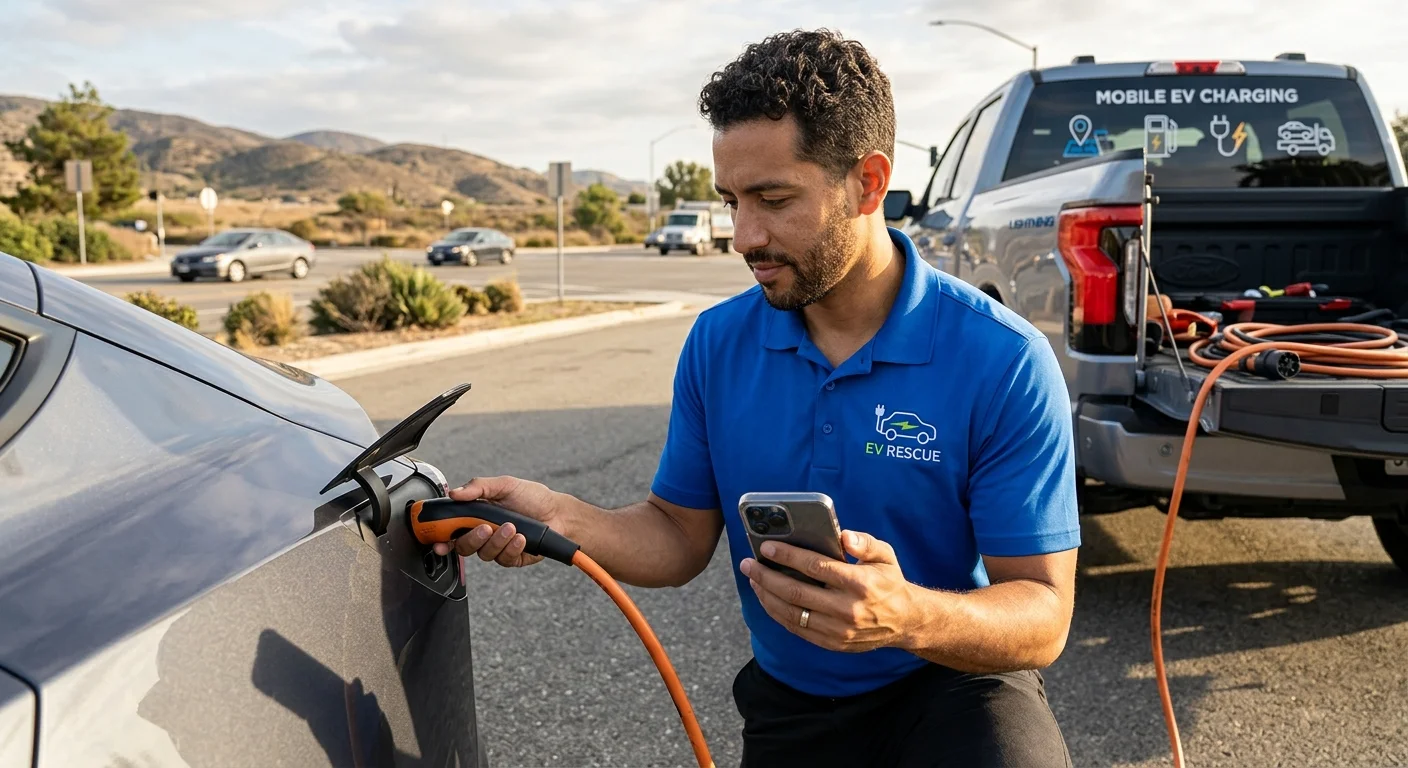
Tesla’s usual manufacturer path is a tow. An independent operator may instead bring a 240-volt Level 2 source to the car. Tesla takes a native NACS plug. The operator has to confirm they can reach you. They also confirm the car will accept energy. Mobile EV charging is that visit, when it fits.
Screens, locks, or the computer look dead
That can be the 12-volt battery, not the pack. Don’t tell the operator you’ve already diagnosed it. Ask if they can assess a Tesla 12V on site. See the 12V versus pack check.
The car needs a hook, not energy
Collision damage, a jammed charge port, or a car that keeps refusing energy. A shoulder where roadside work isn’t safe counts too. Those notes don’t prove the mechanical cause. They help the operator pick transport.
A mobile Level 2 visit isn’t Tesla’s roadside product
Charge Pro IE matches stranded EV drivers with independent local mobile rescue operators. We don’t own trucks. We don’t employ technicians. We don’t set prices or arrival times. The operator quotes you before starting and bills you directly.
They bring a 240-volt Level 2 source to the car. Tesla gets a native NACS plug. Non-Tesla EVs use a CCS or J1772 adapter. They typically add 10 to 20 miles in 15 to 30 minutes of charging. That’s charging time, never an arrival time. They can also jump or replace a dead 12V on site.
That visit only fits if the Tesla is reachable and will accept a charge. See what a mobile EV charging visit actually is. Our Tesla roadside rescue page is how drivers start that match.
A mobile visit isn’t a stand-in for repair. It isn’t a stand-in for Tesla’s tow path either. It’s a third product: energy at an accessible car that can take it.
Home charger trouble lives on a different map
If the Tesla can still drive, stay on the charger problem. Don’t call it a rescue.
Utility territory here is messy, and it matters for the panel. Most of Fontana, Ontario, Chino, Upland, and San Bernardino sit on Southern California Edison. The City of Riverside doesn’t. Colton doesn’t. Banning doesn’t. Apple Valley gets SCE delivery, with Apple Valley Choice Energy procuring generation. San Jacinto is similar: SCE delivers, and San Jacinto Power supplies.
Older housing changes the panel conversation. ACS 2019-2023 puts pre-1980 housing at 60.9% in the City of San Bernardino. The City of Riverside is 56.4%. Eastvale is 2.2%. Temecula is 6.5%. A licensed electrician runs the load calculation. Charge Pro IE doesn’t install chargers. We don’t hold that trade license.
Victorville is easy to get wrong on the utility side. SCE serves residential customers there. Victorville Municipal Utility Services serves only the Southern California Logistics Airport and Foxborough Industrial Park. It states it doesn’t provide utility services in residential areas at this time. That split doesn’t dispatch a roadside truck. It only matters if the wall connector at home went dark.
What to tell whoever you call
Give the city and the road, not a diagnosis. Say whether the Tesla can roll. Read the message on the screen, word for word. Say if you’re on a shoulder, in a lot, or in a garage. On a freeway, add direction and the last exit you saw. Ontario airport and warehouse parks need the lot name. Share a gate code if you have one.
Tesla’s current path may be a tow. If you wanted energy at the car, say so. The independent operator then confirms whether a Level 2 visit is even possible.
How Charge Pro IE connects the call
We’re a referral line for the Inland Empire. The pros we connect you with are licensed and insured. They handle Tesla and every major EV brand. You contract with the operator, not with us.
When you call, describe location and what you can see. We’ll match you with a relevant local operator. That operator confirms charging, a 12V jump, or transport. They explain their own price and terms.
Before you approve work, make them say the plan back. If the job flips from a charge to a tow, get new terms first.
When this number is the right next step
Call when the Tesla can’t reach a charger on its own. You want an independent mobile operator to quote a visit. Call (909) 250-2881 and we’ll connect you with a local EV rescue operator.