A zero-range warning in Yucaipa is a stop, not a dare. The city sits about 2,600 feet up, cooler and higher than the valley floor. From here Oak Glen Road still climbs toward nearly 4,700 feet. I-10 also begins lifting toward the San Gorgonio Pass. An empty pack shouldn’t start either grade.
This town is the pause before the climb
Eastbound I-10 traffic often treats Yucaipa as the last easy town before the pass. Drivers bound for Palm Springs still have a charge decision here. Autumn visitors to Oak Glen’s apple orchards make that same call from the other side. They come up from Los Angeles and Orange counties for the day. Then they roll back down low.
Don’t treat that pause as optional once the gauge is already on fumes. Range from the valley floor won’t hold on a short, steep climb. Winter mornings in Oak Glen run genuinely cold. Higher ground around Yucaipa even sees occasional snow the valley cities never get.
Yucaipa covers about 28 square miles in San Bernardino County. Calimesa sits immediately south of it, in Riverside County. From the freeway they look like one town, and they’re not. Sheriffs, county services, and CHP dispatch all change across County Line Road. A caller in Yucaipa and a caller in Calimesa can be two hundred yards apart. Name the city on the sign, not the skyline you see.
Our Yucaipa EV charging page covers the city as a whole. This piece is only the out-of-charge decision on the climb.
Name the road you’re actually on
Saying you’re in Yucaipa covers too much ground to search. Downtown Yucaipa, Chapman Heights, Dunlap Acres, and Wildwood Canyon are different stops. So are the Crafton Hills College area and the Yucaipa Boulevard corridor. An operator can’t guess which of those you’re sitting in.
Read the nearest sign as printed, then share what you can confirm. Give the route: I-10, SR-38, Yucaipa Boulevard, Oak Glen Road, Calimesa Boulevard, County Line Road, or Bryant Street. Add direction of travel, the last cross street, and a map pin. If you can read a landmark, name it. Crafton Hills College, Yucaipa Regional Park, and the Yucaipa Adobe all help. Say whether you’re on pavement, a turnout, a lot, or private property.
If the pin and the sign disagree, send both. Don’t invent a mile marker you can’t see. Mention which side of the road you’re on. A pin can sit on the wrong side of a median or a fence.
If you’re already talking to an officer or a firefighter, say so. Tell the operator what they said about moving the car.
Redlands and Mentone sit west. Beaumont sits east toward the pass. Oak Glen sits above you. Calimesa sits across the county line. Name a neighbor only if a sign actually says it.
For a Tesla already stuck in town, this Yucaipa roadside comparison walks through Tesla roadside versus a local operator. Use it after you’ve pinned the car.
Keep the scene out of moving lanes if you already can
The first job is the scene, not the battery. If the EV is already clear of moving lanes, say exactly where it sits. If it isn’t, describe that before you try another move.
This page can’t tell you to stay inside, step out, or roll the car. Every turnout, orchard driveway, and freeway shoulder here is different. No verified shoulder rule for I-10 or Oak Glen Road turned up. If anyone is in immediate danger, call 911 and follow the people who arrive.
Don’t assume you can still reach the next driveway. A car showing no usable range may not complete another roll. Report whether it will select drive, steer, or release the parking brake. Don’t test those things if testing would put someone in a lane.
Stopped in traffic and parked off the roadway are different facts. Give the operator the true one.
West of here, I-10 through Redlands is a separate freeway problem. East toward the pass, Beaumont roadside help covers the next climb decision.
An empty pack and a dead 12V are different problems
A car that won’t roll hasn’t diagnosed itself. Copy the messages on the screen. Describe what happened in the last minute, not what you assume. Note the displayed percent or estimated miles, and repeat warnings exactly. Say whether the main screen, doors, and charge port still respond.
Use the car’s app if it still connects. Missing app data isn’t a diagnosis. Note what it shows and when it last updated. A screenshot keeps wording that later vanishes.
If the car reports a low-voltage problem, say that. Don’t call it an empty traction pack unless the car also reports depleted charge. A zero-charge message isn’t a 12V failure either.
Don’t pop panels or try a guess jump from another vehicle. The matched operator should confirm the car, the symptoms, and the fit. Charge Pro IE doesn’t diagnose the vehicle and doesn’t do the roadside work.
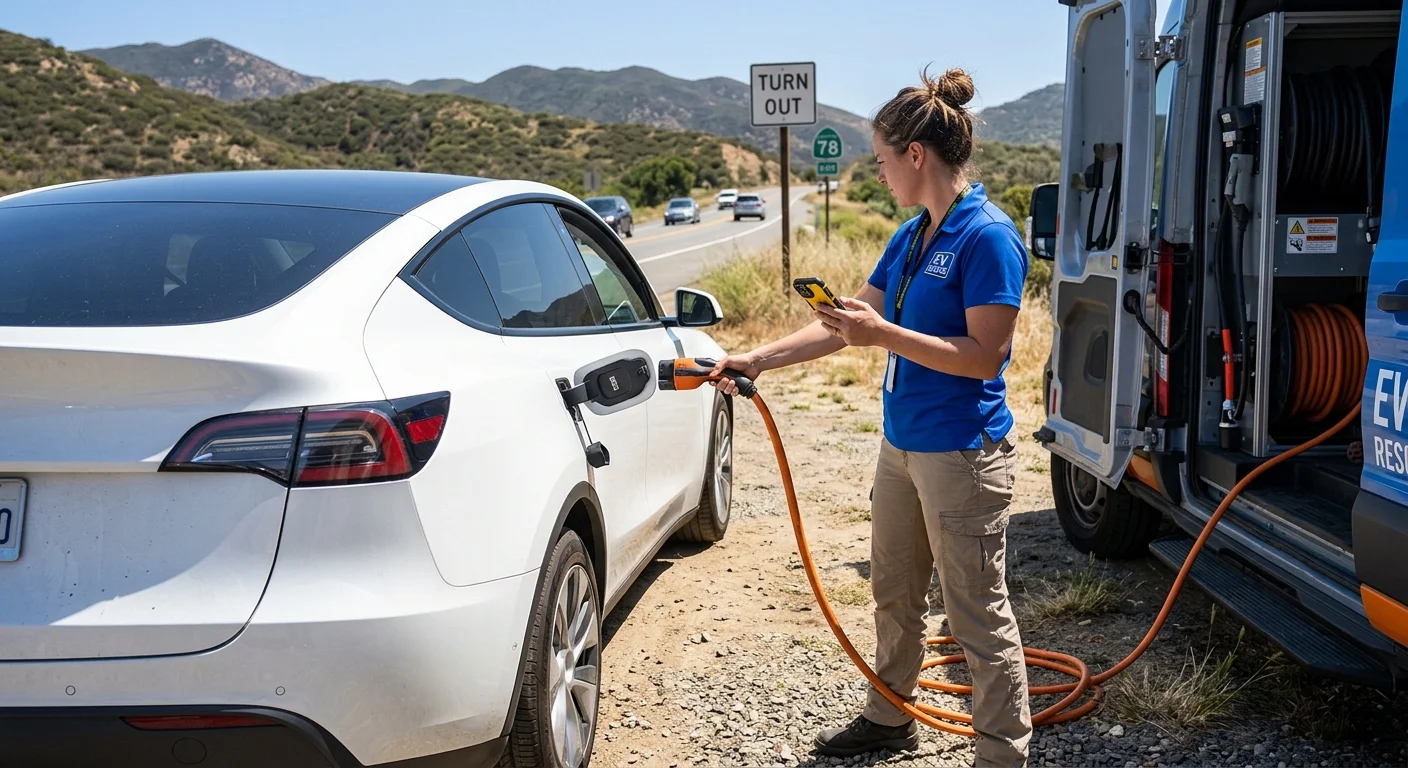
Independent operators in this network can jump or replace a dead 12V on site. They also bring a 240-volt Level 2 source to the car. Tesla owners usually see a native NACS plug. Other EVs typically need a CCS or J1772 adapter. When a charge is the right job, it typically adds 10 to 20 miles. Plan on 15 to 30 minutes of charging for that. That’s charging time, not a promise about when someone arrives.
Mobile EV charging is one of those paths. Share make, model, year, and the exact dash text so the operator can match gear.
Describe the last stretch the truck has to use
A perfect pin still hides the approach. Oak Glen Road is a narrow winding climb into orchard country. Downtown lots, Chapman Heights streets, and an I-10 shoulder each need different equipment placement. Say how a truck would actually reach the charge port.
Say if you’re beside a live lane, in a turnout, or on private land. Mention a gate, a height limit, or a garage. Mention room around the charge port and which side it sits on. Don’t move the EV only to make working room. Do that only if the scene is safe and an authority asked.
Locked doors, a missing key, a flat, or wheels that won’t roll change the recovery. If the lot isn’t yours, say whether you can admit the operator.
Ask the operator to confirm the connector and the output they can actually deliver. Not every mobile charger fits every EV. The U.S. Department of Energy charging guide explains levels and plugs if you want background.
Charge Pro IE passes your details to an independent operator. It doesn’t own trucks, set prices, or control who is free. Confirm equipment, price, and access with the operator before you agree. The operator quotes you before starting and bills you directly.
Choose a mobile charge or a tow on purpose
Mobile charging is a recovery option, not the default. The operator has to decide whether the EV can take energy where it sits. Location, access, vehicle state, and the plug all feed that call. Ask whether a mobile charge fits, whether the connector matches, and where the gear would stand. Ask what output they can provide, and whether a tow is cleaner.
Don’t assume a charge will buy extra miles beyond what they quote. Output depends on their equipment and what your car will accept. Confirm what the visit is meant to accomplish before you say yes.
Transport enters when the EV can’t take a charge where it sits. It also fits when another fault remains, or the spot can’t be worked. The transport provider should confirm loading method, destination, access, and price. Charge Pro IE doesn’t set those terms.
If a charge is on the table, name the next place you actually intend to reach. That might be home in Chapman Heights or a stall you’ve already checked. Don’t aim at a stall you haven’t confirmed is working and open. Check live status before you treat it as the plan.
Out-of-charge recovery is the referral path for that decision. For the visit itself, what a mobile EV charging stop is separates a roadside hookup from a shop.
When to call
Call when the car has already stopped in Yucaipa or on the climb out of town. You need an operator to weigh a mobile charge against a tow. Charge Pro IE is a referral line. It matches you with independent local mobile rescue operators. It performs no work.
Call (909) 250-2881 and we’ll connect you with a local EV rescue operator.