A stranded Rivian, Mach-E, or Ioniq in the Inland Empire needs CCS or J1772. Operators who carry those adapters are the ones who can help. Tesla-only gear won’t wake those cars. Non Tesla EV roadside assistance here is a 240-volt Level 2 hookup. A local operator brings it to the car. Charge Pro IE matches you with independent mobile rescue operators. They handle Tesla, and they handle every major EV brand.
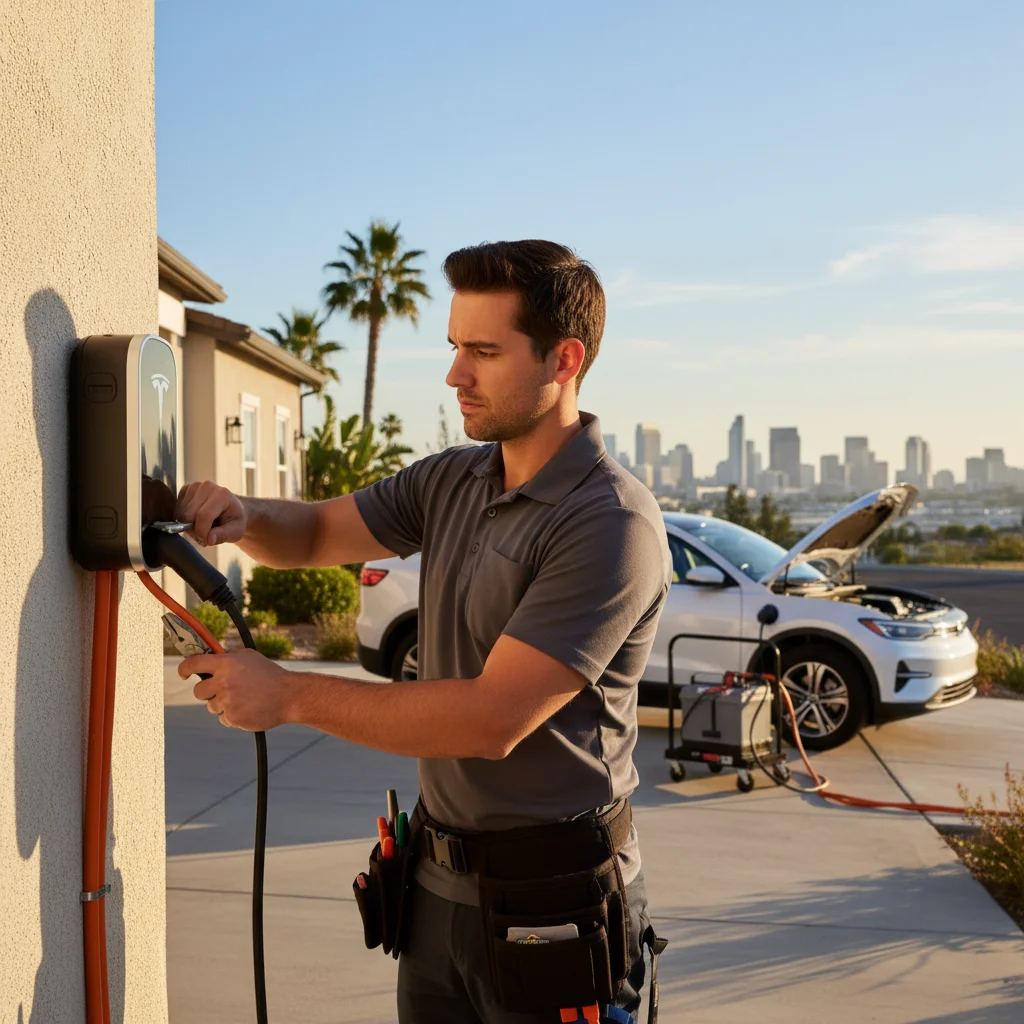
The plug on the truck decides the stop
Tesla built the car, the app, and the Supercharger face as one system. A Model Y that hits zero is a known shape. Ford, Hyundai, Kia, Rivian, GM, Volkswagen, and Polestar aren’t on that stack. Their ports are CCS1, J1772, or NACS on newer trucks. If the person who stops packed only a Tesla plug, the session never starts.
That’s a gear problem, not a knock on the cars. Inland Empire lots make it ordinary. Warehouse rows in Fontana and Ontario leave work EVs sitting after a shift. Employee parking around Ontario airport does the same. In San Bernardino, ACS 2019-2023 puts 60.9% of housing before 1980. In Riverside city the share is 56.4%. Panels and driveways in that vintage weren’t built around a 240-volt EV circuit. Eastvale’s pre-1980 share is 2.2%. French Valley sits at 2.3%. Newer tracts still leave you short when the house circuit is dark. Once you’re on the shoulder, the adapter in the kit is what matters.
The operators behind non-Tesla EV rescue bring CCS and J1772 adapters. They also carry a native NACS plug. They quote before they start, and they bill you directly. Charge Pro IE doesn’t own the truck or set the price. It doesn’t promise an arrival window.
Valley, pass, desert, and mountain drive differently
Riverside County has 2,478,600 people in ACS 2019-2023. San Bernardino County has 2,197,104. The roads between those counties aren’t one commute.
I-15 over Cajon toward Victorville and Hesperia is heat plus grade. I-10 through Colton, Redlands, Beaumont, and Banning climbs east the same way. I-215 through Moreno Valley and Perris stacks traffic on a slope. SR-60 across Jurupa Valley keeps the pack working in slow lanes. The 91 through Corona does the same. Ortega Highway near Wildomar asks for elevation on a narrow shoulder. Lake Arrowhead and Big Bear weekends add a downhill return after a cold morning start.
Public stalls sit along those corridors. A falling range bar is still a reason to stop planning a coast-in. Grade and summer heat pull more from the pack than a flat valley hop. Operators typically add 10 to 20 miles of range. That usually takes 15 to 30 minutes of charging. That span is charging time, never a promise of when someone appears.
Home electricity is split across this market too. Fontana, Ontario, Chino, Upland, and San Bernardino sit on Southern California Edison. Riverside runs on Riverside Public Utilities. Colton owns its electric system inside city limits. Banning has a city utility. Big Bear Lake and Big Bear City sit on Bear Valley Electric Service. Moreno Valley and Rancho Cucamonga are split. SCE serves most of both, plus a municipal pocket. Apple Valley Choice Energy and San Jacinto Power supply generation on SCE wires. Those names change how you charge in the driveway. They don’t change the CCS door on an Ioniq in a work lot.
What the operator actually carries
A roadside rescue here is a 240-volt Level 2 source rolled to the car. The connector on that cable is what most general wreckers skip. For the visit itself, start with what a mobile EV charging visit actually is.
CCS1, the common fast-charge face
CCS1 is still the usual DC inlet on non-Tesla EVs sold in the US. Rivian, Ford, Hyundai, Kia, Volkswagen, Polestar, and many GM models use it. It looks like a J1772 inlet with two extra DC pins under it. Operators use a CCS-capable lead so the car will take the session. You’re not filling the pack. You’re buying miles to reach a named station.
J1772, the AC plug almost every car will take
J1772 is the North American Level 2 AC standard. Almost every non-Tesla EV in this market will accept it. A CCS port still takes J1772 for AC charging. It’s slower than a DC stall, and for a rescue that’s enough. Ten to twenty miles is the job.
NACS, the Tesla-style plug on newer non-Tesla trucks
Ford, GM, Rivian, and other brands have been moving later model years to NACS. Some later F-150 Lightnings already shipped with that rectangular face. Operators bring a native NACS plug and adapters. A newer truck and an older Mach-E are both in play. Look at your port door if you need to confirm. CCS1 has the larger lower block. NACS is the smaller Tesla-style rectangle. J1772 with no DC pins is AC only.
Mobile EV charging is that Level 2 visit. It isn’t a Supercharger on a truck.
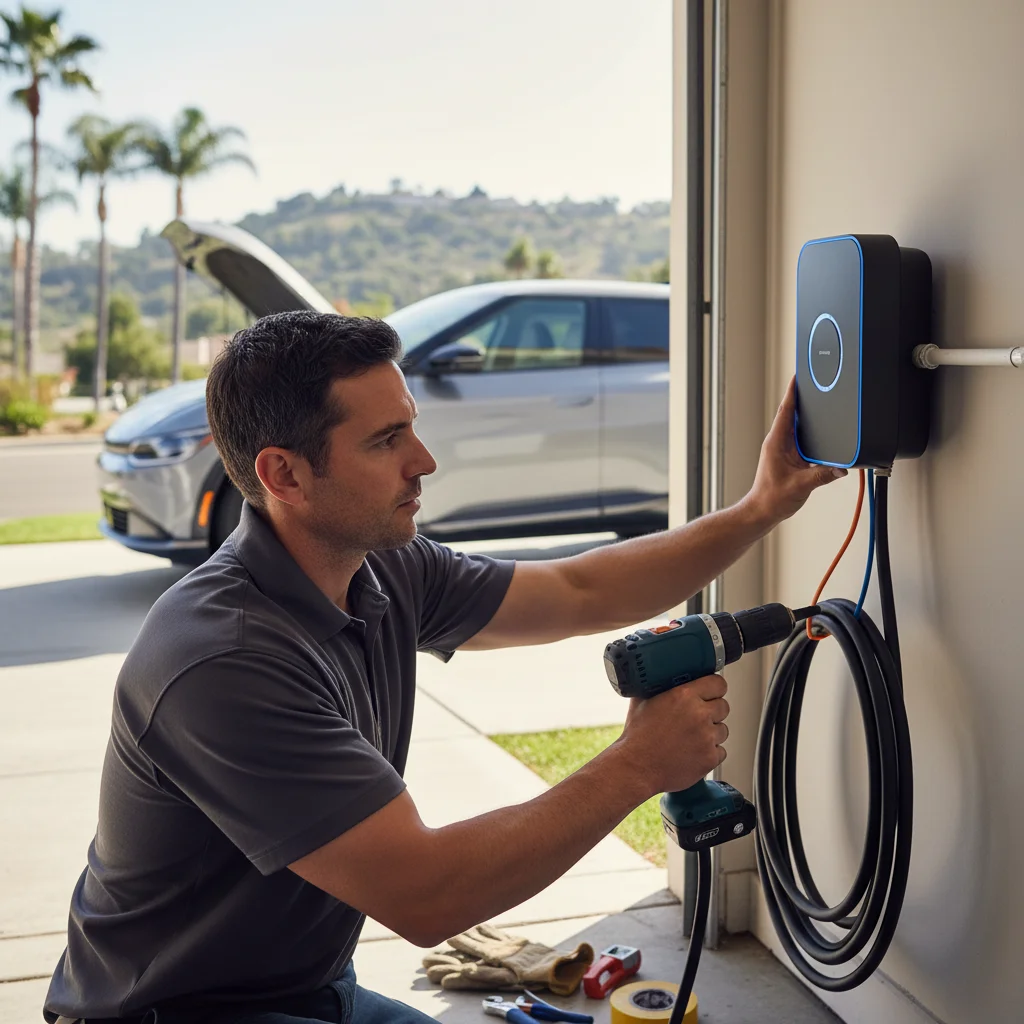
Brand notes that change the first five minutes
Shared connectors don’t mean shared charge-port hardware. The nameplate on the shoulder changes the opening steps.
Hyundai Ioniq 5, Ioniq 6, and Kia EV6
These cars carry large packs. A Level 2 roadside session won’t fill them. It will add the miles you need to roll to a DC stall. They use CCS1. Pack size and usable capacity live in a separate guide. See Hyundai Ioniq 5 battery size, and what that means when you’re low.
Ford Mustang Mach-E and F-150 Lightning
The Mach-E port release is electronic. A dead 12-volt can keep the door shut. Ford put a mechanical pull in the frunk. The Lightning has a similar release. Use that tab before anyone starts pulling trim. Earlier Mach-E and Lightning trucks use CCS1. Later Lightning trucks moved to NACS. A cable can stick in the port later. The Mach-E charge-port release steps cover that snag.
Rivian R1T and R1S
The port is on the driver’s-side rear. The door often needs the truck awake, or in accessory, before it opens. A flat 12-volt blocks that. Rivian hid a manual release behind the rear driver’s-side trim. If the door won’t move, that cable is the next move. Older R1 trucks use CCS1. Later years have been shifting toward NACS. Confirm the model year. If the latch is the problem, use the trim path. Rivian charge-port cable release walks through it.
Chevy Equinox EV, Silverado EV, and GMC Sierra EV
Work lots around Ontario’s airport see these sit empty after a shift. Fontana’s warehouse grid is the same story. GM has been putting NACS on newer model years. Older Bolts still use CCS1. They remain in daily traffic through Rialto and San Bernardino. The Sierra pack can already be gone. GMC Sierra EV emergency charging when you’re stranded is the truck-specific path.
Polestar 2 and 3
Polestar uses CCS1. The port sits on the driver’s-side rear. If the car refuses a charge, it may be in a fault state. A soft reset on the center-console control often clears that before anyone swaps adapters.
When the car looks dead, check the 12-volt first
Range at zero and a dark dash aren’t the same failure. The traction pack turns the wheels. A small 12-volt battery runs the computers, locks, lights, and charge-port door. Inland heat in the valley and the High Desert is rough on that small battery. If hazards look weak and the port won’t open, tell dispatch. Jumping or replacing the 12-volt on site is a different job. It isn’t a Level 2 top-up. The operators in this network do both, on Tesla and on every major EV brand.
A public stall won’t help until that 12-volt is up. The car may not accept a plug at all.
On I-10, I-15, and the 91, stay in the car
If you’re already on a freeway shoulder, stay inside. Pull as far right as you can. Hazards on. Seatbelt on. Step out only on the passenger side, and only if you must.
Give dispatch the make, model year, and port shape. CCS, NACS, or J1772. If a low-voltage warning is separate from the range bar, say so.
Open the charge port if it will move. Most brands hide a manual release. Check the owner’s manual or the glove-box card. Doing that before the operator arrives saves time in the trim.
Pick your next charger in PlugShare so the top-up has a destination. Don’t push the car. Wait for the operator vehicle.
Who Charge Pro IE sends, and who it isn’t
Charge Pro IE is a referral line for the Inland Empire. It matches stranded drivers with independent local operators. It holds no licence. It owns no fleet. It employs no technicians. The operator on scene quotes before any charging starts. You pay that operator.
A tow still has a place when the car can’t take a charge. When the pack is empty and the 12-volt is fine, you need miles. CCS or J1772 Level 2 puts them back in. If the automaker app only offers a hook, that’s a different outcome.
Call (909) 250-2881 when you’re out, or when the port won’t open. That’s the matching desk. The operator who takes the job brings CCS or J1772. That’s the adapter your car actually uses.