A Nissan Leaf that won’t start is usually a flat 12-volt battery. The traction pack can still show leftover range on a last reading. Until that 12V has power, READY mode never arrives. That stall shows up in Inland Empire driveways, warehouse lots, and freeway shoulders.
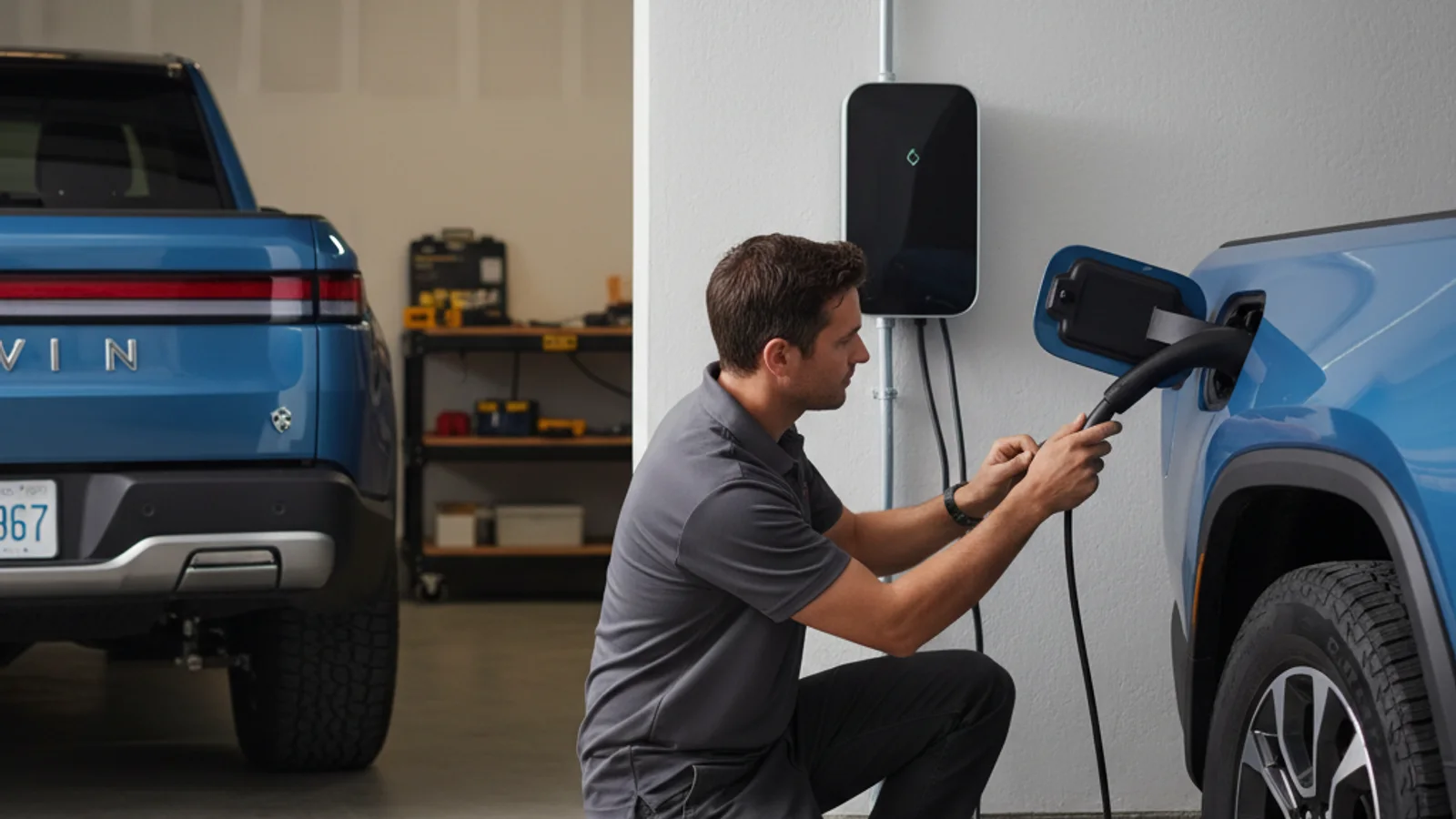
Two batteries, and only one turns the wheels
Your Leaf carries a large lithium traction pack that turns the motor. A much smaller 12V battery runs the rest of the car. Door locks, the dash, the screen, and the pack relays all need it.
When the 12V is dead, those relays stay open. That’s a safety interlock, not a random glitch. The contactors won’t close without low-voltage power. So a full pack still can’t reach the motor. The car looks completely dead even though the pack is fine.
Owners often assume an EV can’t have a dead battery. The 12V system can, and on a Leaf it’s the usual no-start. Other EV brands fail the same way. Here’s what happens when an EV 12V dies on the road.
How to tell a dead 12V from an empty pack
Start with what still responds when you press the fob. A dead 12V often means a black dash and a silent fob. An empty traction pack usually lets the car wake, then shows low range. If nothing on the dash lights, treat the 12V first.
A long shift by an Ontario airport or warehouse lot produces the same mix-up. Someone walks out and the Leaf looks bricked. They assume they ran the pack to empty. The pack may still be fine after a full workday. The 12V sat too long with accessories drawing on it.
A black dash in a San Bernardino or Riverside driveway is the same diagnosis. ACS 2019-2023 puts pre-1980 housing at 60.9% in San Bernardino. The city of Riverside sits at 56.4% pre-1980 housing on that same vintage. Fontana warehouse lots see the same stall after a long shift.
A climb on I-15 toward Victorville is a different stall. There, an empty pack is more plausible after the grade. I-215 through Moreno Valley and Perris can drain a pack the same way. A dark dash after the car sat still is still 12V until you prove otherwise.
Get inside before you chase a charger
A flat 12V can lock you out of the car. The fob may not talk to the Leaf at all. Every Leaf fob still hides a physical key blade. Slide the blade out of the fob body and start at the driver’s door.
The lock cylinder is often behind a small cap on the handle. Use the blade there, then step into the car. Pull the hood release in the driver’s footwell.
Most Leaf years put the 12V under the hood toward the driver’s side. You’ll see the positive and negative posts on top. That’s the battery you jump, not the pack in the floor.
If the car is on the I-10 shoulder in Colton, wait. The 91 through Corona is the same kind of bad DIY site. Don’t work in a live lane if you can get to a lot. Call for an operator if you can’t move it first. SR-60 through Jurupa Valley and I-10 through Redlands have the same shoulder problem.
Clues the 12V was already fading
The Leaf usually hints before it bricks you in a lot. Watch for a 12V or electrical-system message on the dash. READY that takes longer than it used to is another. The center screen may reboot slowly or freeze. The fob may only work pressed against the handle. Cabin lights can look dim on a short walk-up. You might hear a click and get no power-up.
One sign doesn’t prove the case by itself. Several together mean get that 12V tested. Idle time is harder on it than a daily drive. A Leaf that sits through a weekend can fade the same way. That’s true in Temecula, Menifee, Montclair, or Upland.
Heat and age both stress a lead-acid 12V. A published Leaf 12V replacement interval could not be confirmed from the sources on this page. Treat the symptoms you can see, not a guessed calendar. If a charge timer or auto headlights start acting odd, add that to the list. It still isn’t proof on its own.
Jump the 12V in a safe order
Most Leaf years let you jump from under the hood. You need cables and a donor car, or a portable jump pack. Follow a strict clamp order and don’t improvise the last ground. How to jump start an EV at the curb uses the same logic across brands.
- Get in and open the hood. Use the key blade, then the footwell release.
- Find the 12V. Look under the hood on the driver’s side for posts marked + and −.
- Connect in order. Red to the donor positive. Other red to the Leaf positive. Black to the donor negative. Last black to a clean, unpainted metal ground on the Leaf, not the negative post.
- Let the donor feed the 12V. Keep the donor running for several minutes.
- Power the Leaf with the cables still on. Press the power button and wait for READY.
- Disconnect in reverse. Leaf ground first, then donor negative, then Leaf positive, then donor positive.
A jump is a bridge, not a repair. A worn 12V can die again after you park. If it falls a second time, read what a repeat 12V death usually means. Plan a replacement once you can drive to a shop. If the posts are corroded or you can’t find a clean ground, stop. Call an operator instead of guessing at a clamp point.
If READY still doesn’t appear
The jump may take and the car may still sit. Then you’re past a simple 12V flatten. The pack might actually be empty after a long inland drive. The 12V might not hold a charge at all. A fuse or module could be involved too. Stop cycling the power button once those checks fail.
Charge Pro IE connects you with independent local operators. They can jump or replace a dead 12V on site. They can also bring a 240V Level 2 source. That helps if the traction pack is the issue. They use a native NACS plug, with CCS or J1772 adapters for non-Tesla EVs. A Leaf takes J1772 for AC charging. Typical charging on that visit adds 10 to 20 miles of range. That takes 15 to 30 minutes of charging time. That number is charging time, not an arrival time.
Mobile EV charging is the call when the pack is empty. Non-Tesla EV rescue is the call for a Leaf 12V that won’t wake. The operator quotes you before starting and bills you directly.
An empty-pack stall is more plausible after the Cajon climb on I-15. I-215 through Moreno Valley and Perris can do the same. A black dash in a Redlands driveway overnight is still 12V first.
If the Leaf sat plugged in all night and still looks dead, start with the 12V. Don’t blame the home panel first. In the city of Riverside, home power is Riverside Public Utilities, not SCE. In Colton, it’s City of Colton Electric Utility. In Fontana, Ontario, and most of the valley, it’s Southern California Edison. Moreno Valley splits SCE with Moreno Valley Utility in newer tracts. Rancho Cucamonga splits SCE with Rancho Cucamonga Municipal Utility in a southeast pocket. None of those utilities jump a 12V at the curb, so you call an operator.
Who Charge Pro IE actually is
The brand is a referral line for the Inland Empire. It matches stranded EV drivers with independent local mobile rescue operators. It performs no work, owns no trucks, and employs no technicians. It sets no prices and publishes no hours. The operators we connect you with are licensed and insured. They handle Tesla and every major EV brand, including Nissan.
Coverage runs across Riverside County and San Bernardino County. That includes valley cities such as Riverside, Fontana, and Corona. It also includes High Desert cities such as Victorville and Hesperia. Mountain communities sit in the same service area. Big Bear Lake and Big Bear City sit on Bear Valley Electric Service, not SCE. Lake Arrowhead and Crestline stay on SCE. The utility still doesn’t jump your Leaf.
If you drive Nissan’s newer crossover, the Ariya 12V checks follow a similar path. The Leaf still uses the same 12V logic as the Ariya.
When DIY is the wrong move
Jumping is simple with cables, a donor, and a safe place to stand. Many Leaf stalling spots are none of those. A dark lot by Ontario’s warehouse rows is a poor workshop. So is the I-10 shoulder through Colton or Redlands.
If the car is sitting in traffic, make the call. If the fob is dead and you can’t get in, call. If you’re unsure of the terminals, call. The operators we send know the Leaf jump points and quote before they start. Check the official Nissan owners site for warranty and service history before you replace the 12V.
Call (909) 250-2881 and we’ll connect you with a local operator who quotes you before starting.
Frequently asked questions
Why won’t my Nissan Leaf start with a charged pack?
A dead 12V is the usual reason. The Leaf’s 12V powers the locks, the dash, and the pack relays. When it drops too low, the car won’t reach READY. Jump or replace that 12V and the car can wake again.
Can I jump a Nissan Leaf like a gas car?
Yes, on most model years the 12V sits under the hood. The posts are exposed, so a standard jump can work. Use the safe clamp order every time. Connect red to positive on both sides first. Put the last black clamp on a clean unpainted ground, not the Leaf’s negative post. Run the donor several minutes, then press the Leaf’s power button.
What if I can’t jump it myself?
Charge Pro IE will connect you with a local operator. That operator can jump the 12V on site and quote you before starting. The operator bills you directly after the quote. If the pack is empty instead, they can bring a Level 2 source.