A Tesla Model S with no power on I-10 still needs Tesla’s current transport checks. The same rule holds on I-15 through the Cajon. A dark cabin is not a green light for the hook. Confirm the car, the year, and what still responds first.
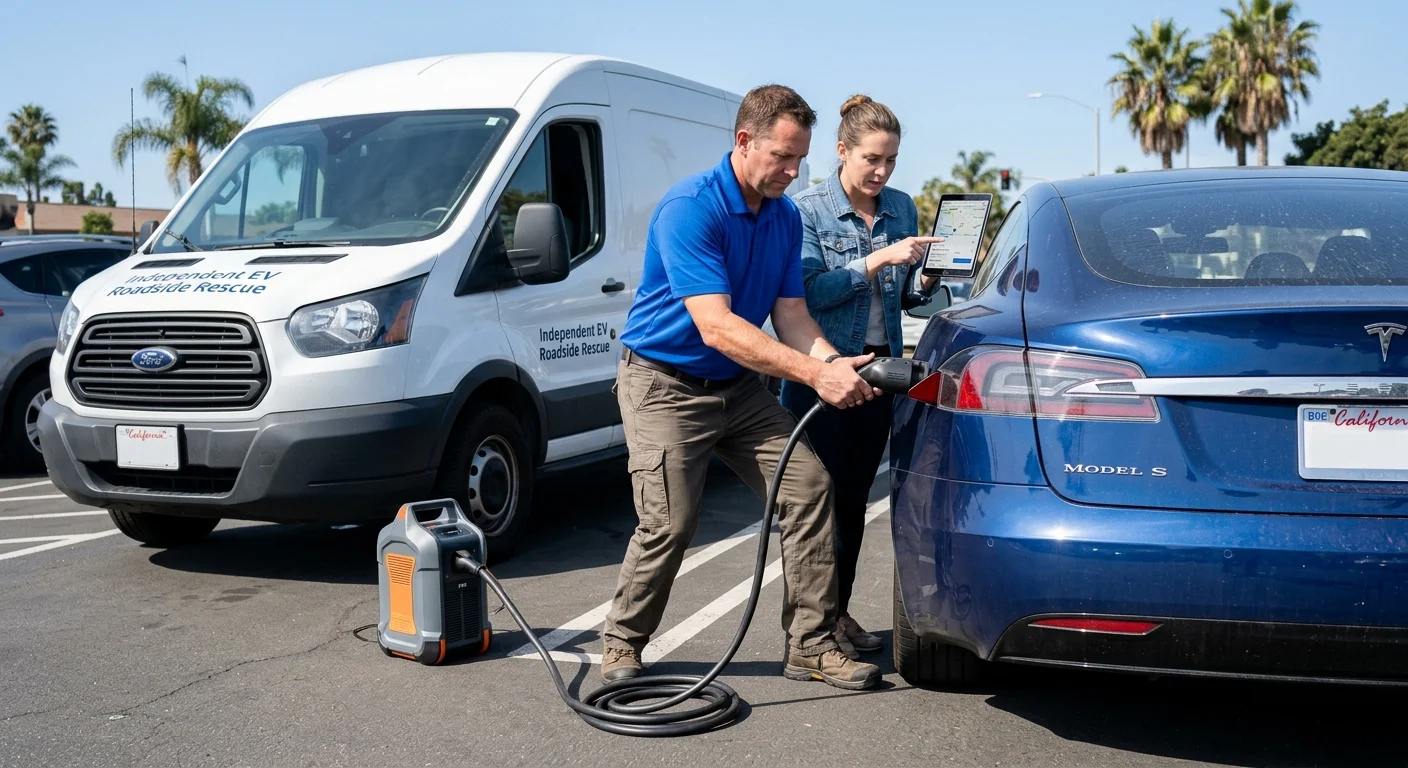
A dark Model S isn’t a loading plan
The cabin can go black and still be the wrong job. A flatbed may not be the next right step. The operator has to match the exact Model S. They also have to match the exact year. Then they open Tesla’s current instructions for that car. They don’t wait for a shop in Fontana. They don’t wait for a garage in Riverside.
Charge Pro IE is a referral line for the Inland Empire. We match stranded drivers with independent local operators. We don’t load vehicles, and we don’t own trucks. The operator quotes before work starts, then bills you directly.
This page is a handoff list, not a loading guide. Our verified claims set has no Model S transport-mode steps. It has no loading points and no jump points. We won’t write those from memory.
If the car went quiet with no crash, start with our Model S 12V checks. Use it to sort what you saw. Don’t treat it as Tesla’s current owner information.
Identify the exact Model S
Say it’s a Tesla Model S. Then read the year from a document you trust. Registration, an insurance card, or the Tesla account all work. Body shape, wheels, and screen layout are a poor substitute.
Give the operator the full description printed in those records. Include any trim line that’s written there. If the vehicle identification number is reachable, keep it handy. Don’t publish it, and don’t text it to a stranger.
Year isn’t trivia, because Tesla writes instructions per vehicle. A Model Y note is the wrong document. An older Model S note can be wrong too. Ask which year the operator is using.
Flag anything that looks aftermarket from the curb. Lowered suspension and unusual wheels are examples. Don’t explain how those changes affect a truck. Report them, and let the operator decide what to verify.
Give the reason you’re calling in one sentence. Blank screens, a zero-range reading, crash damage, and a tire problem are different calls. Stick to what you watched happen.
Report what still responds
“No power” tells the operator the cabin looks dead. It doesn’t name the failed battery. They still need a report of what answers.
Stay out of panels, and leave trim in place. Don’t jury-rig a jump at the curb. You’re describing the car, not opening it.
Use the same buttons you’d use on a normal morning. Note whether doors answer and whether the center display lights. Note whether exterior lamps follow their usual switches. If the whole car stays inert, say that in one sentence.
Speak in observations, not in parts:
- Screen on, with a message you can photograph
- Doors alive, drive not available
- Phone app connected, car still silent
- No lights, no locks, no screen
- Cabin unreachable from where you stand
Copy the message letter for letter. A photo from a safe spot preserves the wording. Don’t translate it into “the pack died” or “the 12V died.” Those are conclusions the operator didn’t ask for yet.
Treat the charge port the same way. Use the normal release, and don’t pry. Say if a cable is still locked on, and who owns it. If you’re still plugged in at home or a public stall, describe that.
That report helps the operator compare a mobile charge and a tow. It doesn’t prove the failed component. On I-10 through Colton, our Colton shoulder guide covers the empty-pack sequence. On I-15 toward Victorville, use the Cajon Pass empty-pack guide.
Open Tesla’s current page before loading
The operator should read Tesla’s current instructions for your Model S year before loading. We don’t reprint those instructions. They’re not in our claims ledger, so they stay off this page.
Search with the year you already confirmed. If the screen or the Tesla app still opens, start there. Then ask the operator to name the official page they’ll follow.
Forum posts, saved screenshots, and old videos are the wrong last word. Send the official page, the year, and any message still on the display.
How to tow a Tesla with no power is planning, not a loading card. Keep that distinction when you talk to the operator.
Don’t claim the car is already in a transport setting. Only say that if the vehicle shows it. Report the screen state instead. “Display is up. I haven’t chosen a setting” is enough.
If you can’t find the right year, say that. Ask the operator to confirm their source before the car leaves the pavement. A named source is the check.
Hand off the inland location
Drop a pin, then add a plain description. Give the street and the direction of travel. Add the nearest exit you already know. Add the parking level or the entrance you used.
I-10 and I-15 don’t take the same sentence. On I-10 through Ontario, Fontana, Colton, or Redlands, give eastbound or westbound. Add the exit you remember. On I-15 at the Cajon, say whether you’re still climbing toward Hesperia. Or say you’re already on the High Desert side near Victorville. Don’t cross live lanes to read a marker.
An Ontario airport parking structure needs the lot if you know it. Add the level and the entrance road. A Fontana warehouse yard needs the gate and the row. Add any posted clearance you can read from a safe place. A Riverside downtown garage needs the building name and the level.
Name the obstacles between the operator and the car:
- A gate, lockbox, or attendant
- A narrow drive or a hard turn
- A steep ramp or a low beam
- An assigned stall or a shared charging space
- A tire against a curb
- Visible crash damage or a flat
- A cable still connected
Describe the site. Don’t order a specific truck. Independent operators don’t all bring the same equipment. Charge Pro IE doesn’t say they do. The operator decides whether they can work that spot.
Choose the destination before the car rolls. Speak the full name and street address. Call that place yourself, and ask how to enter. Ask if they’ll take a Model S in this condition. We don’t publish shop hours we haven’t verified. We don’t promise a facility will accept the car.
Tesla roadside rescue is the referral path. We connect Inland Empire drivers with licensed, insured independent operators. Your contract is with that operator.
Charge, tow, or both
A silent Model S isn’t a verdict, so hand over the facts. Ask whether a mobile charge, transport, or both should be reviewed.
Charging belongs in that review when the last reading was a depleted pack. Repeat the last range figure if you remember it. Say whether the port still answers. Say whether the car sits where a roadside charge could even be considered. The operator decides if that site is workable.
Matched operators typically bring a 240V Level 2 source to the car. Tesla uses a native NACS plug. Charging time is typically 15 to 30 minutes. That window is for about 10 to 20 miles of range. That’s charging time only, not when someone arrives.
Transport belongs in the review when the car won’t take a charge. It also belongs when you can’t get in. Visible damage or a destination that needs the car moved count too. Those are scene notes, not a shop diagnosis.
Ask the operator out loud:
- Are you reviewing a mobile charge, a tow, or both?
- Did you confirm this Model S year?
- Which current Tesla instructions will you follow?
- Does this location block access?
- What else do you need about remaining power?
- Should I call the destination before you load?
When the pack is empty, out-of-charge recovery explains the referral. Charge Pro IE does no charging and no towing. We own no roadside gear, set no prices, and offer no work warranty.
Ask the matched operator about price, payment, scope, and warranty before you agree. Those terms are theirs. Current Model S towing prices couldn’t be confirmed in our claims ledger. This page publishes no estimate.
Ready the five facts
Give the model year and what still responds. Give the exact location, with a pin if you can drop one. Give access limits and the destination name and address. On I-10 or I-15, add direction of travel and the exit you already know.
Then call. We’ll match you with a local operator. That operator quotes first, and that operator bills you.
Call (909) 250-2881 when you need that match.