You’re stalled in Canyon Lake and you can’t roll to a plug. You need mobile EV charging brought to the car. Charge Pro IE matches you with an independent local operator. That operator quotes you before they start, then bills you directly.
A city that’s also a gated community
Canyon Lake is an incorporated city in Riverside County. It’s also a private, gated community. That’s unusual, and it shapes the whole rescue. An operator can’t simply drive in off Railroad Canyon Road. Access runs through the Canyon Lake Property Owners Association. If you live here, you arrange for the operator to be admitted. If that can’t happen, you meet at the Main Gate.
The city covers about 3.89 square miles. Census ACS 2019-2023 data puts the population at 11,119. The 2024 estimate is 11,161. It’s a small map. The streets still climb around the lake. A low battery feels that grade. Even a short hop from East Port to the Village can spend miles you don’t have.
Median household income here ranks among the highest in this market. Housing isn’t all new. About 27.0 percent of units were built before 1980, ACS 2019-2023 vintage. Older homes, second vehicles, and boats sit unused for long stretches. That’s the 12V pattern in this town.
Heat, hills, and a short trip that still drains
Canyon Lake is a hot, hilly community wrapped around a private lake. The climbs are constant. Cabin cooling on a summer afternoon pulls from the pack. You still need that pack for Railroad Canyon Road. If you came in from I-15 with a thin buffer, the last streets can finish it.
I-15 is the nearest freeway. Railroad Canyon Road is the primary way in. Lake Elsinore, Menifee, Quail Valley, Wildomar, and Sun City sit next door. None of that helps if the car already stopped inside the gates. A dead car doesn’t roll to a plug, wherever that plug sits.
If the car still rolls, check a charging app before you strand. If it doesn’t roll, the charge has to come to you. That’s mobile EV charging, not a tow by default.
Where the car is usually sitting
Inside Canyon Lake, the stall is usually a neighborhood stall.
East Port and North Ski. These are named lake areas. Cars sit while people are on the water. Heat in a closed cabin eats range. A pack that arrived already low can sit down to empty.
The Village, the lodge, and the golf course. You park, you stay, you come back to a car that won’t ready. If the 12V dropped while you were inside, the dash can look fully dead. The traction pack may still hold miles.
Longhorn and the lakefront streets. The grades are real. A car that was fine at the bottom may not have enough to climb home.
The Main Gate area. Guests and vendors often meet help here. So do residents who can’t get an operator admitted. If gate access is delayed, don’t leave the car in a travel lane. Pull into a safe spot the association allows.
Railroad Canyon Road. This is the way in and out. A stall on the approach, before the gate, is one scene. A stall on a lakefront cul-de-sac is another. Tell the operator which one you’re in. They need that to plan the hookup.
Southern California Edison serves Canyon Lake. That matters for home charging later. It doesn’t power a dead car on Longhorn. Right now you need range at the bumper.
What a mobile charge actually is
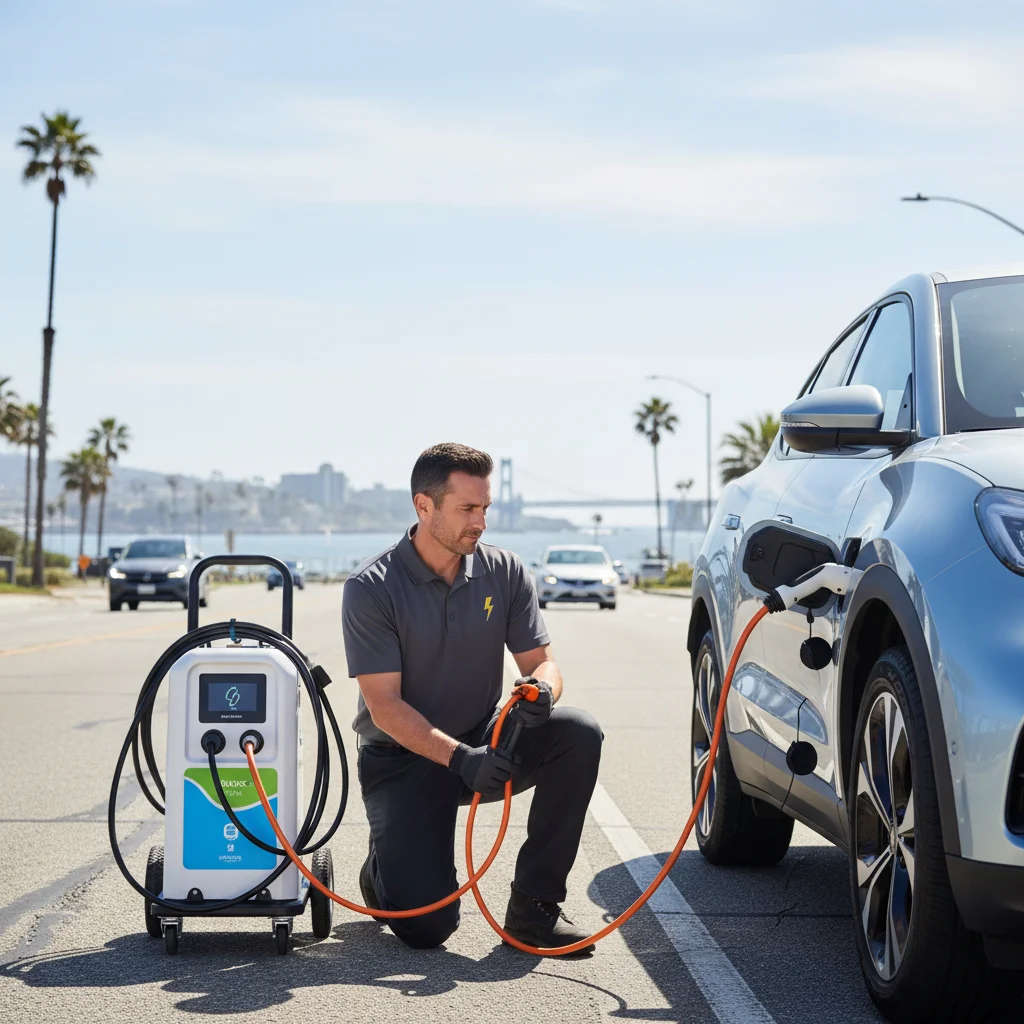
The pros we connect you with bring a 240-volt Level 2 source to the car. Teslas take a native NACS plug. Other EVs use a CCS or J1772 adapter. That covers Tesla and every major EV brand.
A session typically adds 10 to 20 miles of range. That’s 15 to 30 minutes of charging time. It isn’t a promise of when someone arrives. Charging time starts after the plug is in. Arrival is whatever the operator can quote on the call. Charge Pro IE doesn’t set that window.
Ten to twenty miles is usually enough to get through the gates and onto Railroad Canyon Road. From there you can reach a charger you already trust. Or you can get home and plug in. The operator prices the job. There’s no membership, and this line doesn’t publish a fee sheet. Read what a mobile EV charging visit actually is if you want the sequence first.
A tow is a different tool. The car may have a mechanical fault. The pack may refuse a charge. In those cases, towing may be the honest path. For an empty pack that still accepts power, out-of-charge recovery is the usual first try.
Dead pack or dead 12V
Canyon Lake has a lot of vehicles that sit. Boats, weekend cars, and second EVs spend long stretches unused. The 12-volt battery is what wakes the car. If that battery is flat, the car won’t unlock or ready. It also won’t take a charge, even if the traction pack still has energy.
Don’t jump an EV 12V from a gas car. Not unless you know the exact procedure for your model. The 12V closes the high-voltage contactors. A sloppy jump can fault the car. Operators can jump or replace a dead 12V on site. Tell them whether the dash is dark. Or tell them the car shows a true empty pack.
If you’re not sure, say so. A Tesla with a black screen is often the 12V. A car that readies and then shows zero miles is the pack. Those are different jobs. The Canyon Lake roadside assistance notes walk through that split in more detail.
How gate access actually works
You call. You give the make, model, and a pin you can actually share. Inside Canyon Lake, a street name in East Port isn’t enough. Not if the operator can’t clear the gate.
A resident should use the association process they already use for vendors. That may be a guest list, a gate call, or a Main Gate meet. Charge Pro IE can’t buzz the gate for you. We don’t hold a property-owner credential. The operator is an independent pro, not a staff driver with a transponder.
If you’re a guest, text the resident you’re visiting. Ask them to clear the operator. If nobody can get the gate open, say that on the call. The meet point is the Main Gate. Don’t block Railroad Canyon Road while you wait.
A stall near the water in Lake Elsinore doesn’t start with a POA gate. Canyon Lake does.
After you place the call
Turn off cabin climate if the pack is critically low. Climate is a large draw. You want whatever miles remain.
Put hazards on if you’re near moving traffic. Railroad Canyon Road isn’t a parking lot. Inside the neighborhood, follow association rules on where a disabled car can sit.
Stay with the vehicle if it’s safe. The operator will confirm a window when they take the job. That window is theirs, not a brand promise.
If you still have a few miles, don’t spend them hunting a plug you can’t verify. A rolling car can meet the operator at the Main Gate. A dead car needs the operator at the bumper. Handle the gate before they arrive.
For a city-level charging picture, see EV charging in Canyon Lake. That’s the local hub. This post is the stall playbook.
Frequently asked questions
Can an operator get past the Canyon Lake gates?
Yes, if a resident coordinates Canyon Lake Property Owners Association access. If that can’t happen, the meet is at the Main Gate. Charge Pro IE refers the job. We don’t control the gate. You do.
How much range does a mobile Level 2 charge add?
Operators typically add 10 to 20 miles in 15 to 30 minutes of charging. That’s plug time, not drive-over time. It’s usually enough to clear the gates and reach Railroad Canyon Road or I-15. The operator confirms what your car can accept.
What if the 12V is dead, not the main pack?
That’s a common Canyon Lake pattern when a car sits unused. The car looks fully dead. The traction pack may still hold charge. An operator can jump or replace the 12V on site. Don’t improvise a jump from a gas car.
Call (909) 250-2881 when you’re stalled in Canyon Lake. Give your neighborhood and your gate plan. Add the make and model. Say whether the dash is dark or the pack is empty. The operator quotes you, then bills you directly.