EV roadside assistance in San Bernardino means a charge on this valley floor. The operators we connect you with add range on site. They can also jump a dead 12V. This is the last flat charge before the mountain and the Cajon Pass. You’re at about a thousand feet. SR-18 and SR-330 leave for Crestline, Lake Arrowhead, Running Springs, and Big Bear. I-215 joins I-15 north of town and starts the climb toward Hesperia. Charge Pro IE doesn’t do the work. Independent operators quote you before they start, then bill you directly.
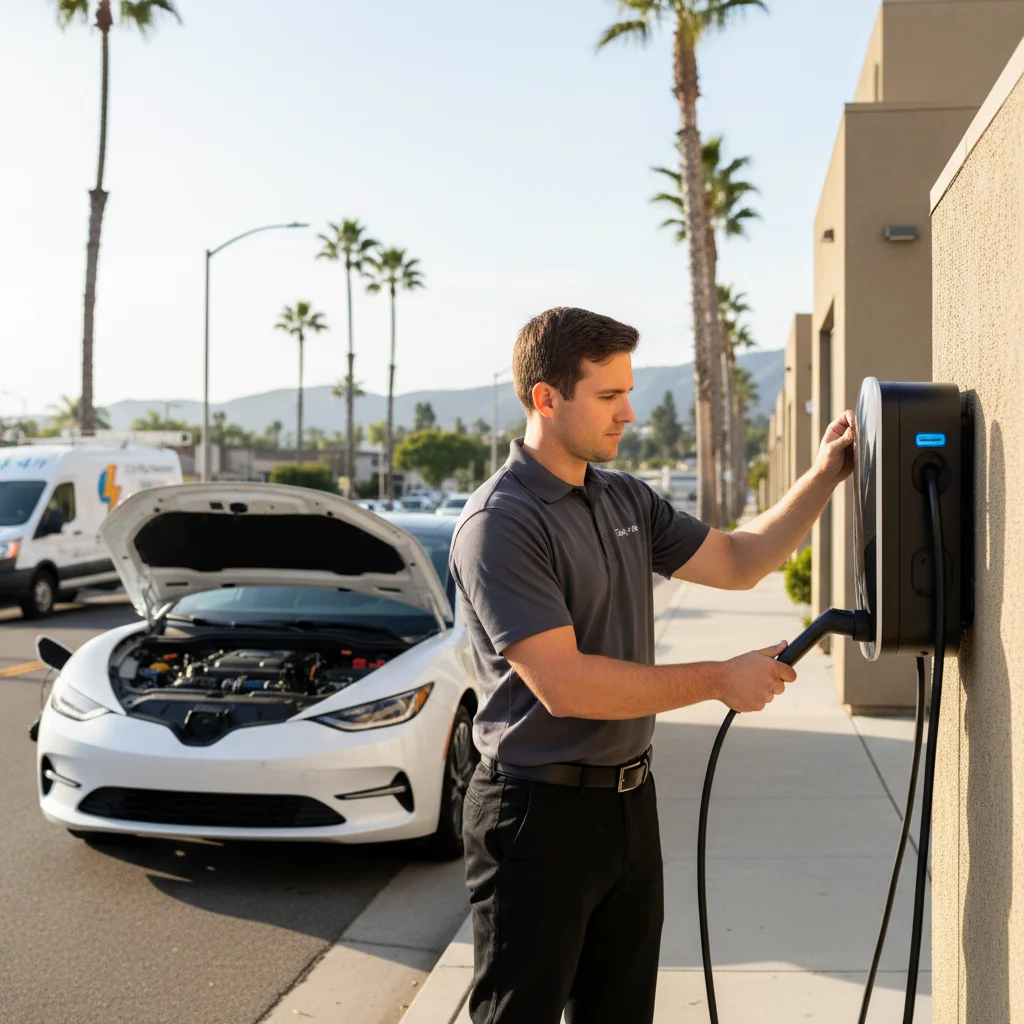
Two climbs start on this valley floor
San Bernardino is the county seat. ACS 2019-2023 counts put 222,724 people here. The 2024 estimate is 224,775. It’s the large city on this floor, and it sits under a wall of mountains.
The San Bernardino Mountains rise thousands of feet directly north of town. That wall traps summer heat on the valley floor. It also funnels Santa Ana winds down the passes in autumn. Summer afternoons here are among the hottest in the non-desert part of this market. Heat already taxes the pack, and the grade takes another bite. You can see the arrowhead landmark on the mountain face above the city. Flat miles end at that wall. Every mountain trip and every High Desert trip starts here.
Highland, Redlands, and this city are the usual top-up towns before drivers leave the floor. Skip that stop and you start SR-18 or SR-330 on whatever the pack still holds. Going up, you don’t get regeneration. Coming back down, you get some of it back, but not all of it. On the mountain the real question isn’t whether you can get up. It’s whether you can get back down. That’s the Lake Arrowhead day-trip problem in one line, and it starts in this city.
The mountain highways and the Cajon launch
Treat the Rim of the World Highway and Cajon as one problem and you’ll plan the pack wrong.
SR-18 and SR-330 climb thousands of feet in a few miles. They serve Crestline, Lake Arrowhead, Running Springs, and the Big Bear area. Big Bear Lake is an incorporated city. Big Bear City is an unincorporated community. Mix those two names and locals notice.
Tesla stalls in the resort towns are a known count. There are six at Big Bear Lake and eight at Lake Arrowhead. That’s fourteen stalls for the whole mountain resort area. A pack that sat overnight at five to seven thousand feet is cold. A cold pack shows less range, and it takes a charge slower after that sit.
Caltrans closes these routes and sets chain controls in winter. Tell the operator if a control is up. A chain-controlled road is a different job, for you and for them.
The other climb is north, not into the trees. I-215 and I-15 merge above San Bernardino and head toward Hesperia. Same range math, different direction. Verdemont sits closest to that merge. If Cajon is already in the windshield, out of charge on I-15 at the Cajon climb is the corridor note.
SR-38 is the long way to Big Bear, from Redlands via Angelus Oaks. SR-330 leaves from Highland. From this valley you still choose a highway. Remaining range is the part people guess wrong.
What a San Bernardino rescue call actually is
Charge Pro IE is a referral line, not a shop and not a fleet. We connect stranded EV drivers with independent operators. We hold no license, own no trucks, and publish no hours. We don’t promise when someone arrives.
The pros we send bring a 240-volt Level 2 source to the car. Tesla takes a native NACS plug. Other EVs use a CCS or J1772 adapter. In 15 to 30 minutes of charging, they typically add 10 to 20 miles of range. That’s charging time on the hookup. It isn’t an arrival estimate.
They also jump or replace a dead 12-volt battery on site. That covers Tesla and every major EV brand. What a mobile EV charging visit actually is walks through the stop without the pitch.
If the traction pack is empty, out-of-charge recovery is the matching path. If you still have a sliver but not enough for the grade, mobile EV charging is the same on-site charge. EV roadside assistance is the umbrella when you’re already stopped.
Campus lots, county lots, and a 12V that quits
Plenty of stalled cars in this city still have range in the pack. They just won’t wake.
Cal State San Bernardino holds vehicles all day in the University District around Kendall Drive. The San Bernardino County government center and the courthouse do the same downtown. Long dwell plus valley heat is how a marginal 12V dies. Lights stay dark and the charge port may stay locked. The high-voltage pack can still be fine.
You get the same long-sit pattern at Glen Helen Regional Park and the Glen Helen Amphitheater. Those sit northwest at Devore, in unincorporated county territory, not inside city limits. Concert parking and all-day park sits still kill a weak 12V.
Perris Hill Park, the Santa Fe Depot, and the original McDonald’s site museum on E Street are local pins, not charging promises. If you stalled near them, say so on the call. The operator needs a pin, not a landmark quiz.
When the dash is black, don’t assume the pack is empty. A 12V jump on site is often the whole job.
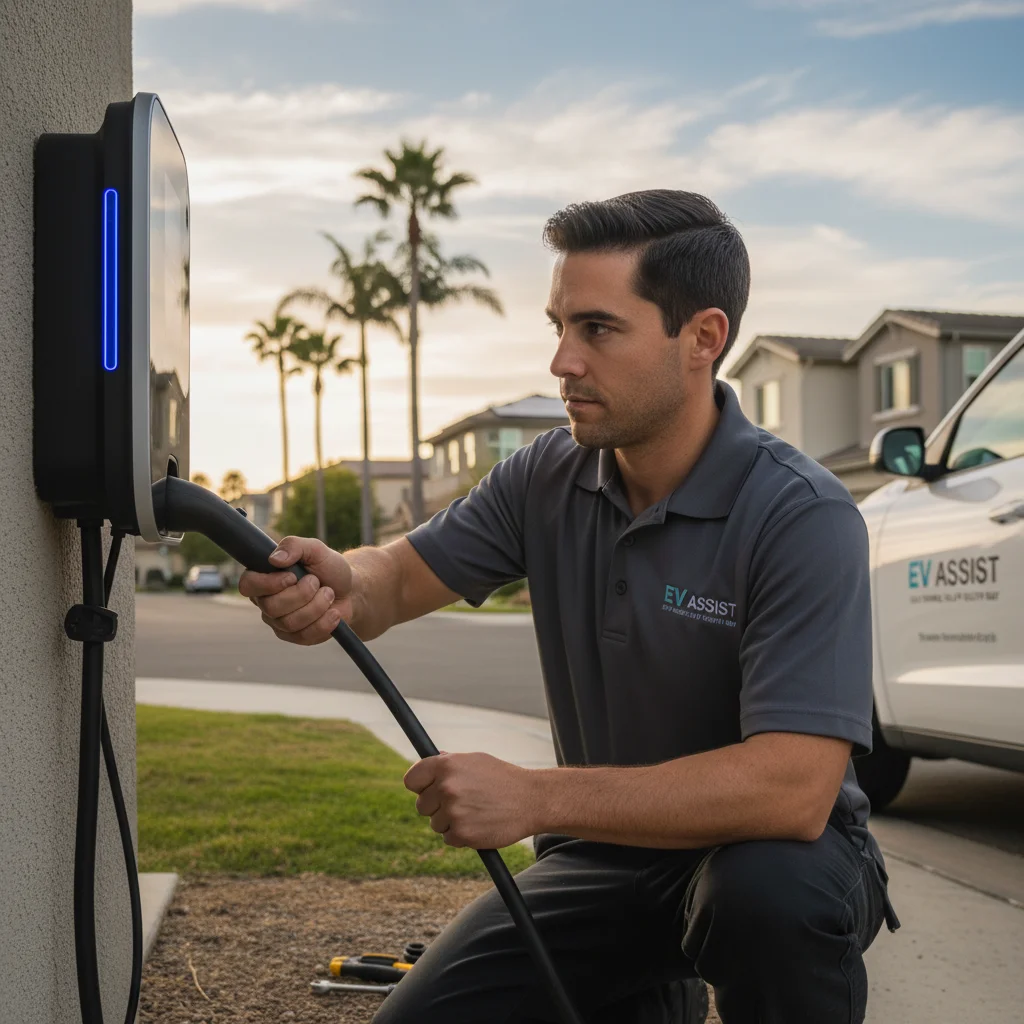
Old houses, public plugs, and a thin buffer
About 60.9 percent of San Bernardino housing was built before 1980, per ACS 2019-2023. That’s the oldest large-city stock in this market. Panel capacity is the constraint, not the driveway. A lot of drivers here never had a home hookup in the first place.
This city also has the lowest median household income of any large city in these profiles. Many owners charge in public and keep almost no spare miles. A tow isn’t a small errand in that setting. We won’t invent a price for a tow or a mobile charge. Distance, time of day, and how much range you need are what move the quote. The operator gives that quote before any work starts.
Southern California Edison serves San Bernardino. Colton, right next door, is different. Colton Electric owns the wires inside Colton city limits. If you’re asking about a home EV rate, call the utility that actually serves the meter. That paperwork still doesn’t move a car already dead on Mount Vernon Avenue.
I-10, I-215, and the streets that feed them
Three interstates shape the shoulder calls. I-10, I-215, and SR-210 meet here. That interchange complex generates ordinary stalls all day. SR-259 cuts through town. Waterman Avenue, Mount Vernon Avenue, Base Line Street, Highland Avenue, Kendall Drive, and Fifth Street catch the rest.
Downtown San Bernardino, Del Rosa, Perris Hill, Arrowhead Springs, and the Base Line corridor each produce different stalls. Del Rosa and Highland Avenue sit closer to the mountain gates. Verdemont sits closer to Cajon. The Waterman Gardens area and the University District are long-dwell zones. Muscoy is on the northwest edge. It’s a neighbor community, not a nickname for the west side.
Rialto’s warehouse belt and the I-10 grid sit west. Loma Linda, Grand Terrace, and Colton sit south. Highland and Redlands sit east. From Redlands, SR-38 is the long mountain road.
If the car has a hardware fault, a smashed charge port, or a pack that refuses current, a flatbed is the honest next step. If you’re empty or the 12V is dead, a mobile charge or a jump is usually the shorter path. Mobile EV charging or a tow lays out that fork without a sales pitch.
The California Energy Commission tracks EV adoption across the state. More EVs on these valley roads mean more of these stops. The response has to fit an electric car, not a gas-can routine.
If you’re already stopped in the valley
Stay out of the travel lanes on I-10, I-215, and SR-210. Put the hazards on. Give the operator your corridor and your heading. Say whether you were bound for the mountains, for Cajon, or just across town.
We’ll connect you with a local pro who can add 10 to 20 miles, or wake the 12V. Call (909) 250-2881 when you want that match. They quote you before they start.