Your Tesla hitting empty at Running Springs is a junction problem. It’s not a quiet neighborhood curb. SR-18 and SR-330 meet here. Caltrans publishes the SR-330 chain-control climb at about 3,500 feet up from Highland. Get the car out of the travel lane. Then call for EV roadside assistance. You want a shoulder charge or a Tesla-safe load.
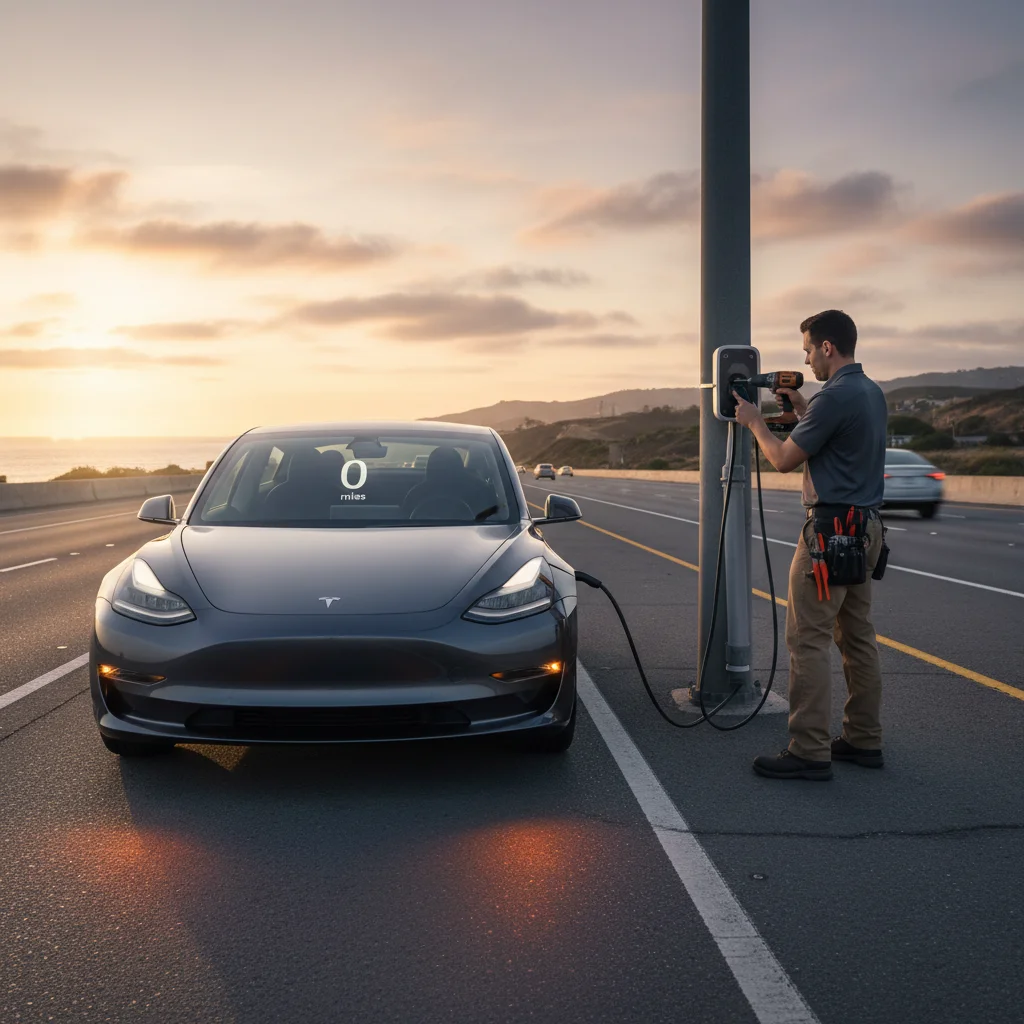
This junction is why people get stuck
Running Springs isn’t an incorporated city. It’s an unincorporated census-designated place in San Bernardino County. About 4,917 people live here, per ACS 2019-2023. The place covers 4.20 square miles. The ZIP people quote is 92382. Elevation is about 6,000 feet. Caltrans puts the top of its SR-330 chain-control range at 6,043 feet.
You’re at the Rim of the World Highway junction, inside the San Bernardino National Forest. SR-330 comes up hard from Highland. SR-18 runs east and west along the ridge. Drivers headed to Big Bear Lake pass through. So do drivers taking the eastern way toward Lake Arrowhead.
A lot of the strandings here are through-traffic. Those drivers aren’t from here. They don’t know Hilltop Boulevard from City Creek Road. They don’t know Green Valley Lake Road. They may be looking for Arrowbear Lake, Smiley Park, Fredalba, or the Hilltop area. If that’s you, pin your phone map. Say the highway and the direction. Name a landmark you can actually see.
Snow Valley Mountain Resort sits in this same mountain cluster. A ski-day Tesla that sat cold in the lot can refuse to wake.
Local context for this CDP is on EV charging in Running Springs.
The 3,500-foot climb is the published fact
Caltrans maps this SR-330 chain-control segment in two elevations. The Lower Passing Lane sits at 2,529 feet. Running Springs sits at 6,043 feet. That’s a checkable climb of about 3,500 feet. Confirm those elevations on Caltrans chain-control materials for this route. Don’t take a blog’s word for a live posting.
The published climb is 3,500 feet. Treat a low pack at Highland as a stop, not a maybe. Elevation and cold both tax the pack. Snow and chain restrictions slow the climb.
If the car’s already warning you on the Highland side, stop. Pull off before you commit to the rest of SR-330. Highland sits at the foot of this climb. A low pack in Highland isn’t the same as a dead pack on the ridge. See EV charging in Highland for the valley end of this road.
If you’re already on the mountain and the estimate is collapsing, stop hunting. Get to a shoulder or a lot. Turn the hazards on. Stay in the car if the weather is ugly. Get out only if you’re safer off the pavement.
What the screen does before the motors quit
A Tesla doesn’t usually go from cruise to brick in one second. You’ll get a charge-now warning. That warning gets louder and redder as the high-voltage pack drops. A snowflake can appear next to the battery icon. That can mean limited power, not just ice. The car is hoarding what it has left.
Acceleration goes soft. Climate control may cut out. The cabin can get quiet and dim. The car is keeping propulsion and lights alive as long as it can. That’s your cue to stop hunting for a perfect lot. Take the first safe pavement.
If you still have a mile or two of shown range, use it. Get fully out of the travel lane. Don’t crawl toward Snow Valley, Big Bear Lake, or Lake Arrowhead on hope. Check the Tesla app for a stall you can actually reach. Then decide if you can make that stall without using the shoulder.
A broader pre-stall checklist is in what to do before an EV strands.
Zero miles is a warning, not a plan
When the display reads zero, the pack isn’t always fully empty. Tesla holds a small buffer so you can limp to a safe stop. Tesla doesn’t publish that buffer as a guaranteed mileage. Grade, cold, speed, and wind spend it fast. On a 3,500-foot mountain road, don’t budget extra miles you can’t see.
Once propulsion cuts, you may still have 12-volt power for a while. Hazards, locks, and windows can keep working. Then the 12-volt can die too. That’s when the car becomes a brick that won’t enter Tow Mode.
Don’t confuse a dead 12-volt with an empty pack. A 12-volt failure can look identical from the driver’s seat. An operator who does Tesla work will check that first. A jump or a 12-volt swap on site can be the whole job. An empty pack needs a charge, not a jump.
ACS 2019-2023 puts 71.0% of Running Springs housing as built before 1980. If you’re a resident and home charging didn’t get you moving, say that. The operator needs the failure, not a guess about the cabin.
Cold lots and ski-day 12-volts
Snow Valley parking is a classic mountain stall pattern. The car sits for hours while the temperature drops. You come back to a Tesla that won’t wake. Sometimes the pack still has range and the 12-volt doesn’t. Sometimes cabin heat on SR-330 spent the pack for real.
Green Valley Lake and Arrowbear Lake add the same cold soak, with narrower roads. Either way, describe what the screen showed before it went dark.
If you still have phone battery, screenshot the last warnings. Note whether you had a red charge alert or a 12-volt message. That photo saves a round of guessing.
Don’t push it, and don’t rope-tow it
A gas car that runs dry can sometimes be rolled. A Tesla can’t be treated that way, especially all-wheel drive. The motors stay coupled to the wheels. If those wheels turn on a tow strap, the motors turn. Without the car’s cooling and control, that can damage the drive units.
Tesla wants the car in Tow Mode, also called Transport Mode, before it’s moved. On a living screen, that path is Controls, then Service, then Towing. The car has to have 12-volt power to take that command. If the 12-volt is dead, the parking brake may not release. A proper Tesla tow then uses a flatbed. The operator may need dollies or skates for the load.
That’s why “just send any tow” is a bad ask at this junction. Ask for a Tesla-aware flatbed if you need a tow. Ask for a mobile charge if the pack is empty and the car still wakes.
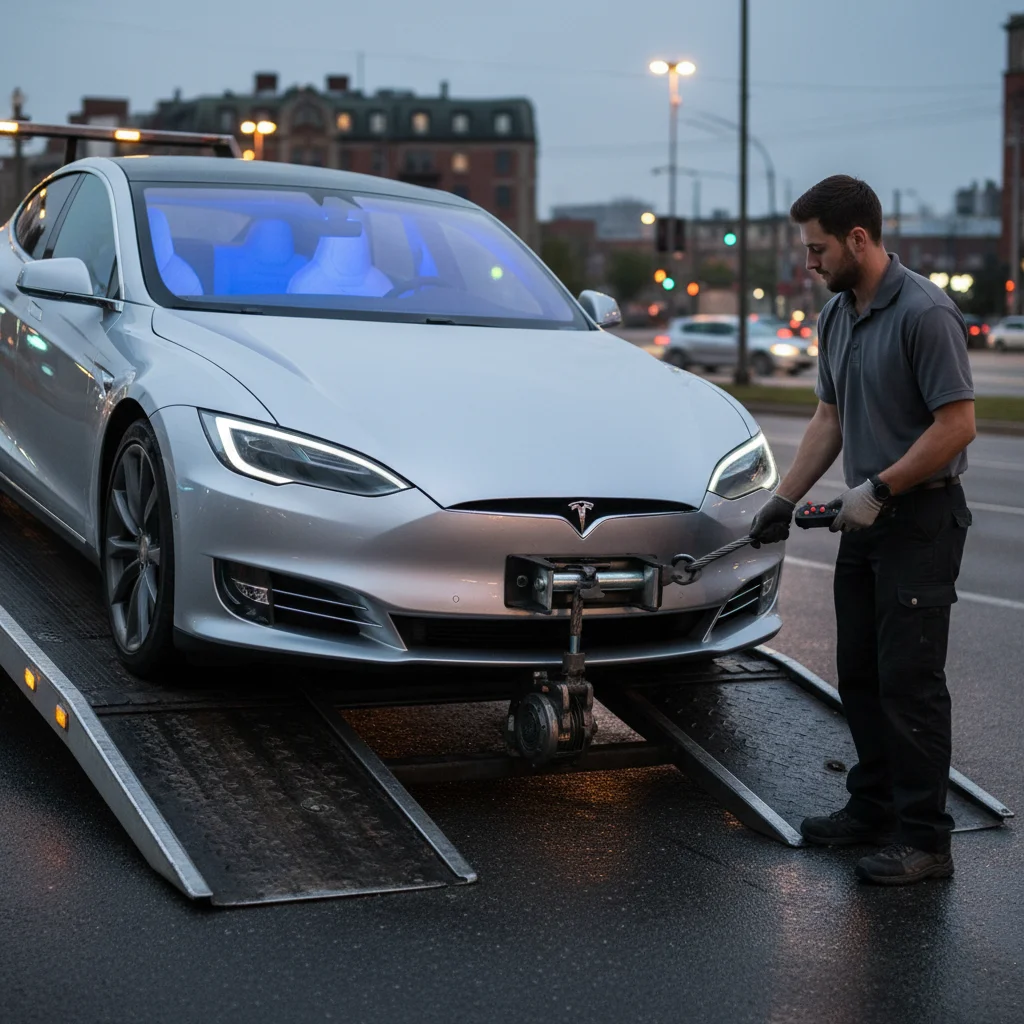
A Level 2 visit versus a flatbed off the ridge
Two honest options sit in front of you. Bring energy to the car, or haul the car to energy.
Charge Pro IE is a referral line. We match you with independent local mobile rescue operators. We don’t own trucks, employ technicians, or set the price. The operator quotes you before work starts and bills you directly.
They bring a 240-volt Level 2 source to the car. Teslas take a native NACS plug. Other EVs use a CCS or J1772 adapter. Typical charging time isn’t travel time. On the plug, you typically add 10 to 20 miles. That takes 15 to 30 minutes of charging, not driving. That’s enough to get off the junction and keep driving. Confirm a working stall in the app first.
A flatbed is the right call when the car can’t take a charge. It’s also right when it can’t enter Tow Mode without a 12-volt fix. Or when you want it taken somewhere the operator agrees to haul. Loading on SR-330 or SR-18 has to respect weather, grade, and chain postings.
If you want the service built for an empty pack, that’s out-of-charge recovery. For Tesla-specific dispatch language, use Tesla roadside rescue. For what the visit actually looks like, read how a mobile EV charging rescue works.
The mountains have 14 Supercharger stalls total. Confirm in the Tesla app that a stall is open. Don’t spend remaining miles on a stall you haven’t checked.
An Arrowhead day trip can leave you empty at this junction. The Lake Arrowhead day-trip notes cover that downhill pattern.
Chain controls can stop a rescue in its tracks
SR-330’s chain-control story isn’t decoration. Caltrans posts restrictions on this exact climb. R-2 and R-3 are the serious ones. When those are up, every vehicle follows the posted rule. That includes a rescue operator. This junction also takes chain controls from SR-18. Two highways, two directions, same ridge.
We can’t promise an operator can reach you through R-2 or R-3. That would be a guess. What you can do is say the posting out loud when you call. Check Caltrans’s current chain-control posting, or the signs you already passed. If you put chains on to finish the climb, say that too. The operator will tell you if they can run that posting. If they can’t, you wait. Or you work a different access only if that route is actually open. SR-18 from the ridge is the other door. It’s not automatically the open one.
What to say so the right truck shows up
Get as far from live traffic as you can. Keep the hazards on. If you’re in a Snow Valley lot, stay in the space and wait. Don’t walk a dark highway in snow.
You can request help in the Tesla app. Tesla typically sends a contracted truck. That truck may be a tow. Say what you want in plain words.
When you call a local dispatcher, give four facts.
One: the model. Model 3, Y, S, X, or Cybertruck. That sets the plug and the tow plan.
Two: the failure. Empty high-voltage pack, dead 12-volt, or you can’t tell. If the car still shows a range number, read it off.
Three: the pin. Running Springs junction of SR-18 and SR-330. Direction of travel. Shoulder versus lot. Name Hilltop Boulevard or City Creek Road if that’s the pin. Green Valley Lake Road works too. Name Snow Valley or the village neighborhood if that’s where you are. Mile markers help if you have one.
Four: the job you want. A mobile Level 2 charge, a 12-volt jump or replacement, or a flatbed. Add the chain-control posting if Caltrans has one up.
If you want Charge Pro IE to make the match
If the car is dead at this junction, call for a local operator. That’s the match we exist to make. We serve the Inland Empire, including this mountain CDP and the roads that feed it. The pros we connect you with handle Tesla and every major EV brand.
Call (909) 250-2881. Tell them you’re in Running Springs, and on which highway. Say whether you need a charge, a 12-volt, or a flatbed. The operator quotes before they start. They bill you. We don’t.