When the pack hits empty in Riverside, you need a mobile Level 2 visit. EV roadside assistance here isn’t a utility truck. Riverside Public Utilities has served the city since 1895. It’s not Southern California Edison, and the map still confuses people. That fact belongs on your home bill. It doesn’t charge a car sitting dead on University Avenue.
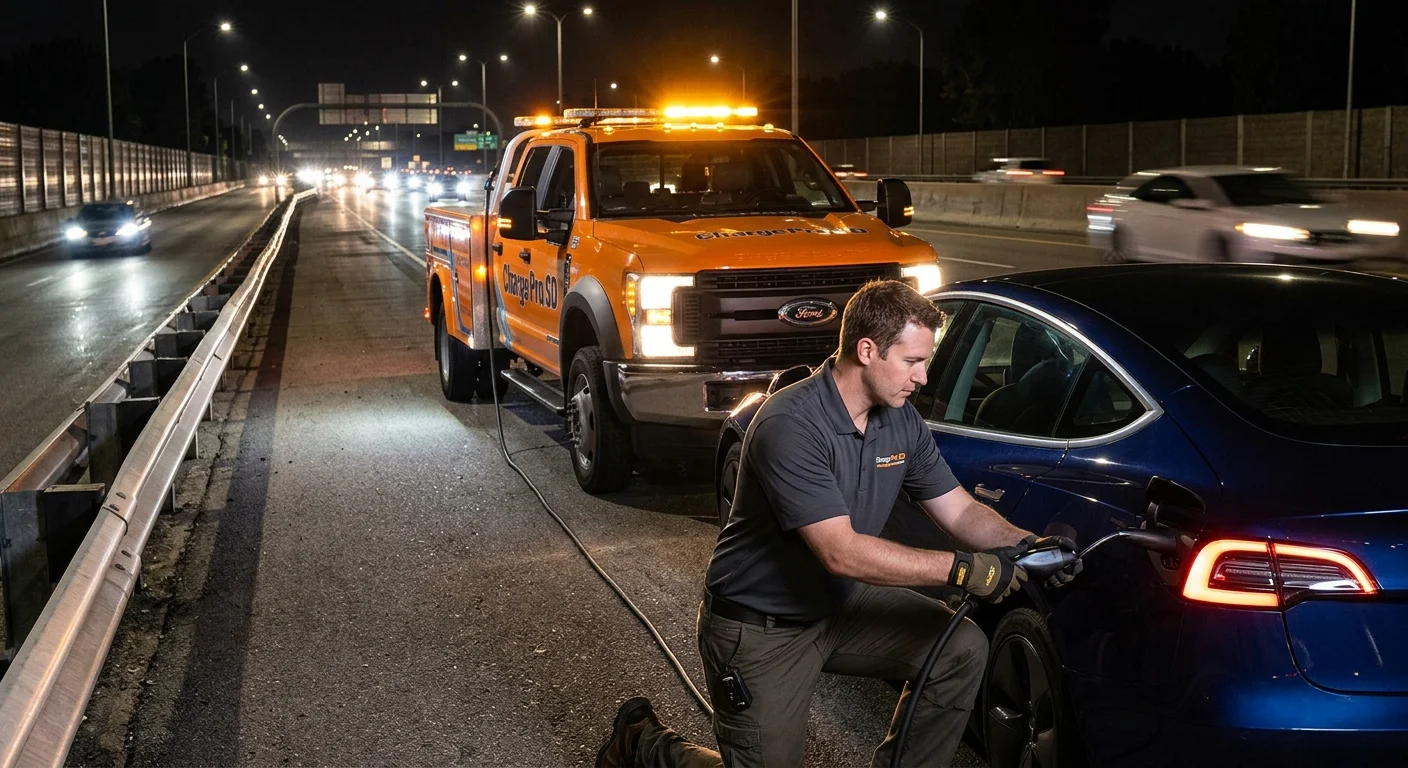
Charge Pro IE is a referral line for the Inland Empire. We match stranded EV drivers with independent local operators. We don’t own trucks, yards, or chargers. We don’t set prices or arrival windows. The operator quotes you before any cable goes in, then bills you directly.
Your city utility won’t meet you on the 91
Most Inland Empire addresses sit on Southern California Edison, and Riverside doesn’t. RPU serves throughout the City of Riverside, not a pocket. If you live in the Wood Streets or downtown, your meter is municipal. Neighbors in Corona, Eastvale, and Jurupa Valley are on SCE. Moreno Valley is split between SCE and Moreno Valley Utility. Confirm your own provider on the bill, not on a forum.
Your home EV rate lives under RPU’s Electric Vehicle Rate. Electrify Riverside lists the current rebate rules on the city site. Confirm both programs at riversideca.gov before you plan around them. Check live pages, because programs change. None of that follows you onto I-215. A dead traction pack still needs 240-volt Level 2 power at the car. The operators we send typically add 10 to 20 miles of range. That’s in 15 to 30 minutes of charging. Charging time isn’t an arrival time.
Four ways Riverside actually strands an EV
Riverside is the largest city in the Inland Empire. It’s also the county seat, with more than 81 square miles of ground. Riverside’s charging and rescue page covers the whole footprint.
Over half the housing here was built before 1980. That’s ACS 2019-2023, at 56.4 percent. About 2.2 percent of Eastvale’s housing predates 1980 on the same vintage. Home charging is common in Eastvale, and Riverside’s historic core is the opposite. Old panels are a house problem. Empty packs on Magnolia are a road problem.
The SR-91 commute is the first pattern. Riverside drivers crawl west toward Orange County jobs. Range loss is time with the air conditioning running, not distance. Summer afternoons here regularly clear a hundred degrees, with no coastal relief. A trip computer can look fine on Alessandro Boulevard. It can still fall while you sit still. The same crawl comes back east at night. For the shoulder sequence on that freeway, read out of charge on the 91.
The freeway knot is the second pattern. SR-91, SR-60, and I-215 all converge in Riverside. That interchange is where a lot of shoulder stops start. If you die inside the 91 or 15 Express Lanes, remember the geometry. Both run in the median, so you pull left, not right. That’s the reverse of every driving lesson you’ve had.
The campuses are the third pattern, and UCR leads it. UC Riverside has long-dwell lots and a young EV fleet. Older apartments ring the University District around campus. California Baptist University and La Sierra University add the same all-day park. Students often can’t absorb a tow. A Level 2 boost is the practical path.
The hills are the fourth pattern. Box Springs Mountain sits on the east side, with the C on the slope. Mount Rubidoux, Hawarden Hills, and Alessandro Heights sit in the middle. Canyon Crest and Orangecrest climb on the south. Grades plus AC make the dash optimistic. Mission Grove and Sycamore Canyon add the same kind of climb.
Long-dwell parking is a quieter fifth pattern. The Mission Inn, the Riverside Plaza, and the County complex fill lots for hours. The Festival of Lights packs downtown for weeks. Cars sit with climate control and 12-volt loads.
Empty pack or a silent 12-volt
Low charge and a car that won’t wake aren’t the same job. A low pack usually cuts power and stacks warnings. You may still coast to a curb. A fully drained high-voltage pack is worse. If the 12-volt also drops, doors, hazards, and park-to-neutral can fail. Every major EV still has that small 12-volt battery, Tesla included.
Say what the dash did before it went dark. Operators we connect you with can jump or replace a 12-volt on site. They can also do mobile EV charging through a native NACS plug. CCS and J1772 cars get an adapter. If the car is already inert, you’re in out-of-charge recovery. Charging the traction pack won’t wake a car that has no 12-volt.
Get somewhere safe, then pin the spot
If you’re still rolling, coast to the shoulder or a lot. Turn the hazards on if they still work. On a freeway, stay belted inside the cabin. Don’t try to push it. These cars are heavy because of the pack.
The 91 west of town funnels into the Santa Ana River canyon through Corona. Shoulders tighten there, and exits stretch out. If you entered that stretch already low, stay in the car. Take the next off-ramp you can actually use. SR-60 toward Moreno Valley has the same committed feel. I-215 through the south side does too, once you’re in a lane. If you’re blocking traffic, call 911 so patrol can hold the scene.
City streets that collect stalled cars include Magnolia, Van Buren, and Arlington. University Avenue, Central Avenue, La Sierra Avenue, and Chicago Avenue do too. Give a cross street, not a landmark guess. Near the C isn’t a pin on an 81-square-mile city. Norco’s dirt shoulders sit next door, and decomposed granite isn’t asphalt. Tell the operator the surface so they can set up.
Downtown lots around the Fox Performing Arts Center are paved and tight. The Riverside Plaza lots are tight too. Leave room for the truck without blocking a fire lane.
What the visit is, and what it isn’t
You call and leave a location, make, model, and a callback number. We match that to an independent operator covering this part of Riverside County. That operator calls you, quotes the job, and starts after you accept. Charge Pro IE doesn’t publish hours, and we don’t promise a window.
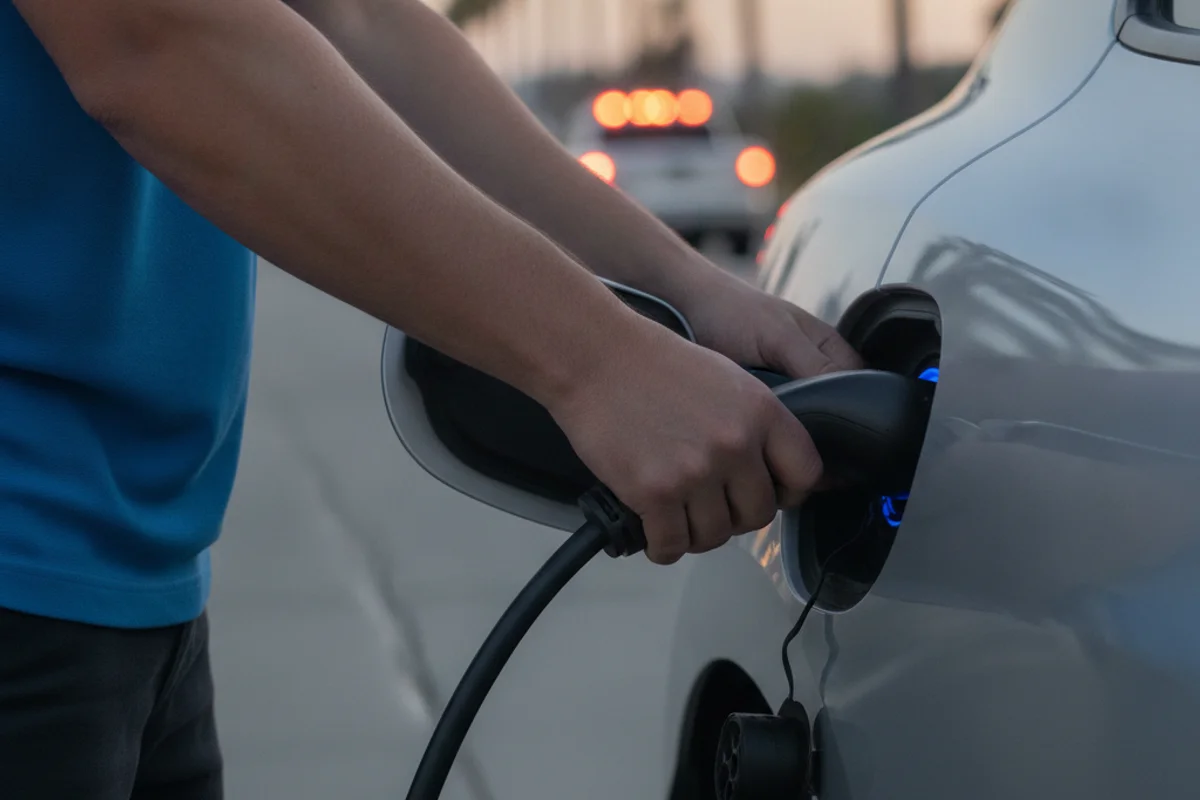
The truck brings a 240-volt Level 2 source to the port. It isn’t a household outlet or a Supercharger stall. The goal is enough energy to roll. Tesla and every other major EV brand are in scope when the adapter fits.
For the mechanics of the stop, see what a mobile EV charging visit actually is. If you’re already downtown, stalled downtown in Riverside covers that grid.
Enough range to roll, not a full pack
Typical add is 10 to 20 miles. That’s in 15 to 30 minutes of charge time. Use it to reach a public charger you can confirm is working. Get home only if home sits inside that window. We won’t guess the next working plug. Open your app and pick a stall that’s actually online. Tell the operator that target so they can leave enough.
Grades change how far those miles actually go. Dropping from Orangecrest toward the basin spends less than climbing Box Springs. Sitting on the 91 with AC on spends range without moving.
RPU programs stay at the house. A Time-of-Use EV meter rebate doesn’t follow the car onto SR-60. Confirm current RPU language on the city utilities site. Don’t treat an old PDF as a quote.
When the car will not roll
Call when you can’t reach a charger under your own power. Don’t wait on the utility. An unprepared hook can hurt the drive unit. If the pack is the only problem, skip the guesswork. A Level 2 visit is the direct fix.
Charge Pro IE serves Riverside and the rest of the Inland Empire. Call (909) 250-2881 and we’ll connect you with a local operator who quotes first.