When a Bloomington warehouse shift ends, the pack is often already thin. You need EV roadside assistance in Bloomington that can meet you in the lot. Charge Pro IE is a referral line. We match stranded drivers with independent local operators. Those operators quote you before they start. They bill you directly.
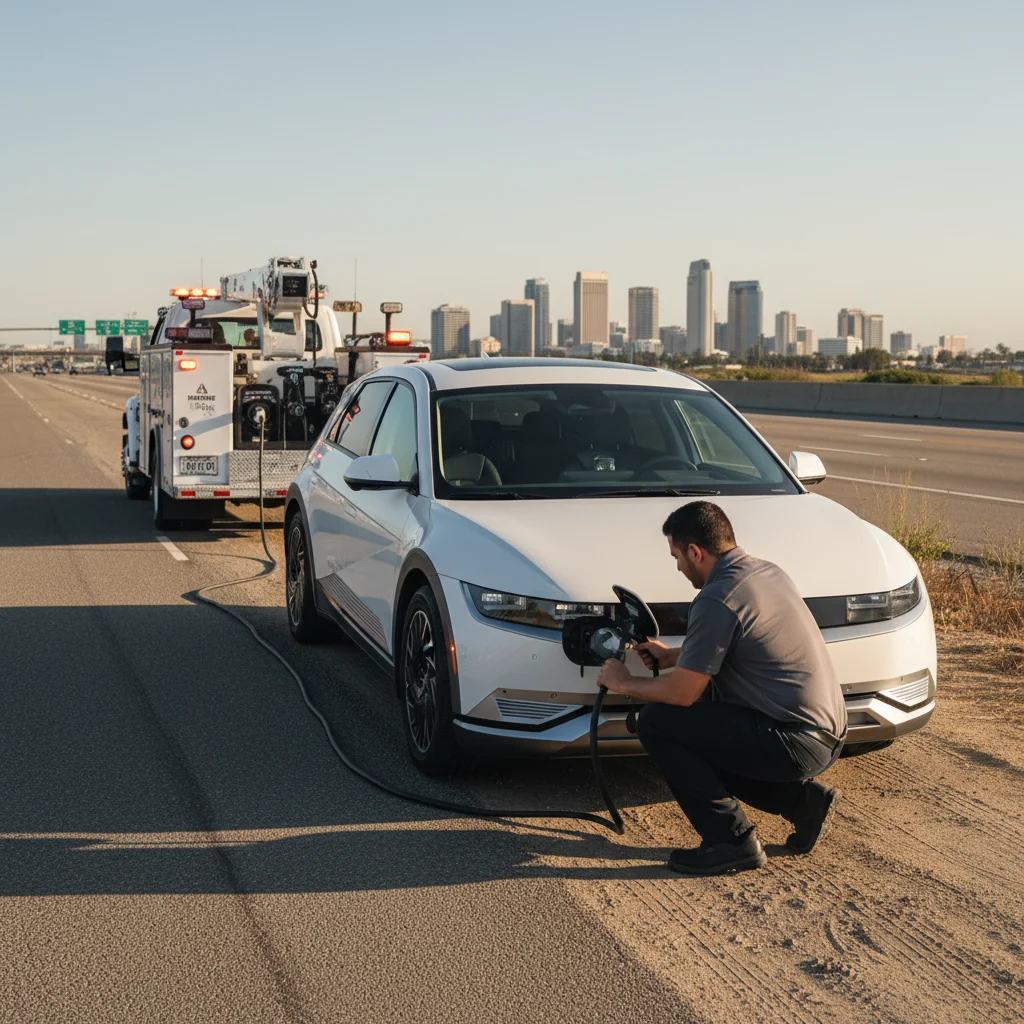
Warehouse shifts drain packs before the drive home
Bloomington sits on the San Bernardino County valley floor. The census counts 25,698 people here in 6.07 square miles. It’s unincorporated land, not a city. Warehouses have grown around it along Slover Avenue and Santa Ana Avenue. Delivery vans, yard trucks, and employee EVs spend a full shift in that heat. By clock-out, many packs sit lower than planned.
This isn’t a mountain grade problem. It’s flat, low, valley-floor heat with no relief. Climate control runs the whole day on the lot. Then the drive home still has to clear I-10. It may also use Valley Boulevard or Cedar Avenue. Slow truck traffic on Valley Boulevard and Slover Avenue makes that last stretch inconsistent. A buffer that looked fine at lunch can be gone when the lot empties.
Fleet EVs and personal commuter cars show up in the same calls. A van that ran routes all day. A Tesla that sat in employee parking. The operators we connect you with handle Tesla and every major EV brand.
Fontana’s warehouse rows sit just west of this belt. Bloomington’s industrial rows sit next to older lots, not across town.
Unincorporated Bloomington isn’t a city hall address
Bloomington is a census designated place, not a city. There’s no mayor and no city council. The San Bernardino County Board of Supervisors governs it. That matters when you’re stuck. You still have to describe the stop without a city hall map.
Callers often lead with a ZIP. 92316 and 92335 both overlap this community. Those ZIPs also spill into neighboring places. An operator who only hears Fontana or Rialto can miss the actual lot. Name the avenue first. Name the warehouse row, the gate, or the nearest cross street. Cedar Avenue, Alder Avenue, and Slover Avenue pin most stops down. Santa Ana Avenue and Valley Boulevard do the same.
If you’re on I-10, say which direction you were going. Add the nearest exit you can still see. Shoulder stops need that extra line. County territory isn’t the same as a city limit sign. The operator still comes to you. They just need a description that works.
Our Bloomington EV charging page is the local hub for this community. Rialto EV roadside assistance covers the neighbor just north of these lots.
Horse lots north of Slover, warehouses along Santa Ana
North of Slover Avenue, Bloomington still reads as rural-residential. Horse-keeping lots and older houses sit on streets that never looked like a logistics park. 62.5 percent of the housing stock was built before 1980. That figure is from ACS 2019-2023. A lot of those panels were never set up for a home charger. When the EV dies in the driveway, there may be no wall box waiting.
South of that, along Santa Ana Avenue, the picture flips. The warehouse belt is the day’s workplace. End-of-shift strandings happen in employee lots and at gatehouses. They also happen on the short connectors back to Valley Boulevard. You’re not lost on a scenic drive. You’re trying to leave work.
Those two maps need different help. A dead car on a rural lot is often a 12V failure. The car won’t wake. A dead car in a warehouse row is often an empty pack. It ran down on the clock. Either way, don’t guess. Tell the operator what the dash still shows.
Heat, trucks, and the last miles on Valley Boulevard
Valley Boulevard is the old surface spine through this part of the county. It also sits inside one of the region’s heaviest truck corridors. Traffic crawls. Stops stack up. Air conditioning stays on in that valley-floor heat. The lot doesn’t cool just because you left the dock.
That combination eats range without a hill. You’re not climbing toward the high desert. You’re idling next to trailers on Slover, then merging toward I-10. If the pack was thin at clock-out, these miles can strand you.
Cedar Avenue and Alder Avenue cut north-south through the community. They look like a short hop home. In afternoon truck traffic they aren’t. If the car is already warning you, pull into a legal lot and stop. A parking stall is easier for a mobile visit than a live travel lane.
Jurupa Valley sits to the south of this belt. Fontana and Rialto wrap the west and north. Colton sits east along I-10. You can still be sitting in Bloomington when the car gives up.
Empty pack or a dead 12-volt
An EV that won’t roll isn’t always out of charge. Many dead-looking cars still have traction range and a failed 12V. The 12V runs computers, contactors, and door logic. When it dies, the car can look fully bricked. Miles can still sit in the pack.
On older Bloomington lots, cars sit through heat all day. That’s hard on a 12V. Warehouse employee lots do the same thing. If lights are dim, say that on the call. If the screen won’t boot, say that too. The operators we connect you with can jump a dead 12V on site. They can replace it there too.
If the dash still boots and range reads near zero, you’re out of charge. Then you want a mobile charge, not a 12V jump. Mixing those two up wastes the visit. For the on-site charge path, read what a mobile EV charging visit actually is.
What a mobile visit actually puts on the car
Charge Pro IE doesn’t own trucks, yards, or equipment. We don’t send a company technician. We connect you with independent local operators. The operator quotes the job before work starts. You pay that operator directly. The pros we connect you with are licensed and insured.
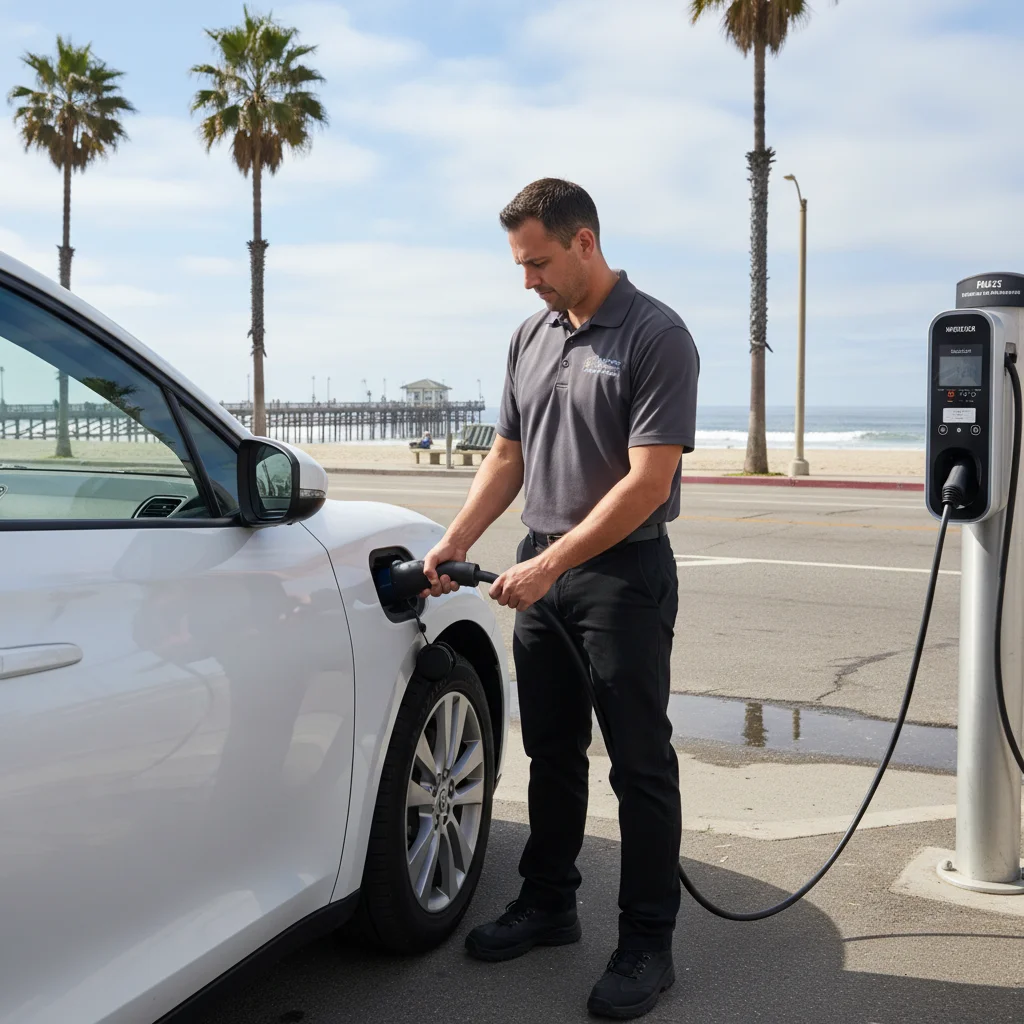
What they bring is a 240V Level 2 source to the car. Tesla drivers get a native NACS plug. Other EVs get a CCS or J1772 adapter. Typical charging time adds about 10 to 20 miles of range. That takes 15 to 30 minutes of charging. That’s charging time, not a promise of when someone arrives. Arrival depends on the operator and traffic on I-10. It also depends on where you actually are.
That bump is usually enough to leave the warehouse row. You can clear Valley Boulevard and reach a public stall you choose. It isn’t a full fill. It’s enough to get you off the lot. Then you’re out of the way of the next shift.
For the service itself, start with EV roadside assistance or mobile EV charging. See a dead EV by a Fontana warehouse.
A tow from a warehouse row is a different job
If the car has a mechanical failure, a tow may be the honest path. If the car is only empty, a gated-lot tow is extra work. You may not need it. The operator has to clear the gate. Then they need a flatbed that can load an EV. Then they haul you to a charger you didn’t pick.
A mobile charge keeps the car in the stall. You stay with it. The operator adds range, and you drive out. On Santa Ana Avenue and Slover Avenue, that keeps a truck lane clear. A flatbed doesn’t have to line up in it.
No page here can quote a price. The operator who shows up sets the number. They tell you before they plug in. If you don’t like the quote, you can decline. That’s the point of a referral line.
We don’t publish arrival times or business hours. Ask the operator for their current window when you call.
After the shift, what to do in the lot
Stay with the car if it’s safe. Warehouse lots after dark are still active with trailers. Put on hazards if you’re on a shoulder of I-10 or Valley Boulevard. If you’re inside a gated yard, tell the gate which stall. Add the company name on the building.
Have the year, make, and plug type ready. Tesla NACS is straightforward. Hyundai, Kia, Ford, Rivian, and Chevy usually need CCS. If you’re not sure, say so. The operator would rather bring the adapter than guess.
Don’t sit in a live travel lane on the last percent. It won’t reliably get you to the next exit. Pull in. Call. Let the quote come back, then decide.
The same warehouse-lot pattern shows up around Ontario’s airport rows. Read EV rescue around Ontario airport lots and warehouse rows. Bloomington’s piece is the unincorporated belt on Slover and Santa Ana. It also includes the older horse lots north of Slover.
When to call
Call when the car won’t wake. Call when the pack is too low to leave the lot. Charge Pro IE matches you with a local operator. That operator tells you the price before any cable goes in.
The number is (909) 250-2881. It’s a referral line, not a promise of a truck in the driveway. You get a quote, then you choose.