Roadside assistance for EV drivers in the Inland Empire is a power problem. It isn’t a gasoline errand. You’re not waiting on a gas can. You need an independent operator who can feed 240-volt current. They can also wake the small 12V that runs the computers. Charge Pro IE is a referral line. It doesn’t own trucks, employ technicians, or set prices. It matches you with a local operator. That operator quotes before any work starts. Then they bill you directly.
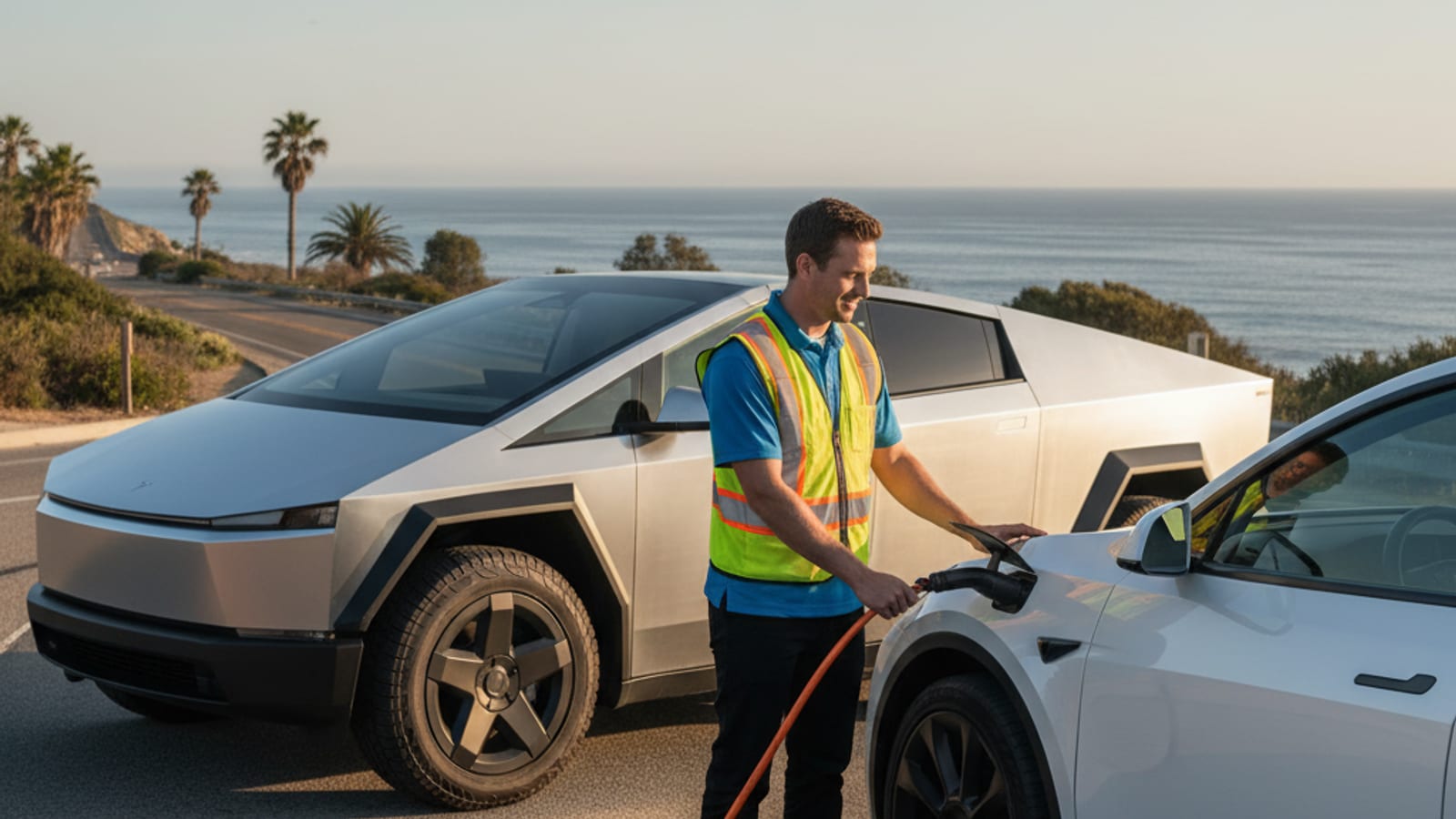
Two failures that look the same from the driver’s seat
Most inland strandings are electrical. They feel identical when you’re already stopped.
The traction pack is the big battery in the floor. When it’s empty, the motors have nothing to draw. Range hit zero. The car coasted, then sat. Heat, grades, and freight traffic all raise consumption. They just empty the pack sooner than a flat map suggested.
Riverside County holds 2,478,600 people on ACS 2019-2023 counts. San Bernardino County holds 2,197,104. That’s a huge commuting market. It isn’t one compact grid.
The 12V is a different battery. Almost every EV still has one. It runs locks, screens, and the contactors that connect the pack. If the 12V dies, a full pack won’t roll the car. The app may go silent. Doors may not open the usual way. Owners often assume the main battery is finished. It isn’t. Start with how to tell a dead Tesla pack from a dead 12V. The same fork applies to Rivian, Ford, Hyundai, and Kia. Chevy, BMW, and Mercedes fail the same way.
Operators in the network can jump that 12V on site. They can replace it when a jump won’t hold. That’s a repair at the curb, not a guess about public plugs.
A third stall is a tire. EVs are heavy. Many skip a spare. A shredded tire on a freeway won’t take a charge as a fix. That’s a tire shop or a flatbed. Charge Pro IE doesn’t match you for tire work. It doesn’t run tow trucks.
Software lockups happen. Try the car’s own restart once. A stuck charge handle is a separate sequence. Don’t yank it.
What roadside assistance for an EV actually is
National clubs were built around gasoline, inflators, and hooks. An empty EV needs electrons. A dark EV often needs a 12V jump done with the right polarity. Towing with drive wheels on the pavement can damage a motor. If you need a hook, ask for a flatbed. That call isn’t this service.
Mobile EV charging is the out-of-charge tool. An independent operator brings a 240V Level 2 source to the bumper. Teslas take a native NACS plug. Other brands use a CCS or J1772 adapter. A typical session adds about 10 to 20 miles of range. That’s 15 to 30 minutes of charging. That window is charge time. It isn’t an arrival time. Charge Pro IE doesn’t promise when someone shows. It doesn’t set the price.
That’s EV roadside assistance in this market. Enough energy to leave the shoulder. Then you drive to a charger you pick, or home if that’s closer. Tesla, Ford, Rivian, Hyundai, Kia, and Chevy all sit in the same traffic. Mercedes and BMW show up on these freeways too. The operators we connect you with handle Tesla and every major EV brand.
West valley miles and new tracts
Ontario, Fontana, Rancho Cucamonga, and Upland sit on the west side. Chino, Chino Hills, and Montclair sit there too. ACS 2019-2023 puts Ontario at 180,547 people. Fontana is 214,169. Rancho Cucamonga is 175,411. These are large inland job centers, not a compact downtown grid.
A car that sat through a long shift can fail in two ways. The pack can be empty after errands. The 12V can die after the car sat locked. Neither failure is a utility outage. Southern California Edison serves these cities on the residential side. Rancho Cucamonga is the split case. SCE covers most of the city. Rancho Cucamonga Municipal Utility covers a southeast pocket. That pocket has more than 3,900 metered businesses and residents. It includes The Enclave, Day Creek Square, The Resort, and the Victoria Gardens area. If your house charger is dark, check which utility prints the bill. If you’re already on a shoulder, the bill doesn’t matter.
Eastvale is newer. Only about 2.2% of its housing predates 1980, ACS 2019-2023. Chino Hills is about 17.4% pre-1980. Montclair is the opposite, at about 68.5%. Older panels show up as home-charger trouble. They don’t refill a car that already stopped.
The central valley, the 10, and the 215
Riverside city has 319,069 residents. San Bernardino city has 222,724. Moreno Valley has 211,666. Colton, Rialto, Grand Terrace, Loma Linda, and Highland fill the seams. These are ACS 2019-2023 figures.
I-10 through Colton and Redlands is a heat-and-grade run as you head east. I-215 through Moreno Valley and Perris Valley stacks traffic with summer temperatures. SR-60 through Jurupa Valley is a commuter trench. They do require a buffer. A stall in the travel lane is the real hazard.
Housing age is older in the core. San Bernardino is about 60.9% pre-1980. Riverside city is about 56.4%. Redlands is about 60.4%. Colton is about 51.8%. Grand Terrace is about 60.6%. That vintage is 2019-2023 ACS. It explains driveway charger faults in older neighborhoods. It doesn’t explain a pack that hit zero on the freeway.
Riverside is not an SCE city. Riverside Public Utilities has served the city since 1895. Colton owns the electrical infrastructure inside its boundaries. That’s the City of Colton Electric Utility. Moreno Valley is split. SCE covers much of the city. Moreno Valley Utility serves newer development since 2004. It has more than 6,500 customers. It publishes an address lookup. A dead car downtown is still a bumper visit. The municipal logo on your bill doesn’t jump a 12V.
South county grades and the 91
Corona, Norco, Lake Elsinore, and Wildomar sit on the southwest edge. Canyon Lake, Menifee, Hemet, and San Jacinto fill the inland basin. Murrieta, Temecula, French Valley, and Winchester sit farther south. Temecula’s ACS 2019-2023 population is 111,167. Murrieta is 112,064. Menifee is 110,305. Corona is 159,670.
The 91 through Corona fills on weekdays. The Ortega near Wildomar is a two-lane canyon road. French Valley and Winchester are more spread out than they look. Temecula housing is young, about 6.5% pre-1980. Murrieta is about 6.2%. Lake Elsinore is about 13.6%. Hemet is older, about 43.1%. Canyon Lake is a small incorporated city of 11,119 people. That’s the ACS 2019-2023 count.
San Jacinto still has SCE on the wires. San Jacinto Power, a community choice aggregator, supplies the generation. That split matters for home rates. It doesn’t change what you need on the shoulder.
East toward the pass, then the mountains
Beaumont, Banning, Calimesa, Yucaipa, and Cabazon sit on the way toward the desert pass. Beaumont is growing and relatively new, about 16.8% pre-1980. Banning is older, about 44.8%. Yucaipa is about 52.5%. Cabazon is an unincorporated CDP of 1,887 people.
Banning is not SCE. The City of Banning Electric Utility serves that city. Calimesa and Beaumont are on SCE. If you’re planning a home charger, that distinction is everything. If you’re already stopped on I-10, you need a Level 2 visit. A 12V jump is the other common fix. You don’t need a rate sheet on the shoulder.
The mountains are a different climate. Crestline, Lake Arrowhead, and Running Springs add altitude and colder nights. Big Bear Lake and Big Bear City do the same. Crestline housing is old, about 77.7% pre-1980. Big Bear Lake is about 59.6%. Big Bear City is about 55.3%. Lake Arrowhead is about 57.9%. Running Springs is about 71.0%. Those are ACS 2019-2023 shares.
Big Bear Lake and Big Bear City are on Bear Valley Electric Service. Its service-area page names Lake Williams, Erwin Lake, and Sugarloaf. It also names Moonridge, Fawnskin, and Boulder Bay. Lake Arrowhead and Crestline are not on that Bear Valley list. Don’t assume one mountain utility covers every ridge. Wrightwood is a High Desert mountain community in the census files. Confirm its electric provider on your own bill. A published city-level confirmation was not locked down here. Check the bill, not a guess.
High Desert after the Cajon
Victorville, Hesperia, Adelanto, Apple Valley, Phelan, and Oak Hills sit beyond the climb. Victorville has 137,627 residents. Hesperia has 100,775. Apple Valley has 75,473. Adelanto has 37,964. Those are ACS 2019-2023 counts.
The Cajon climb on I-15 is the range eater that feeds those cities. If that’s your stall, read out of charge on I-15 at the Cajon climb. High Desert miles around Adelanto and Phelan are long and exposed. Housing is newer in several of these places. Victorville is about 19.6% pre-1980. Adelanto is about 18.3%. Phelan is about 17.7%.
Victorville homes are on SCE. Victorville Municipal Utility Services serves only the Southern California Logistics Airport. It also serves Foxborough Industrial Park. It doesn’t serve residential areas. Apple Valley has SCE on the wires. Apple Valley Choice Energy procures the generation. Hesperia and Adelanto are SCE cities. None of that rolls the car for you.
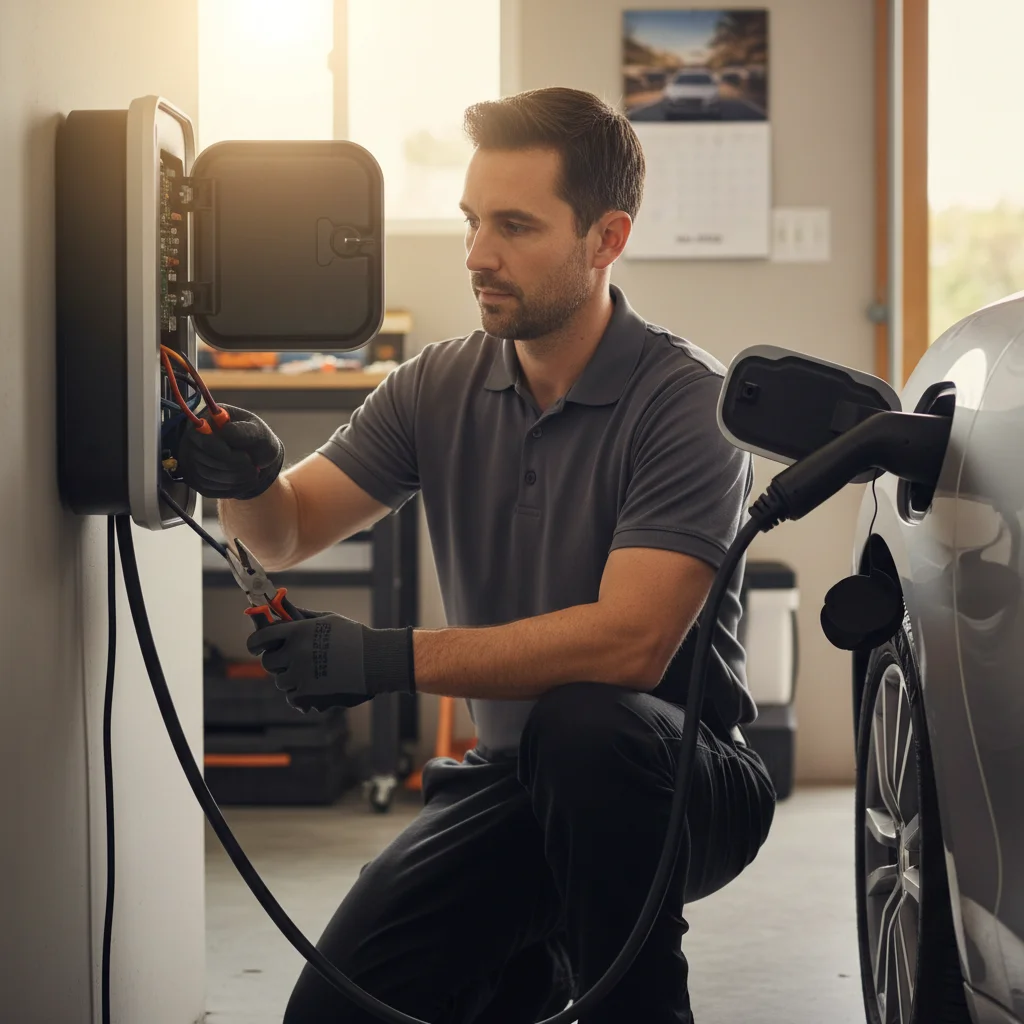
Tesla’s program, a club card, or a local quote
Tesla publishes roadside assistance for its cars. Other makers do too. What they cover, and for how long, lives on their sites. Charge Pro IE can’t certify those programs. Read the maker’s page before you assume a truck is included. Club memberships and insurer add-ons vary the same way. Some send a jump. Some send a tow. Some are a poor fit for an empty pack. Compare that in AAA or a local Tesla rescue before you argue with a dispatcher.
Call a local independent operator when you want a Level 2 quote. The same path covers a 12V job. Charge Pro IE matches you. It doesn’t perform the work. The operator’s quote is the number that matters. You accept it, or you look elsewhere.
If the car won’t take a charge, you may need a flatbed. A car that won’t wake may need one too. Confirm the driven wheels leave the ground. Charge Pro IE doesn’t operate that equipment.
First moves when you’re already stopped
If the car still rolls, get out of the travel lane. Hazards on. On a freeway, stay belted inside unless you’re in immediate danger. NHTSA publishes general roadside safety guidance at https://www.nhtsa.gov/.
Name the failure in one sentence. Empty range on the display, or a car that won’t power up. Give make, model, and color. Say Tesla NACS, CCS, or J1772 if you know the port. Lot calls need a street, a gate, and a building name. Mountain calls need the place name. Use Crestline, Running Springs, Lake Arrowhead, Big Bear Lake, or Big Bear City. “Up the hill” wastes a match.
Kill climate control if the pack is the issue. Keep lights if you need them for safety. Don’t walk along I-15, I-10, I-215, or the 91.
The California Energy Commission keeps statewide charging information at https://www.energy.ca.gov/. Use it when you still have miles. It won’t pull a dead car off a canyon shoulder.
What a matched visit looks like
You call the referral line. You describe the car and the pin. An independent operator quotes the job. If you agree, they come with the Level 2 source. They plug in. You wait through that 15 to 30 minute charge window. A 12V jump is a shorter bumper job. They bill you. You drive.
More detail on the hardware sits in what a mobile EV charging visit actually is. City-level charging context for the two counties is at EV charging in the Inland Empire.
Prevention is dull and it works. Leave home with a usable buffer. Do that before Cajon, the 10 east, or a mountain day. Watch 12V warnings instead of dismissing them. Keep tire pressures in spec. Heavy EVs shred underinflation. Charge at home on the EV rate your actual utility publishes. For many SCE cities that’s TOU-D-PRIME. Riverside drivers should look up RPU’s electric vehicle rate. Confirm today’s figures with the utility. Don’t copy a number from a forum. Rebates and TOU plans change, and funding runs out.
When you need the match, call (909) 250-2881. That number reaches Charge Pro IE. It doesn’t guarantee when an operator arrives. The person who quotes you is the person who bills you.
Frequently asked questions
What happens when an EV pack hits empty on an inland road?
The car stops producing motion. Get to a safe spot if you still can. Stay with the vehicle on a freeway. Call for a mobile Level 2 visit rather than waiting on a gasoline-style truck. An independent operator can add about 10 to 20 miles of range. That’s 15 to 30 minutes of charging. Then they bill you directly. Drive to a charger you choose after that.
Can a regular jump pack wake an EV?
Often, yes, but only the 12V. You aren’t jump-starting the traction pack. The small battery wakes the system. Technique matters, and polarity mistakes are expensive. If the 12V is worn out, a jump dies again. Then you need an on-site replacement from an operator who carries EV 12V units.
Who sets the price, Charge Pro IE or the operator?
The operator. Charge Pro IE is a referral line. It matches stranded EV drivers with independent local mobile rescue operators. It performs no work, owns no trucks, and sets no prices. The operator quotes before starting. You agree or you don’t. Then they bill you directly.