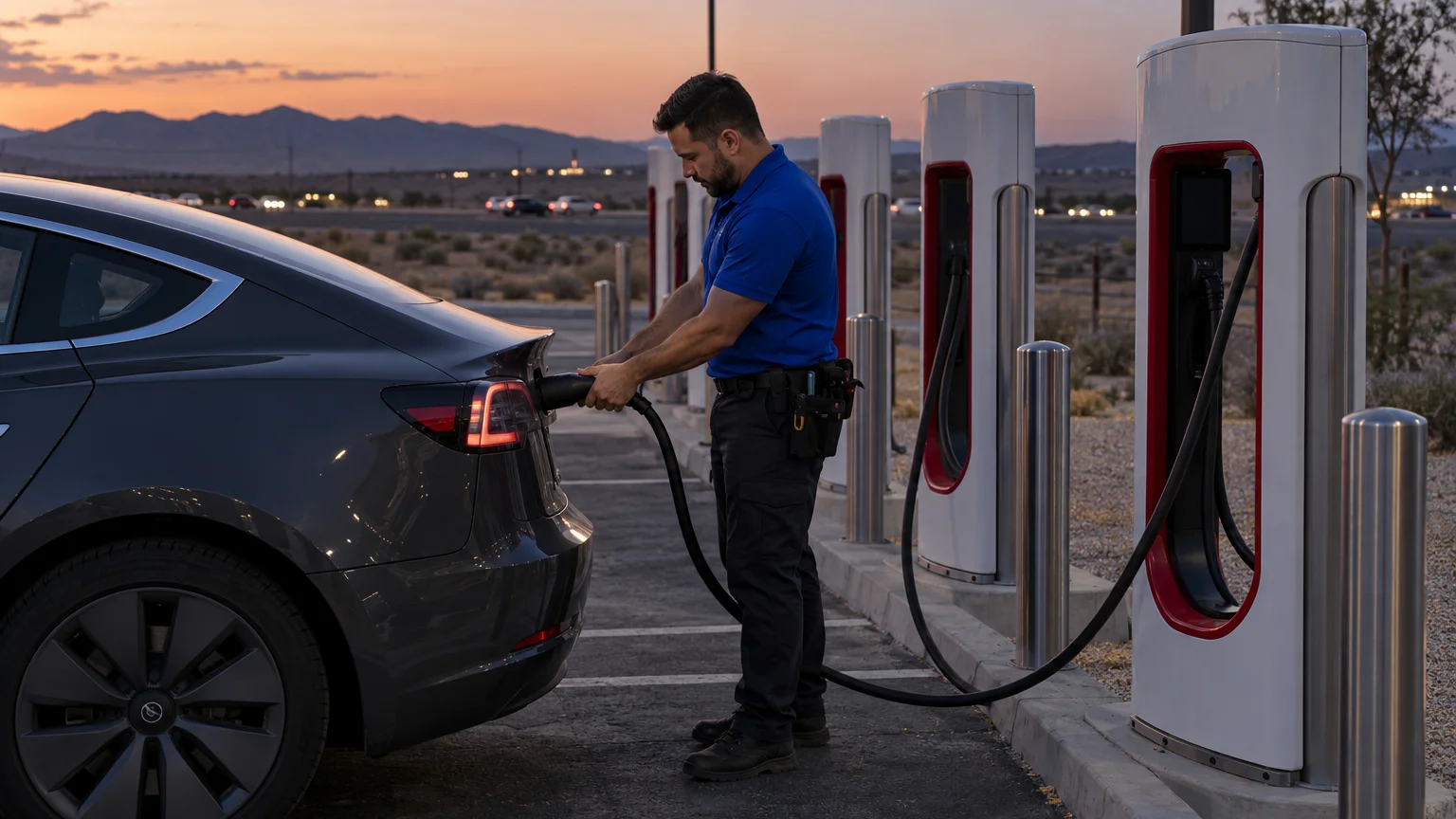
A failed charging session feels different when your battery is nearly empty. In Victorville, the immediate decision is whether to try another charger or stop driving and request help.
Check whether the station or vehicle caused the failure
Start with the screen and app before moving the car. Check the live station status in the Tesla app or the charging network’s app. A directory listing can confirm an address, but it can’t prove a charger works right now.
Victorville has two Supercharger sites confirmed by the U.S. Department of Energy’s Alternative Fuels Data Center. They’re at 14598 7th Street and 11604 Amargosa Road. That federal inventory can lag Tesla’s map, so use the vehicle or app for current availability.
Look at the scope of the failure. If one stall fails but the app shows others available, try another open stall at the same site. If several stalls show unavailable, consider another charging location. Don’t keep circling the lot when the remaining range is too low.
The vehicle’s behavior also matters. Note whether the charge-port door opens, the connector locks, charging begins briefly, or the car shows a fault. Save the exact message or take a screenshot. That information helps distinguish a station problem from a vehicle problem.
Tesla says a Model 3 or Model Y charge-port door may open through several supported controls. Don’t force it. A dead screen, unresponsive locks, and a door that won’t open can point toward a low-voltage issue, though those signs aren’t a complete diagnosis.
Our broader guide to a Tesla that won’t charge explains how these symptoms change the next step.
Why the Cajon climb leaves fewer backup choices
Victorville sits around 2,954 feet at its Census place centroid. Drivers arriving from the Inland Empire often reach it after crossing Cajon Summit. The I-15 high point sits north of Cajon Pass, and the climb from Devore is roughly 2,080 feet.
That grade matters when the battery is already low. Turning south toward another charger may mean retracing part of the corridor. Your car’s displayed route estimate should guide that decision. Don’t rely on a remembered range figure from an easier drive.
Victorville also gets more extreme heat than Riverside. NOAA’s 1991–2020 climate normals show an annual average of 42.2 days at or above 100 degrees in Victorville. AAA testing has found that heat and cabin cooling can reduce EV range. The exact effect varies, so use the car’s current estimate rather than a fixed percentage.
The local charging map isn’t limited to Tesla. The approved station inventory includes CCS sites from Electrify America, ChargePoint, EVgo, and Circle K in Victorville. Connector compatibility, adapter support, and live status still need checking before you move.
Hesperia has a confirmed Supercharger at 12795 Main Street. It also has an Electrify America site at 13401 Main Street. Those addresses identify possible alternatives, not a promise of current availability.
If your route brought you over the grade, read the specific guide for an out-of-charge problem on I-15 through Cajon Pass. A freeway shoulder requires a different response than a Victorville parking lot.
Compare another charger with a roadside visit
Another charger makes sense when the car is operating normally and shows enough range. Confirm the destination in the appropriate app first. Check that the connector works with your vehicle and that the app shows current availability.
A roadside visit becomes the better option when reaching another site looks uncertain. It also fits when the vehicle can’t shift, the charge port won’t cooperate, or repeated charging attempts produce the same fault.
Don’t treat every failed session as an empty-battery problem. A station outage, account issue, connector problem, charging schedule, vehicle fault, or low-voltage failure can create similar symptoms. The useful question is what the car can do now.
Before requesting help, collect these details:
- Your vehicle’s year, make, and model
- The displayed battery percentage and estimated range
- The charger address and stall identifier
- The exact warning shown by the car or app
- Whether the car powers on and shifts into drive
- Whether the charge-port door opens
- Whether you’re parked safely or blocking traffic
That information lets an operator decide whether mobile charging, low-voltage help, or towing fits the situation. Charge Pro IE is a referral service. We connect drivers with licensed, independent local operators. The operator quotes and bills the driver directly.
For a wider look at local coverage, see EV roadside assistance in Victorville or the emergency EV roadside assistance service.
Know when the 12V is the actual problem
A Tesla with usable traction-battery range can still become unresponsive. The low-voltage system supports functions needed to access and operate the vehicle. When screens, locks, and the charge-port door all stop responding, a low-voltage problem deserves attention.
That pattern differs from a car that remains awake and displays a nearly empty main battery. An awake vehicle may show charging errors, route estimates, or remaining range. A dark vehicle may not provide those clues.
Don’t assume the small terminals behind a Tesla tow-eye cover charge the low-voltage battery. Current Model 3 and Model Y manuals distinguish those external hood-release terminals from the under-hood jump points. The external terminals release the hood latches only.
Jump locations vary by model, build, and low-voltage system. Use the manual for your exact vehicle. Don’t copy a procedure from a different Tesla or model year. Stop if the correct connection points aren’t clear.
A stuck charging adapter needs its own process. Tesla’s manuals instruct drivers to stop charging and unlock the vehicle first. At a public station, the handle and adapter may need to come out together. Manual release is a last resort, and its location varies by model. It must not be used while charging.
If the car is dark rather than empty, a Tesla 12V battery jump service may fit better than mobile charging. A licensed operator can assess the symptoms and follow the correct vehicle-specific procedure.
Mobile charging versus towing in the High Desert
Mobile charging is meant to add enough range for a practical next move. The approved rescue figure is 10 to 20 miles of range during 15 to 30 minutes of Level 2 charging. That is charging time, not an arrival estimate.
That amount may help a working vehicle reach a nearby compatible station. It won’t repair a damaged charge port, vehicle fault, or failed low-voltage system. It also may not be enough for the route you planned before the charger failed.
Towing fits when the car can’t accept power or move safely. It may also be the sensible choice when reaching another confirmed charger would require more range than a roadside charge can reasonably add.
Ask the matched operator what equipment is coming. A tow-capable truck and a mobile charging unit solve different problems. Confirm whether the operator can work with your vehicle, connector, parking position, and destination.
No verified statewide price covers every private tow or mobile charge. CHP says privately arranged towing is a private transaction. Ask the operator for the rate and what it covers before authorizing service. Charge Pro IE doesn’t set that price or provide the warranty.
Victorville’s High Desert setting makes location and route especially important. The city spans 73.71 square miles. A driver near 7th Street isn’t in the same position as someone near Amargosa Road or the I-15 corridor.
See mobile EV charging across the High Desert for more regional context. If the main battery is depleted, review out-of-charge EV recovery before choosing between added range and a tow.
How to share an accurate Victorville location pin
A correct location pin prevents confusion between similarly named lots and nearby charging sites. Open your map app while standing near the vehicle. Drop the pin on the car, not the shopping center’s main entrance.
Then add plain-language details. Include the charger address, nearest driveway, stall marker, parking row, or visible business name. Say whether the car is inside a gated lot, against a curb, or blocked by another vehicle.
The confirmed Victorville Supercharger addresses are 14598 7th Street and 11604 Amargosa Road. Don’t send only “Victorville Supercharger.” Give the full address and confirm which site appears in your app.
Share your direction of travel if you’re near I-15. A driver coming north over Cajon Summit may describe the location differently from someone approaching from Apple Valley or Adelanto. The precise pin settles that ambiguity.
If you’re stopped on a freeway, safety comes first. California law requires hazard warning lights when an equipped vehicle is disabled on the roadway. A disabled vehicle’s freeway-stop exception is conditioned on having summoned assistance. If the vehicle blocks traffic or creates immediate danger, call emergency services.
San Bernardino County’s Freeway Service Patrol covers named sections of I-15, but its published pages don’t mention EV charging. The program can provide minor roadside help or a no-charge tow to a CHP-designated location when it’s operating on that beat. Coverage and schedules can change, so don’t assume a patrol truck will provide energy.
Send the operator the pin by text if requested. Keep your phone available, but don’t stand in an active lane to guide anyone.
When to call us
Call when the Victorville Supercharger isn’t working, another charger looks unreachable, or the vehicle may need low-voltage help. Charge Pro IE will match you with a licensed local operator who can discuss mobile charging, a jump, or towing.
Call us at (909) 250-2881 and we’ll connect you with a local EV rescue operator.