A Tesla with a flat on I-10 through Colton has no spare in the trunk. Same on I-15 toward the Cajon climb. Tesla roadside assistance for a flat tire usually means a tow to a shop, not a patch on the shoulder. On named Inland Empire freeways, RCTC and SBCTA patrols list a flat change as free motorist aid. Their pages talk about tires and disabled cars. They never mention EVs, Tesla lift points, or the pack under the floor.
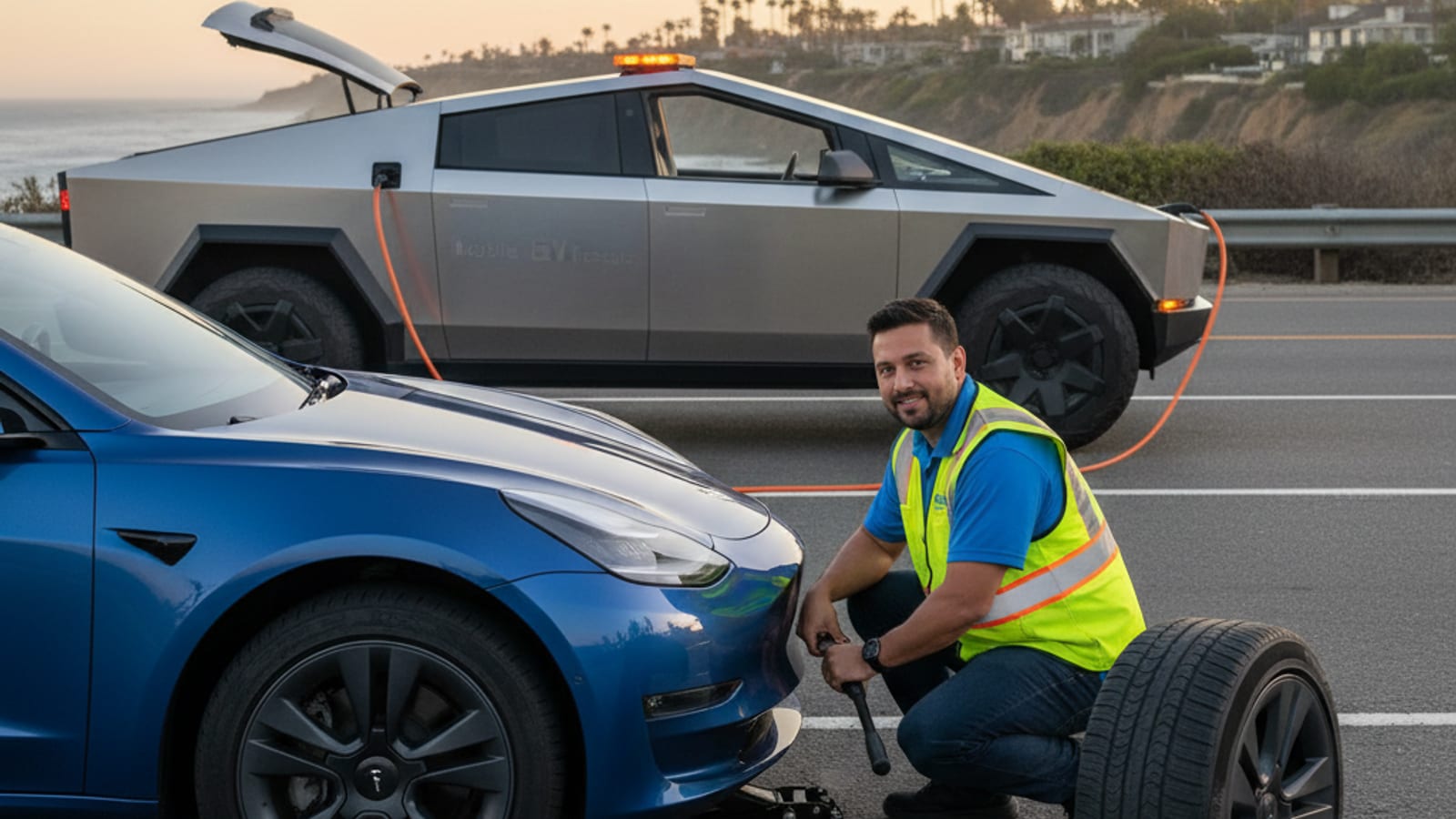
The Inland Empire’s two freeway patrols
This market is two counties. Each one funds its own freeway service patrol.
Riverside County Transportation Commission, RCTC, covers Riverside County freeway beats. San Bernardino County Transportation Authority, SBCTA, covers San Bernardino County beats. A stop on I-215 in Moreno Valley is an RCTC problem. A stop on I-10 in Colton is an SBCTA problem. Call the agency that maps that stretch. If you can’t tell which county you’re in, ask CHP for freeway motorist aid. Confirm the current request method on the RCTC or SBCTA Freeway Service Patrol page.
Confirm the live beat list on those same pages. Hours for those trucks weren’t confirmed in the research for this page. Don’t treat a published freeway program as coverage on the Ortega near Wildomar. Don’t assume it covers the climb toward Big Bear Lake, or a surface street in downtown Riverside. Those agencies write about freeways. They don’t write a promise for every inland road.
What those patrol pages actually cover
RCTC and SBCTA publish freeway service patrols that change flats on named freeways. That’s the free option on I-10, I-15, I-215, SR-60, and SR-91 when a truck is on the beat. The service is written for mixed traffic. It’s not written as a Tesla procedure.
Say you’re in a Tesla when they stop. Ask where they’ll lift. Tesla publishes jacking points so the pack doesn’t take the weight. A wrong lift can turn a tire stop into a pack repair. The patrol’s job is a clear lane. Your job is to protect the floor.
Their pages never mention NACS, CCS, or a skateboard pack. They never tell a driver to skip a bumper jack. That silence is why this post exists. The free change can still be the right first call. It’s not an EV owner’s manual.
If they can’t seat a safe tire, ask whether they can move you off the travel lanes. Ask what drop spot their program allows. This page doesn’t publish a drop-radius or a list of lots. The driver in front of you has the current rule.
How Tesla’s own flat-tire path works
Open roadside in the Tesla app or on the car’s screen. Tesla’s support pages describe help for a flat. That help is usually a tow to a Tesla Service Center, a tire shop, or another location inside Tesla’s published rules. Tesla doesn’t describe an on-site patch as the normal fix. Plan on a tow.
If the car is under Tesla’s New Vehicle Limited Warranty, Tesla’s published roadside terms often include that tow for a covered event. Tesla states the warranty as four years or 50,000 miles, whichever comes first. Check your VIN in the app before you assume it’s included. After warranty, Tesla can bill for dispatch. Tesla quotes that fee. This page won’t.
The tire work is always yours. A car warranty isn’t a tire warranty. The shop that repairs or replaces the tire sets that bill. Ask before they start.
For the wider dispatch picture, read What Tesla roadside covers, and what it sends a truck for. For tire-only limits, see Tesla tire repair on the roadside: what they will and won’t do. Tesla’s own overview stays at Tesla support.
Why you can’t just swap a wheel
Tesla doesn’t ship a spare. There’s no donut under the cargo floor. There’s no factory jack in a well. When TPMS hits on SR-60 in Jurupa Valley, you’re not changing a wheel in the gore.
The pack runs under the whole floor. Lift only at Tesla’s published points. You can find those in the in-car owner’s manual. Show them to whoever brings a jack. The car is heavy, so the replacement tire has to match Tesla’s load and speed ratings for that wheel. A gas-car tire can bolt on and still be the wrong spec.
Some Teslas wear run-flats. Many don’t. Don’t guess from the model badge. Read the sidewall and Tesla’s tire data for your VIN. Start with Run-flats on a Tesla: what Inland Empire owners should assume.
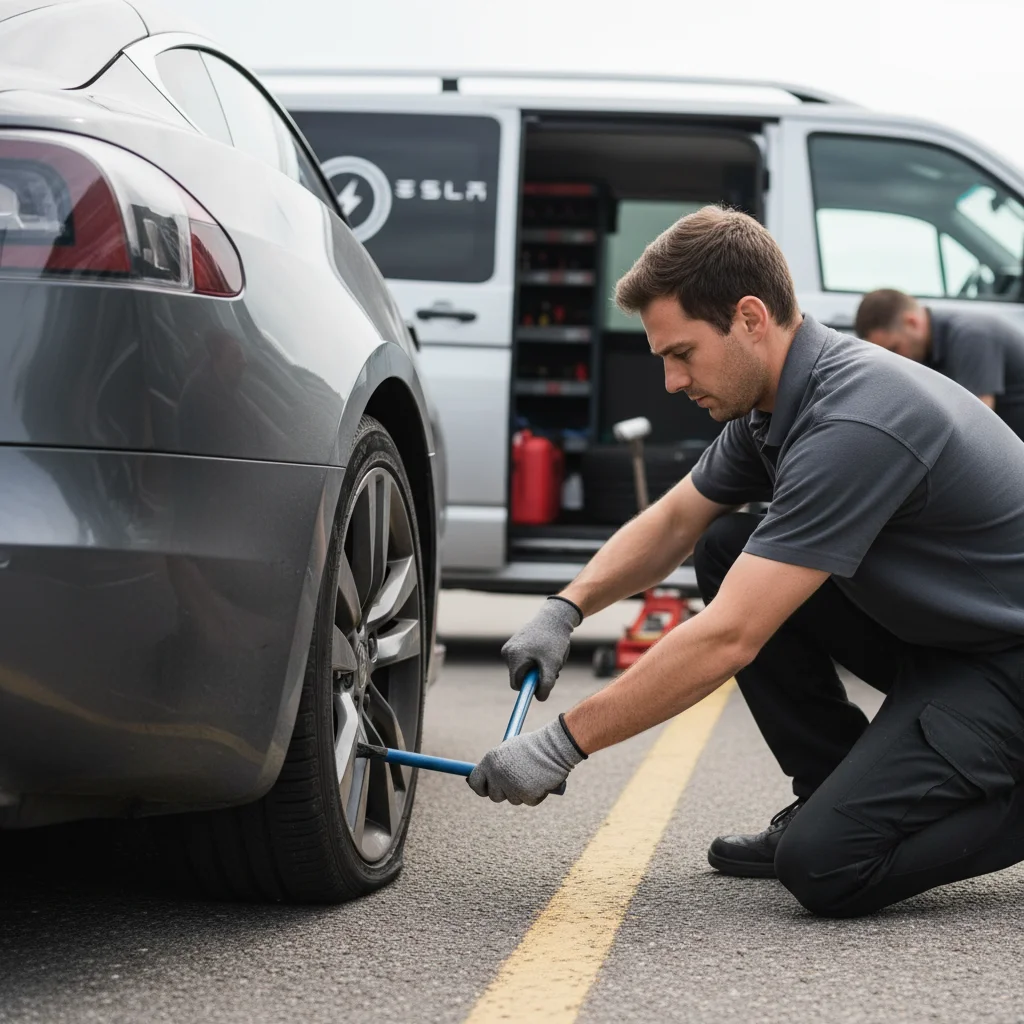
Warehouse miles, grades, and mountain roads
Truck lanes around Fontana and Ontario throw belt fragments and screws. I-10 through Colton and Redlands is a fast, narrow shoulder. I-215 through Moreno Valley and Perris Valley mixes freight with commute traffic. SR-91 through Corona stacks against the hills. I-15 south through Murrieta and Temecula is a different rhythm. It’s still Riverside County. It’s still an RCTC map if you’re on the freeway.
North of the valley floor, I-15 toward Victorville and Hesperia is the Cajon climb. A flat there is still a San Bernardino County freeway problem if you’re on a published beat. Confirm that on SBCTA’s page. Don’t assume the same truck covers SR-18 into Running Springs, or the lake roads around Lake Arrowhead. Mountain two-lanes aren’t the freeway program.
You can run climate while you wait. That draws the pack. Watch the range. This page won’t guess the next charger. If the tire is already sorted and the pack is too low to reach a shop, that’s a charge problem, not a tire problem.
What to say when help pulls up
Keep it short. You’re in a Tesla. There’s no spare. The pack is under the floor. Lift only at Tesla’s points. If they want to tow, ask for a flatbed or Tesla’s published method, not a drag on a locked motor.
If the car still wakes, put it in the tow mode Tesla shows in the manual. If the dash is dark, say that next. A dead 12-volt can look like a dead pack. It changes how the car should ride.
When the 12-volt or the pack fails too
A shredded tire is one failure. A dark dash is another. An empty range ring is a third. They stack on a long shoulder wait.
Charge Pro IE is a referral line. It matches stranded EV drivers with independent local mobile rescue operators. It doesn’t change tires. It doesn’t own a fleet. It doesn’t patrol I-10. The operators we connect you with bring a 240-volt Level 2 source to the car. They use a native NACS plug, plus CCS or J1772 adapters for non-Tesla EVs. They typically add 10 to 20 miles of range in 15 to 30 minutes of charging. That number is charge time, never an arrival time. They can jump or replace a dead 12-volt on site. They handle Tesla and every major EV brand.
If a patrol or a Tesla tow already gave you a rollable tire, and the pack won’t reach the shop, a mobile charge is the missing piece. If the 12-volt died while you sat there, a jump may wake the car so it tows in the right mode. Compare local options in Who actually helps a stranded Tesla in the Inland Empire. For an empty pack on the Cajon climb, see Out of charge on I-15 at the Cajon climb toward Victorville. Tesla matching is also on Tesla roadside rescue.
If the car has to ride
When nobody can mount a safe tire, the Tesla has to leave on a bed. Tesla publishes tow steps so the drive unit isn’t dragged. Neutral, the right dollies or a flatbed, and Tesla’s lift points still matter with a flat. Read How to tow a Tesla with no power without damaging the drive unit before the hook is set.
This page doesn’t name a Tesla Service Center or a wait. A third-party tire shop that stocks your size can be the closer stop. Confirm wheel size, load index, and whether the axle needs a pair. The shop sets the price. Ask before they break the bead.
Keep the three calls straight
RCTC and SBCTA still own the free freeway tire change on the beats they publish. Tesla still owns Tesla roadside, usually as a tow. Charge Pro IE only matches you for charge or 12-volt help.
If you call (909) 250-2881, you’re asking for a match to a mobile rescue operator, not a freeway tire truck. The operator quotes you before starting and bills you directly. Call the patrol for the flat on a named freeway. Call Tesla when you need Tesla’s tow. Keep those lanes separate and you spend less time with the wrong dispatcher.