A Tesla that won’t roll in the Inland Empire leaves you three real options. Tesla’s own roadside line. A national club such as AAA. Or a local mobile rescue operator who quotes you first and bills you directly. Those aren’t the same product. The best roadside assistance for Tesla here matches the failure. It also tells you the price before work starts.
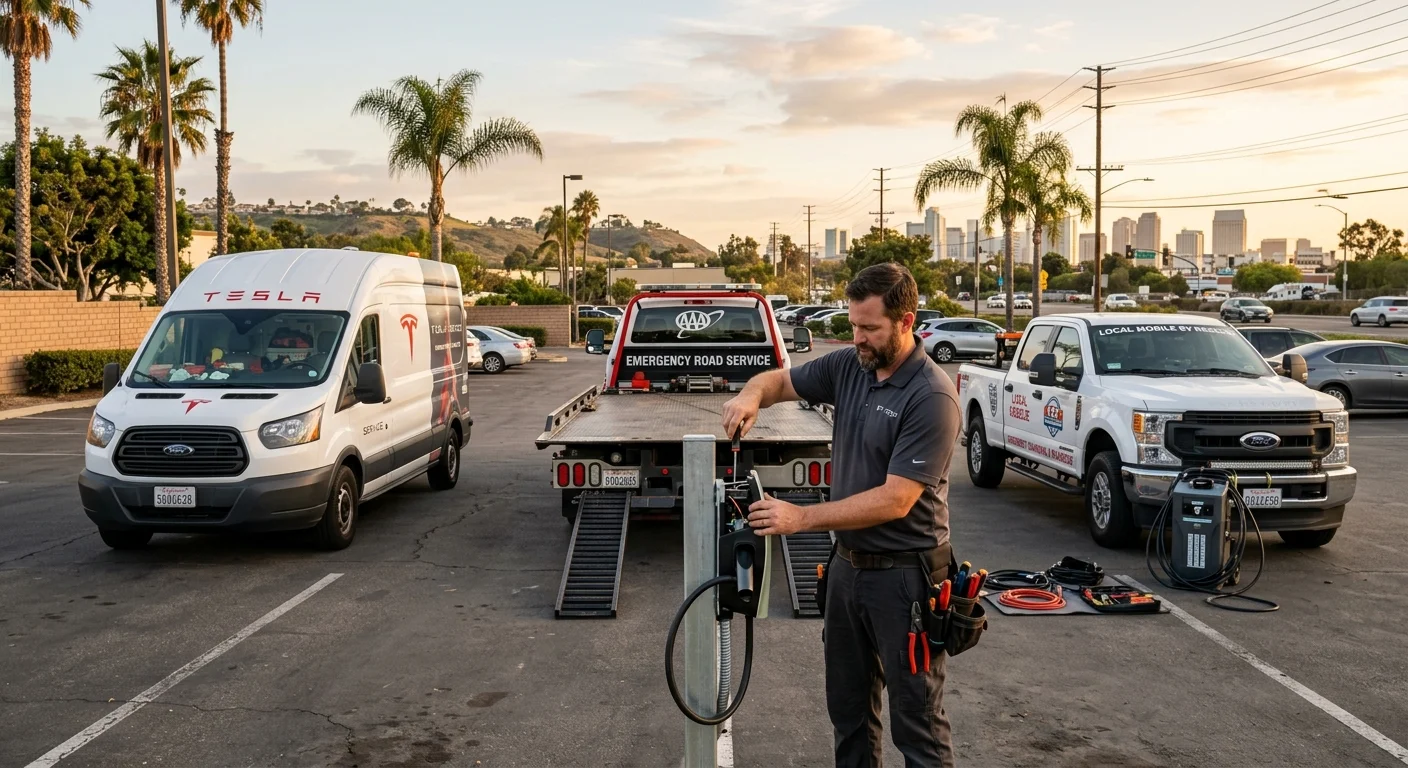
Three phone paths, three ways you pay
Most owners already have Tesla Roadside inside the car’s app. Plenty also carry a club card from a prior gas car. The third path is a local referral line. It matches you with an independent operator in Riverside County or San Bernardino County.
National dispatch and local rescue split on money and control. Tesla routes the job through Tesla. A club routes it through a contractor network. A local operator talks to you and names a price. Then that operator invoices you. Charge Pro IE doesn’t own trucks, yards, or a fleet. It doesn’t employ technicians. Independent operators do the work. They quote before they start. They bill you, not a membership desk.
That quote-first model is the local difference in 2026. A dispatcher in another state doesn’t set that number. The person at your bumper does.
Empty pack, dead 12-volt, or a tow
The fix depends on which battery failed.
The small 12-volt battery runs the computers and the locks. It also runs the contactors that close the high-voltage system. When it’s down, the big pack can still hold range. The car still won’t wake. Local operators can jump that 12-volt on site. They can replace it when a jump won’t hold. Tesla roadside can treat a 12-volt too. A club truck might. Ask before anyone rolls.
An empty high-voltage pack is a miles problem. The car drove until estimated range hit zero. A Supercharger only helps if you can get there. Operators in this network bring a 240-volt Level 2 source to the car. Tesla uses a native NACS plug. Non-Tesla EVs use a CCS or J1772 adapter. A typical hookup adds 10 to 20 miles of range. That’s 15 to 30 minutes of charging time, not arrival time.
A flat or a lockout is another job. So is a car that must ride a flatbed. Factory roadside and club memberships are built for those. A mobile Level 2 visit is built for power.
Heat and elevation chew range on inland roads. The I-15 Cajon climb toward Victorville is a long grade. I-10 through Colton and Redlands mixes heat with freight traffic. I-215 cuts Moreno Valley and Perris. SR-60 crosses Jurupa Valley. SR-91 stacks through Corona. The Ortega near Wildomar is a two-lane hill road. Those roads don’t pick your vendor. The failure mode does.
Tesla factory roadside: what that path is for
Tesla includes roadside help with new cars for a limited warranty window. After that window, remaining coverage can depend on time or miles. Read the current terms in the Tesla app, or on Tesla’s published roadside page. This article doesn’t reprint Tesla’s schedule. It doesn’t invent a leftover allowance.
When the factory path is the right one, it’s because Tesla knows the VIN. Jack points and tire rules are Tesla’s native work. So is which service center can take the car. Lockouts and a tow to the nearest Tesla stop sit in that bucket.
For a pack at zero, Tesla’s emergency charge is often a tow to a Supercharger. It isn’t always a Level 2 truck at your bumper. If the car can’t roll, the tow is the product. If you only need enough miles to reach a charger, that’s a different product.
Tesla may send a contractor, not a Tesla employee. You still go through Tesla’s process. You don’t get an independent curb-side quote. Read the 2026 Tesla roadside policy for Inland Empire drivers.
Club membership: confirm EV help before you strand
AAA and similar clubs sell a membership, then send a contracted truck. That model is useful when you need a long tow. It’s a poor match when you need a price before a cable goes in.
This page couldn’t confirm AAA’s 2026 EV add-on terms from a primary AAA source. It couldn’t confirm mobile-charge availability by Inland Empire city. It also couldn’t confirm tow mile caps or any fee. Don’t treat a club card as an on-site Tesla charge. Open the membership kit. Call AAA. Ask whether they send a mobile EV charge for your city, or only a tow. Ask who bills you if the contractor’s work sits outside the membership.
The dispatcher isn’t the operator. The truck that arrives may be a gas-car jump pack and a flatbed. That mix can still move a Tesla if the job is a tow. It may not treat a Tesla 12-volt like an EV-focused operator would. It may not carry a NACS Level 2 source.
Keep a club card for distance towing if that’s what you bought it for. Pair it with a local path for empty-pack and 12-volt stalls. The practical split is in AAA or a local Tesla rescue: what actually shows up.
Local mobile rescue: the operator quotes you
A local Inland Empire rescue is an independent pro. It isn’t a factory tech and it isn’t a club desk. Charge Pro IE is the match. The operator is the business you pay. They tell you the price. You accept or you walk. Then they bill you directly.
That’s the 2026 local angle. You aren’t waiting on a membership rules engine in another time zone. You aren’t finding out after the hook that empty-pack recovery was never included.
On site the job is usually one of two things. A Level 2 hookup so the car can leave under its own power. Or a 12-volt jump or replacement so the computers come back. Tesla is in scope. So is every major EV brand. The Tesla-shaped version of that visit is Tesla roadside rescue.
Limits matter. These operators aren’t a Tesla service center. They aren’t a statewide tow fleet. A failed drive unit or a crash is a Tesla or club job. So is a long-bed tow. A mobile charge doesn’t replace a warranty repair. The visit itself is spelled out in what a mobile EV charging visit actually is.
Two counties, split utilities, same referral area
The Inland Empire isn’t one city with a new name. Riverside County’s ACS 2019-2023 population is 2,478,600. San Bernardino County’s is 2,197,104. Housing and power change by city.
San Bernardino County has 43.8 percent of housing built before 1980, ACS 2019-2023 vintage. Riverside County is 30.2 percent on that same vintage. Pre-1980 shares run high in San Bernardino, Upland, Redlands, and Montclair. Eastvale sits at 2.2 percent pre-1980. French Valley sits at 2.3 percent on the same table. A Tesla that won’t wake in the driveway may be a 12-volt. It may be a breaker. It may be a wall unit that never started. It isn’t always an empty pack on a freeway shoulder.
Electric service is split too. Southern California Edison’s served-cities list includes Fontana, Ontario, Corona, Temecula, and Hemet. The City of Riverside has run Riverside Public Utilities since 1895. Colton owns the electric infrastructure inside its boundaries. Moreno Valley is split. SCE serves part of it. Moreno Valley Utility serves newer development. Banning has a city electric utility. Big Bear Lake and Big Bear City sit on Bear Valley Electric Service. Rancho Cucamonga is mostly SCE. Rancho Cucamonga Municipal Utility covers a southeast pocket, including the Victoria Gardens area. San Jacinto gets SCE delivery. San Jacinto Power supplies the generation. Apple Valley gets SCE delivery. Apple Valley Choice Energy procures the power.
Those utilities set home rates and rebate names. They don’t send a truck when you stall. A roadside operator isn’t your utility. Ontario, Fontana, Temecula, and Murrieta sit on that referral map. So do Victorville, Hesperia, Lake Arrowhead, and Crestline. City pages start at EV charging across the Inland Empire.
Match the failure to the number you dial
If the dash is dark and the doors are fussy, start with the 12-volt. If the phone app acts lost, start there too. Tesla roadside can work that job. So can a local operator on site, with a jump or a replacement. A club truck may or may not. Ask on the first call.
If the car drove until the miles hit zero, you need energy in the pack. Tesla may tow you toward a Supercharger. A local operator can put Level 2 into the NACS port where you sit. A club may offer a charge, a tow, or neither. Confirm it for the city you’re in. Don’t trust a generic EV line on a brochure.
If the car belongs on a flatbed to Tesla service, use Tesla or a club. Don’t expect a mobile charger to replace that tow. Geography doesn’t pick the vendor. The failure does. See who actually helps a stranded Tesla in the Inland Empire.
Keep more than one number, or pick a gap
Tesla’s app path is the warranty-shaped door. Use it when you need factory rules, a VIN-aware tow, or Tesla’s contractor list. A club card is the long-tow network, if your documents still say it is. A local referral line is the stall that’s really a battery. That’s an empty pack or a dead 12-volt. The operator says the price before the work.
You won’t use all three on one afternoon. You should know which one bills how. A local operator quoting you on the shoulder isn’t Tesla service. Tesla roadside isn’t a Level 2 visit if that’s what you wanted.
If you keep only one
Tesla only keeps you inside Tesla’s process. You get factory knowledge. You may get a tow to a charger instead of a charge at the bumper. After the included window, confirm what remains.
Club only keeps a contractor network and, often, tow miles. It doesn’t automatically put a NACS Level 2 truck at your door. Verify EV help for your city before you need it.
Local mobile rescue only keeps a quoted visit you pay yourself. That visit is aimed at charging and 12-volt work. It doesn’t give you a factory diagnostic network. It doesn’t give you a long flatbed program.
Each path leaves a gap. Live with the gap, or save a second number.
When the local operator is the call
The Tesla is in Riverside County or San Bernardino County. The pack is empty, or the 12-volt won’t wake the car. You want a price before work starts. You want to pay the person who did the work.
Call (909) 250-2881. Charge Pro IE matches you with an independent local operator. That operator quotes you before starting and bills you directly. This line doesn’t publish an arrival time. Hooked up, charging is typically 15 to 30 minutes. That window is for 10 to 20 miles of range.