If you searched tesla mobile charger near me, your Tesla already stopped. In the Inland Empire, that search means a native NACS plug at the car. Charge Pro IE connects you with independent local operators. Those operators bring a 240V Level 2 source with that plug. They typically add 10 to 20 miles during 15 to 30 minutes of charging. That window is charging time, never an arrival time.
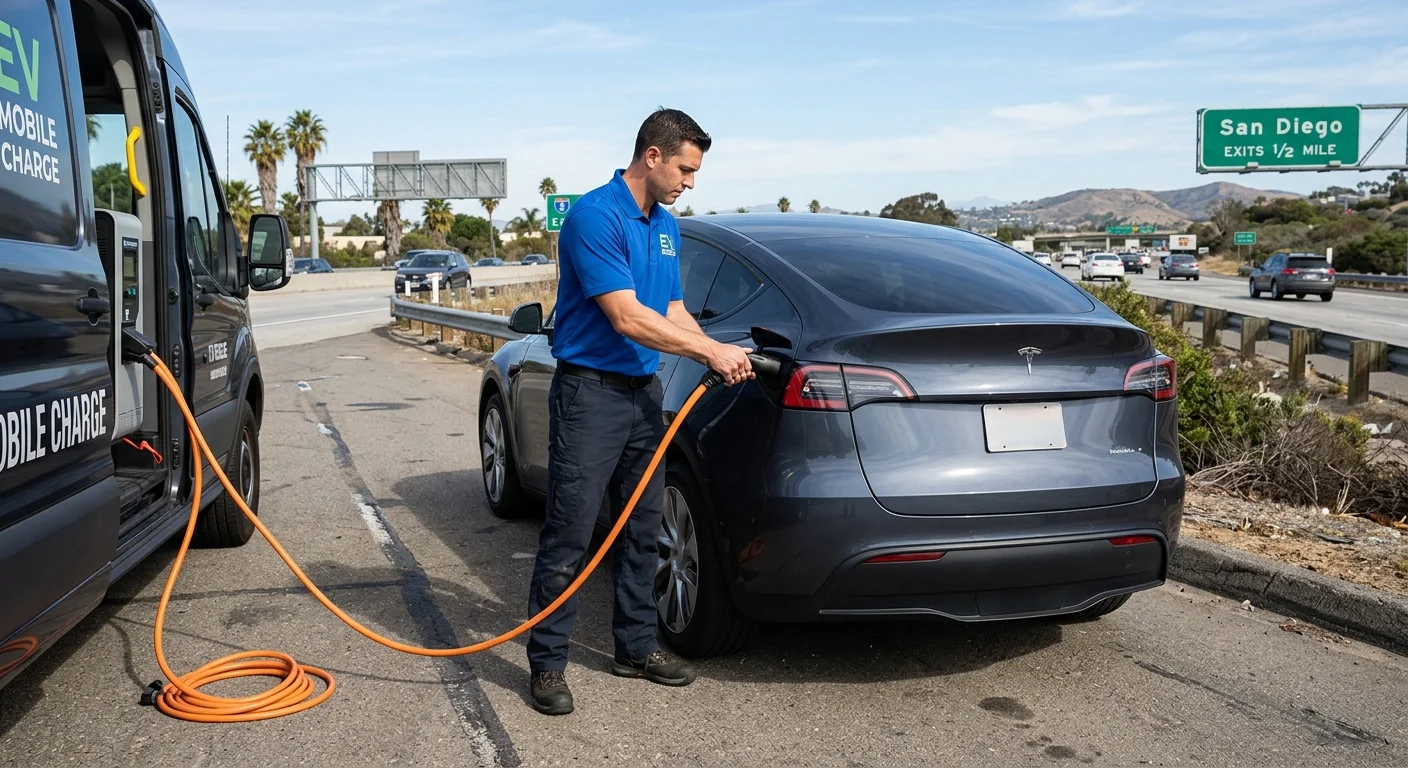
A native NACS plug is what the car needs
A stranded Tesla with an empty pack isn’t waiting for jumper cables. It needs energy at the charge port. Tesla uses NACS for that Level 2 connection. The US Department of Energy lists the same connector as J3400.
Local operators bring a native NACS plug. That’s the inlet your Tesla already has. They carry CCS and J1772 adapters for other brands. Your car is a Tesla, so NACS is the one that matters. The operator still confirms the plug against your model. Model 3, Y, S, X, and Cybertruck aren’t one guess.
Charge Pro IE is a referral line. We don’t own trucks or charging gear. We don’t employ technicians or perform the roadside work. We match stranded Tesla drivers with independent local operators. The operator quotes you before starting, then bills you directly. The pros we connect you with are licensed and insured.
Our Tesla roadside rescue page covers that Tesla-specific connection. It isn’t Charge Pro IE arriving with a truck.
”Near me” here spans two counties
Riverside County’s ACS 2019-2023 population is 2,478,600 people. San Bernardino County’s is 2,197,104. “Inland Empire” isn’t a pin, so name the city.
Fontana warehouse rows and Ontario airport lots often sit behind a gate or a desk. Riverside is the region’s largest city, with 319,069 residents in the ACS 2019-2023 figures. If you’re in a garage, send the floor and stall number. Temecula and Murrieta sit at the south end of the valley. Victorville, Hesperia, and Apple Valley sit after the I-15 Cajon climb. Lake Arrowhead, Crestline, and Running Springs sit on steep mountain streets.
Home power isn’t one utility either. Southern California Edison serves Fontana, Ontario, San Bernardino, Corona, Temecula, and most valley cities. Riverside Public Utilities serves the City of Riverside. The City of Colton owns the electric system inside its limits. Banning runs a city electric utility. Bear Valley Electric Service covers Big Bear Lake and Big Bear City. Moreno Valley Utility serves over 6,500 customers in newer development. Rancho Cucamonga Municipal Utility covers over 3,900 metered businesses and residents, including the Victoria Gardens area.
The truck’s NACS plug doesn’t change with the utility. Your story might. If the Tesla died in the driveway, name the city. “The house charger is dark” means a different utility in Riverside than in Fontana. A Tesla on a Victorville residential street is on SCE. Victorville Municipal Utility Services serves only the Southern California Logistics Airport and Foxborough Industrial Park, not homes. For a city map of charging context, open the Inland Empire EV charging hub.
If the Tesla sits in a live traffic lane, contact emergency services first. Follow their directions, then send the same pin to the operator.
Empty pack and a dead 12-volt aren’t the same job
Both failures can leave the Tesla looking fully dead. An empty traction pack needs Level 2 energy at the port. A failed 12-volt battery needs a jump or a replacement on site. Operators here handle Tesla 12-volt work too. They still need what you saw, not a name you picked.
Write the last percentage from the screen or the app. Copy every warning exactly. Say whether the center display wakes. Say whether doors, lights, and the app still respond. Say whether the car will shift, and whether it was already on a charger. If there was a collision or a flat, say that too.
A pack already in the low single digits supports a charge request. A low-voltage warning with miles still showing supports a 12-volt request. Mixed signs mean you shouldn’t pick the service. How to tell a dead Tesla pack from a 12V failure helps you sort the clues. It doesn’t replace an operator looking at your car.
Don’t promise yourself that a mobile charge will wake every Tesla. Match the symptom to the tool.
Send the model, a pin, and the access story
“Tesla near me” wastes the first minute. Give the model and year. Give the city: Chino, Corona, Redlands, Yucaipa, Menifee, or wherever you actually are. Then drop a map pin, and describe how a truck reaches the charge port.
Tell the operator whether the Tesla is:
- In a driveway, garage, or assigned stall
- Behind a gate, a guard shack, or a warehouse fence
- On a street, a shoulder, a ramp, or an open lot
- Boxed in by another vehicle
- Still connected to charging equipment
- Locked, with normal entry not working
If you’re on SR-60 in Jurupa Valley, send the direction and the nearest exit. If you’re in a Cabazon destination lot, send the row and the nearest entrance. Do the same in the Glen Helen lot. High Desert miles near Adelanto or Phelan need a cross street or a mile marker. Eastvale has 2.2% of housing built before 1980 on the ACS 2019-2023 figures. Many Teslas there sit in newer driveways. Crestline has 77.7% of units built before 1980 on the same ACS vintage.
Photos of the screen and the parking position help. Keep gate codes off public threads. Send them on the channel the operator names. Mention standing water at the port, a cable that won’t release, or a crumpled inlet. Those details can end a charging plan on first look.
When a mobile Level 2 visit fits
Mobile charging may fit when the facts point to an empty traction battery. The Tesla also has to sit where an operator can work safely. The NACS gear has to match your car. Ask the operator to confirm the scope and the price before you agree.
Charge Pro IE doesn’t set prices, warranties, or service terms. No Tesla mobile-charging fee could be confirmed from the claims ledger for this page. Confirm the current quote with the operator before you pay. You contract with that independent professional. You don’t contract with Charge Pro IE for the work.
Say what you need the charge to do. You might need range to reach a public stall you already picked. You might need to clear a dock in Bloomington or a driveway in Upland. Our mobile EV charging page is the connection for that roadside Level 2 visit. Typical charging time is 15 to 30 minutes on the plug. That often adds about 10 to 20 miles of range.
For a plain walkthrough of the stop, read what a mobile EV charging visit actually is.
When you should stop asking for a charge
Charging won’t wake a Tesla whose 12-volt is gone. It won’t feed a damaged inlet. It won’t help a car that still refuses a plug. The operator may switch to a jump, a 12-volt swap, or a tow.
The plan can change on site. A blocked stall or a new warning can end the charge. If a tow is next, confirm the destination and the handling. Say whether the Tesla shifts, steers, rolls, or unlocks, and repeat the model. Don’t assume the tow crew already has your first call’s notes.
A stall in Perris isn’t the same as a Montclair block. The right next step still follows the car, not the city name. For that fork, read mobile charging or a tow, which you actually need.
What to have ready when you call
Call when the Tesla looks empty or won’t move. You want a local operator to judge whether a mobile charge fits. Have the model, city, pin, last pack reading, warning text, and access notes ready. Charge Pro IE serves Tesla drivers across the Inland Empire. We don’t promise that an operator is free. We don’t promise a connector match. We don’t promise a set number of delivered miles. The matched operator confirms those points after reviewing your request.
Call (909) 250-2881 and we’ll connect you with a local EV rescue operator.